

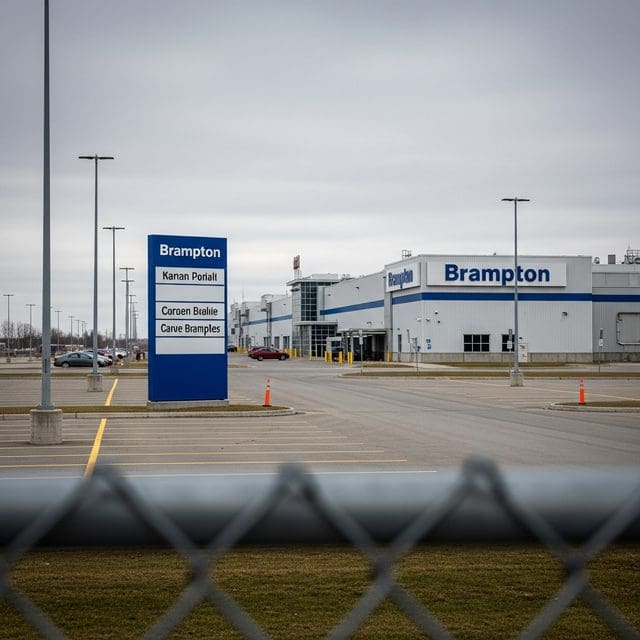
Stellantis has notified Unifor it is considering the sale or closure of its idled Brampton facility, putting 3,000 jobs at risk as production shifts to the United States.
The industrial landscape of the North American auto sector faced a significant tremor this week as Stellantis signaled the potential permanent closure and sale of its Brampton Assembly Plant. The disclosure, made public by the Unifor labor union on August 14, 2026, marks a sharp departure from previous commitments to retool the facility for electric vehicle production. The plant, idled since late 2023, sits in a state of limbo that threatens roughly 3,000 direct manufacturing jobs and thousands more in the local supply chain. This development follows a period of mounting tension as the automaker paused retooling efforts originally slated to bring the Jeep Compass program to Ontario, opting instead to shift that production to Belvidere, Illinois.
The shift in corporate strategy appears closely tied to a changing regulatory environment. Stellantis’ pivot follows the enforcement of stricter U.S. trade policies, including a federal court ruling on August 13 that upheld the administration’s ability to block certain tariff-free imports. As the U.S. strengthens domestic manufacturing requirements to protect local industry, Canadian facilities that once thrived under integrated trade agreements are finding themselves on the outside. This trend is mirrored elsewhere in the economy, where firms like Hadrian are securing $360 million in credit to accelerate U.S.-based manufacturing infrastructure, signaling a capital flight toward American soil.
For the workers in Brampton, the uncertainty is already taking a tangible toll. Reports indicate that more than 200 employees have already relocated over 350 kilometers to Windsor to maintain employment, a move that highlights the immediate disruption to family stability even before a final decision is reached. While management claims no formal closure notice has been issued—a process requiring a one-year warning under current collective agreements—the threat of a sale looms large over upcoming contract negotiations. The current agreement for Brampton, Windsor Assembly, and Etobicoke Casting is set to expire on September 20, 2026, placing the plant’s fate at the center of the fall bargaining table.
Adding to the complexity is the unresolved proposal regarding Leapmotor, a Chinese electric vehicle partner. Earlier this year, discussions surfaced about using the Brampton site for “knock-down-kit” assembly of Chinese-designed EVs. However, provincial leadership and labor advocates remain skeptical, noting that such an arrangement would utilize very little of the local supply chain and offer a fraction of the high-skilled jobs provided by traditional vehicle manufacturing. This reflects a broader tension in the labor market where automation and global partnerships often threaten to replace stable, manual trades with lower-value assembly work that lacks long-term security.
While the S&P 500 reached new highs in early August and tech stocks continue to drive market optimism, the blue-collar workforce in Brampton faces a K-shaped reality. For these workers, the dignity of their trade is currently a bargaining chip in a high-stakes game of international trade policy. The union has vowed to use every tool available to keep vehicle production at the site, but the corporate line remains non-committal. Stellantis maintains it is seeking a “solution for the plant” through the bargaining process, yet the movement of production programs across the border suggests a strategy that prioritizes navigating U.S. tariffs over maintaining its Canadian footprint.
As the September 20 deadline approaches, the situation at Brampton serves as a reminder of how quickly global economic shifts can erode local industrial stability. For the 3,000 workers waiting for an answer, the coming weeks will determine whether their facility remains a cornerstone of North American manufacturing or becomes another casualty of a shifting trade map that increasingly favors the American heartland.

Tom Blake serves as the Senior Correspondent for Labor, Wages, and Automation at Just Right News, where he brings a grounded, principled perspective to the most pressing economic issues facing the American heartland. As the lead voice behind the acclaimed feature series “The Price of Work,” Tom focuses his reporting on the intersection of traditional industry and the rapidly evolving technological landscape, always prioritizing the dignity of the individual worker and the health of the American family.
Tom’s deep understanding of the labor market is not merely academic; it is rooted in his upbringing in Detroit, Michigan. Growing up in the shadow of the automotive industry, he witnessed firsthand the triumphs and tribulations of the American blue-collar workforce. He saw how the stability of a manufacturing job could build a community and, conversely, how the erosion of those industries could tear the social fabric apart. This background instilled in him a lifelong respect for the trades and a healthy skepticism toward economic policies that prioritize globalist interests over the well-being of local communities.
Now based in Pittsburgh, Pennsylvania, Tom continues to report from the front lines of the shifting economy. Pittsburgh, a city that has reinvented itself while maintaining its gritty, industrious spirit, provides the perfect vantage point for his beat. From the steel mills that remain to the high-tech robotics labs reshaping the city’s future, Tom explores how automation is changing the nature of employment. His reporting often highlights the tension between innovation and tradition, arguing that while progress is inevitable, it must not come at the expense of the American worker’s ability to provide for their family through honest, meaningful labor.
In his role at Just Right News, Tom has become a vital voice for those who feel overlooked by mainstream economic coverage. He rejects the notion that the decline of American manufacturing is an unavoidable casualty of the modern era. Instead, his work often examines how regulatory overreach, rising energy costs, and the unchecked rise of automation impact the take-home pay of everyday citizens. Through “The Price of Work,” Tom delves into the true cost of economic shifts, looking beyond the raw data to tell the stories of the people behind the statistics.
Tom’s reporting is characterized by a commitment to the conservative values of self-reliance, fiscal responsibility, and the preservation of the American dream. He believes that a strong nation is built on a foundation of stable jobs and fair wages, and his work seeks to hold both government and corporate entities accountable to that standard. Whether he is interviewing a shop floor manager about the implementation of new AI technology or analyzing the impact of wage inflation on small businesses, Tom provides a clear-eyed analysis that resonates with readers who value hard work and common sense.
Through his dedicated coverage, Tom Blake remains a steadfast advocate for the American workforce, ensuring that the voices of those in the industrial heartland are heard loud and clear in the national conversation. His perspective is essential for anyone seeking to understand the complex realities of labor and automation in the twenty-first century.