

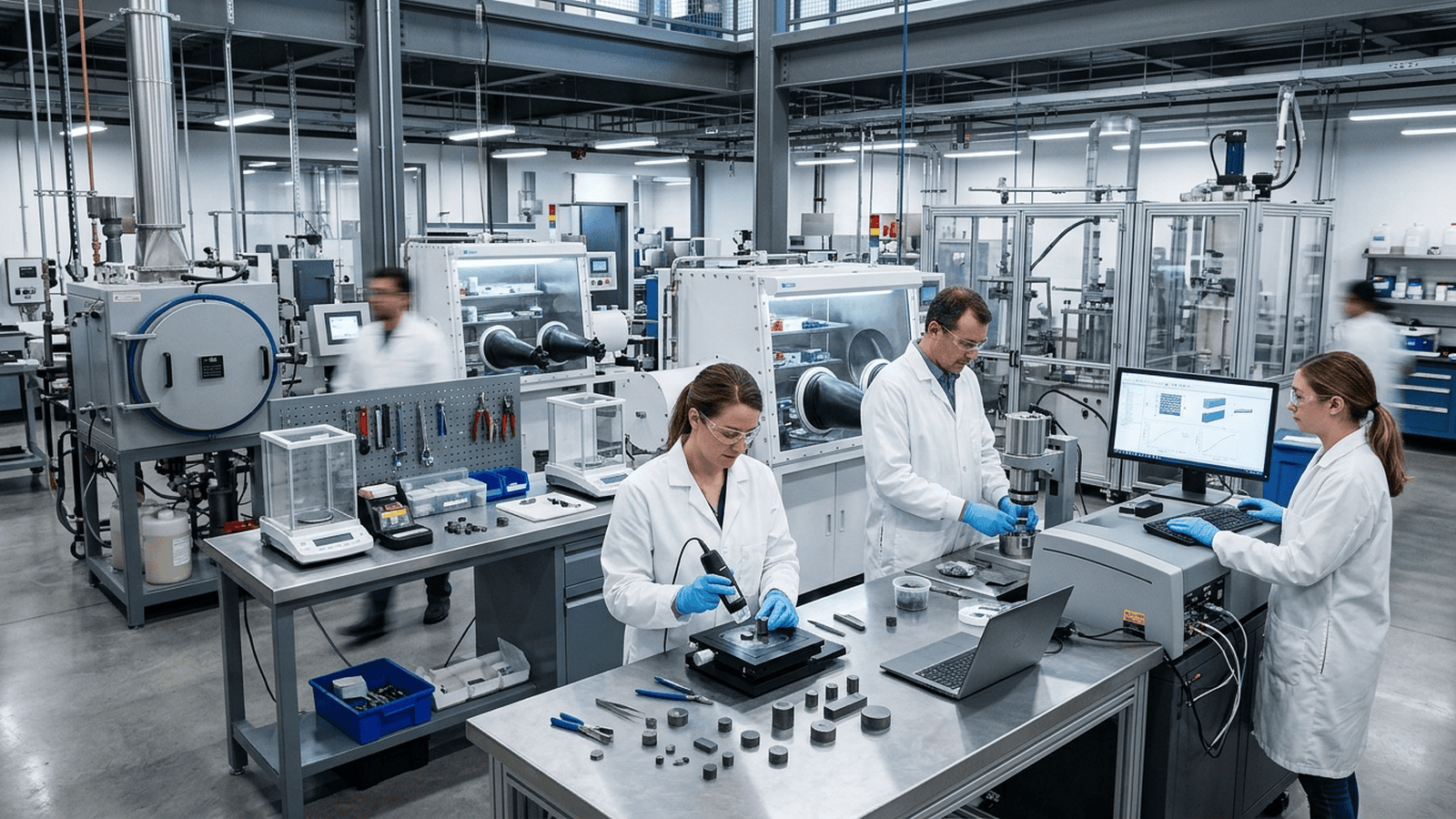
Niron Magnetics opened a Minneapolis pilot line in 2024 to produce permanent magnets based on iron nitride, a potential alternative to rare-earth magnets. The facility will help test manufacturing consistency and real-world performance; it does not yet demonstrate that iron nitride can replace established magnets across applications.
TLDR: Niron Magnetics is scaling up production of iron-nitride permanent magnets at a pilot facility in Minneapolis. Because the material uses abundant iron and nitrogen rather than rare-earth elements, it may offer manufacturers another supply option. Independent performance, durability, yield, and cost tests will determine its practical potential.
A Minnesota materials company is moving an unusual magnet material from laboratory research toward manufacturing. Niron Magnetics opened a pilot production line in Minneapolis in 2024 to make permanent magnets based on iron nitride, a compound that could offer an alternative to magnets made with rare-earth elements. The facility is a step toward testing whether the material can be produced consistently and at useful scale, not proof that it is ready to replace established magnets.
Permanent magnets are used in electric motors, wind turbines, speakers, and many other devices. Some of the strongest and most widely used varieties contain neodymium, a rare-earth metal. Those magnets are valuable because they deliver strong magnetic performance in a compact size, but their supply chains are concentrated and their production can carry environmental costs. Iron and nitrogen are more abundant, making iron nitride attractive if it can meet the performance and manufacturing requirements of real applications.
The material at the center of Niron’s work is iron nitride, a family of compounds in which nitrogen atoms combine with iron. A particular form, known as alpha-double-prime iron nitride, has drawn scientific interest for its high theoretical magnetic strength. Producing that phase reliably is difficult: the material can be unstable, and the arrangement of its atoms matters to its magnetic properties. The challenge is not simply mixing two common elements, but creating and preserving the right structure.
Niron says its manufacturing approach can produce permanent magnets without rare-earth elements or cobalt. The pilot line is intended to make magnets in quantities large enough for customers and engineers to test, while giving the company information about process control and production costs. Public descriptions of the project do not establish that its magnets match neodymium magnets across every measure, including strength, durability, temperature performance, and price. Those comparisons depend on the finished magnet and the application.
That distinction matters because a new material has to work as part of a complete machine. Motor designers may need to adjust a motor’s geometry, cooling, or control systems to accommodate a magnet with different properties. Manufacturers also need confidence that every batch behaves predictably and that the material can be formed into the shapes their products require. Pilot production provides a way to investigate these questions before a company commits to a much larger factory.
The project also reflects a broader effort to reduce dependence on minerals whose mining and processing are geographically concentrated. Rare-earth elements are not actually rare in Earth’s crust, but economically useful deposits and processing capacity are unevenly distributed. A magnet made from more common elements could give manufacturers another option, particularly if it can be produced domestically. It would not, by itself, eliminate all supply-chain risks: equipment, energy, and other components still have to be sourced and managed.
Niron’s work builds on decades of research into iron nitride, a material that scientists have investigated for its unusual magnetic behavior. Moving from promising laboratory results to commercial production is a separate achievement, requiring repeatable synthesis, quality checks, and reliable performance in finished products. The company’s pilot line is therefore best understood as a test of manufacturability and customer interest, rather than a completed replacement for conventional magnets.
The next evidence will come from independent measurements and trials in motors or other equipment, alongside data on production yield, lifetime, and cost. If those tests confirm useful performance at scale, iron nitride could broaden the materials available to manufacturers seeking alternatives to rare-earth magnets. If it falls short on strength, stability, or economics, its role may be narrower. Either outcome will help clarify whether a common-element magnet can move from a promising laboratory material into everyday technology.

Sean Bradley serves as the Senior Correspondent for Trade, Supply Chains, and Global Labor at Just Right News, where he brings a principled, clear-eyed perspective to the complex systems that power the modern world. With a focus on the economic forces that impact the American household, Bradley has distinguished himself as a leading voice in explaining how global shifts in manufacturing and logistics translate to the kitchen table.
Growing up in Long Beach, California, Bradley’s interest in the movement of goods was forged against the backdrop of one of the nation’s most vital maritime gateways. Raised in a community where the towering cranes of the port were a constant fixture on the horizon, he developed an early appreciation for the blue-collar industries that form the backbone of the American economy. This upbringing instilled in him a profound respect for the dockworkers, truckers, and laborers who keep the country moving, a sentiment that remains a cornerstone of his reporting today. For Bradley, trade is not merely a series of abstract figures on a spreadsheet; it is a human endeavor that sustains families and defines the strength of a nation.
Now based in Seattle, Washington, Bradley occupies a strategic vantage point in another of the country’s most significant trade hubs. His location allows him to witness firsthand the intersection of traditional industry and the evolving technological landscape of global logistics. From the Pacific Northwest, he monitors the flow of goods across the ocean, providing Just Right News readers with timely insights into how international tensions, regulatory hurdles, and labor disputes affect the availability and cost of essential goods.
His signature feature series, “The Journey of Things,” has become a staple for readers seeking to understand the intricate path products take from raw materials to the retail shelf. Through this series, Bradley pulls back the curtain on the global marketplace, often highlighting the risks of over-reliance on foreign adversaries and the importance of domestic manufacturing resilience. His reporting consistently emphasizes the conservative values of national sovereignty, free-market competition, and the protection of the American worker from unfair global practices.
As a journalist of Irish heritage, Bradley maintains a deep-seated respect for the dignity of the individual worker and the importance of community stability. He approaches his beat with a commitment to transparency, often questioning the status quo of globalist policies that prioritize corporate efficiency over local prosperity. Whether he is reporting from a warehouse floor or analyzing a new international trade agreement, his goal remains the same: to provide the American public with the truth about where their products come from and what it costs to get them there.
Throughout his tenure at Just Right News, Bradley has remained a steadfast advocate for economic common sense. His work serves as a vital resource for those who believe that a strong nation is built on secure borders, robust trade, and a respected workforce. By combining his local roots in Long Beach with his professional experience in Seattle, Bradley continues to offer a unique and necessary perspective on the forces that shape the American way of life.