

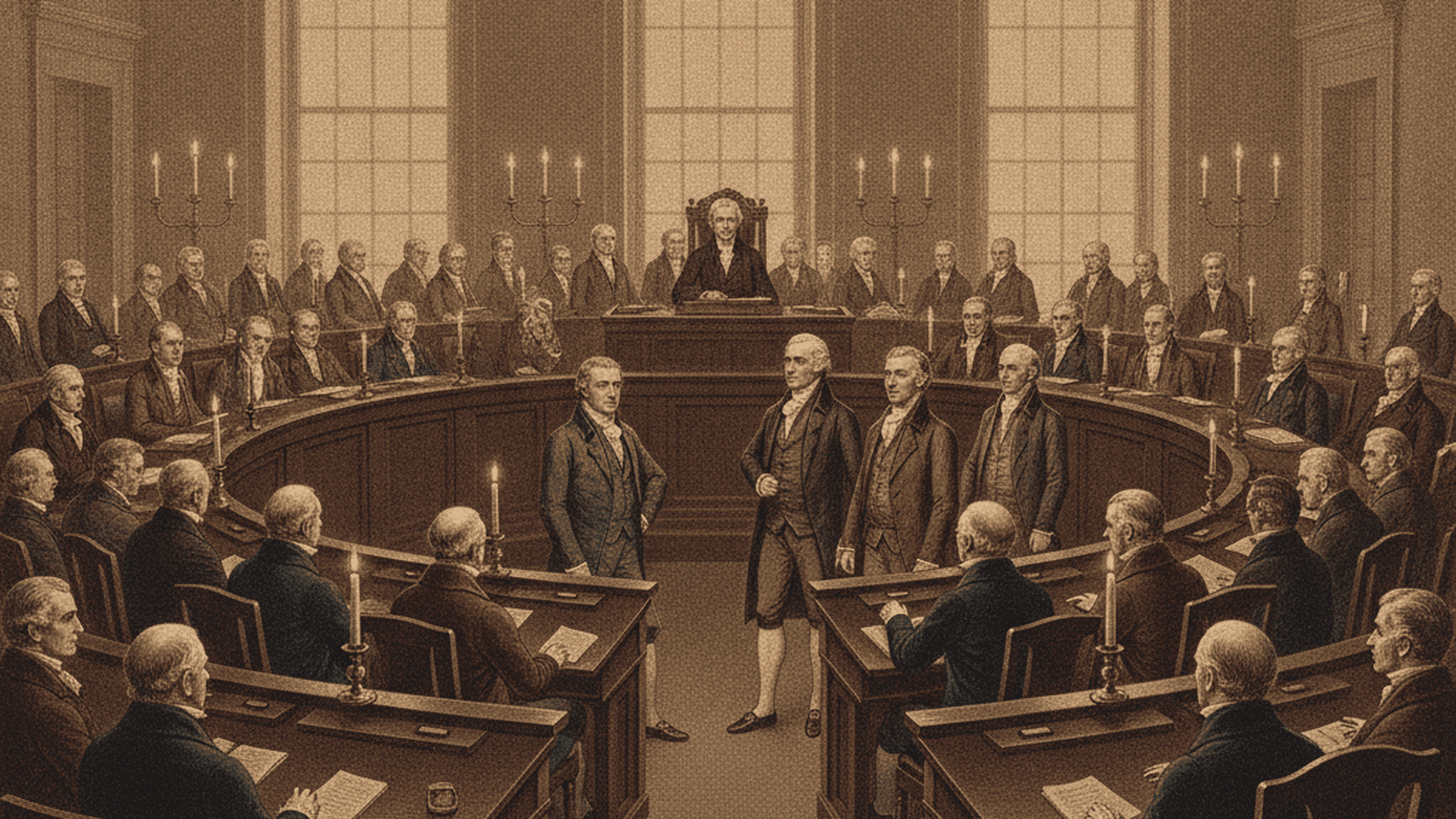
The 1805 impeachment trial of Supreme Court Justice Samuel Chase addressed whether federal judges could be removed for political reasons. The United States Senate’s decision to acquit Chase established a critical precedent for judicial independence and the separation of powers.
TLDR: In 1805, the United States Senate acquitted Supreme Court Justice Samuel Chase of impeachment charges, rejecting the idea that judges could be removed for political bias. The trial solidified judicial independence, ensuring that high crimes and misdemeanors required more than mere partisan disagreement or intemperate behavior on the bench.
In the early months of 1805, the United States Senate chamber in Washington, D.C., became the stage for a high-stakes constitutional drama that would define the boundaries of the American government for centuries. Associate Justice Samuel Chase, a signatory of the Declaration of Independence and a staunch Federalist, stood trial following his impeachment by the House of Representatives. This proceeding represented the first and only time a Supreme Court justice has been impeached, marking a pivotal moment in the definition of the separation of powers. The trial tested whether the judiciary would remain an independent branch or become a subordinate tool of the prevailing political party.
The conflict originated from the intense partisan bitterness between the outgoing Federalists and the incoming Democratic-Republicans led by President Thomas Jefferson. Chase had earned the ire of the Jeffersonians through his aggressive conduct on the bench. He frequently delivered political harangues to grand juries and presided over trials under the Alien and Sedition Acts with what critics described as blatant bias. Specifically, his conduct during the trials of John Fries for treason and James Callender for sedition was cited as evidence of his partisan zeal. The House, dominated by Democratic-Republicans and spurred on by Jefferson’s quiet encouragement, passed eight articles of impeachment in 1804, alleging that Chase had behaved in an arbitrary, oppressive, and unjust manner.
The central constitutional question was whether a judge could be removed for political leanings or judicial errors, or if “high crimes and misdemeanors” required an actual indictable offense. Jefferson’s allies, led by the volatile John Randolph of Roanoke, argued that impeachment was a tool of political oversight intended to keep the judiciary responsive to the will of the people. They viewed the life tenure of judges as a monarchical remnant that needed to be checked by the legislature. Conversely, Chase’s defense team, which included former Attorney General Charles Lee and the formidable Luther Martin, argued that the independence of the judiciary depended on judges being free from removal based on the content of their rulings or their political expressions. They maintained that Chase had committed no crime and that his removal would destroy the constitutional balance, effectively turning the courts into a political football.
Vice President Aaron Burr presided over the Senate trial with meticulous impartiality, despite his own legal troubles following his duel with Alexander Hamilton. The proceedings lasted throughout February 1805, drawing large crowds to the Capitol. Witnesses testified to Chase’s intemperate language and his tendency to interrupt defense counsel. However, the defense successfully argued that while Chase’s behavior might have been improper or discourteous, it did not constitute the criminal conduct necessary for removal from office under the Constitution. They emphasized that a judge must be allowed to make legal errors without fear of losing their livelihood, provided those errors were not the result of corruption.
On March 1, 1805, the Senate voted on the articles. Although the Democratic-Republicans held a significant majority, several members of the party broke ranks. These “Northern Democrats” feared that a conviction would set a dangerous precedent, allowing any future executive branch to purge the courts of political opponents. Chase was acquitted on all counts, as none of the articles received the required two-thirds majority. The failure to convict Chase effectively ended the Jeffersonian effort to use impeachment as a political weapon against the Federalist-dominated judiciary.
The acquittal of Samuel Chase established a lasting precedent that federal judges should not be removed for their judicial philosophy or political affiliations. This outcome solidified the concept of life tenure as a safeguard for judicial independence in the United States. Future attempts to remove judges would generally focus on actual criminal behavior or ethical lapses rather than legal disagreements. This standard remains a cornerstone of the American legal system, ensuring that the courts remain a co-equal branch of government capable of checking the other two through the power of judicial review. Had Chase been convicted, the Supreme Court might have evolved into a body far more susceptible to the shifting winds of partisan politics, fundamentally altering the American experiment in self-governance.

Sean Bradley serves as the Senior Correspondent for Trade, Supply Chains, and Global Labor at Just Right News, where he brings a principled, clear-eyed perspective to the complex systems that power the modern world. With a focus on the economic forces that impact the American household, Bradley has distinguished himself as a leading voice in explaining how global shifts in manufacturing and logistics translate to the kitchen table.
Growing up in Long Beach, California, Bradley’s interest in the movement of goods was forged against the backdrop of one of the nation’s most vital maritime gateways. Raised in a community where the towering cranes of the port were a constant fixture on the horizon, he developed an early appreciation for the blue-collar industries that form the backbone of the American economy. This upbringing instilled in him a profound respect for the dockworkers, truckers, and laborers who keep the country moving, a sentiment that remains a cornerstone of his reporting today. For Bradley, trade is not merely a series of abstract figures on a spreadsheet; it is a human endeavor that sustains families and defines the strength of a nation.
Now based in Seattle, Washington, Bradley occupies a strategic vantage point in another of the country’s most significant trade hubs. His location allows him to witness firsthand the intersection of traditional industry and the evolving technological landscape of global logistics. From the Pacific Northwest, he monitors the flow of goods across the ocean, providing Just Right News readers with timely insights into how international tensions, regulatory hurdles, and labor disputes affect the availability and cost of essential goods.
His signature feature series, “The Journey of Things,” has become a staple for readers seeking to understand the intricate path products take from raw materials to the retail shelf. Through this series, Bradley pulls back the curtain on the global marketplace, often highlighting the risks of over-reliance on foreign adversaries and the importance of domestic manufacturing resilience. His reporting consistently emphasizes the conservative values of national sovereignty, free-market competition, and the protection of the American worker from unfair global practices.
As a journalist of Irish heritage, Bradley maintains a deep-seated respect for the dignity of the individual worker and the importance of community stability. He approaches his beat with a commitment to transparency, often questioning the status quo of globalist policies that prioritize corporate efficiency over local prosperity. Whether he is reporting from a warehouse floor or analyzing a new international trade agreement, his goal remains the same: to provide the American public with the truth about where their products come from and what it costs to get them there.
Throughout his tenure at Just Right News, Bradley has remained a steadfast advocate for economic common sense. His work serves as a vital resource for those who believe that a strong nation is built on secure borders, robust trade, and a respected workforce. By combining his local roots in Long Beach with his professional experience in Seattle, Bradley continues to offer a unique and necessary perspective on the forces that shape the American way of life.