

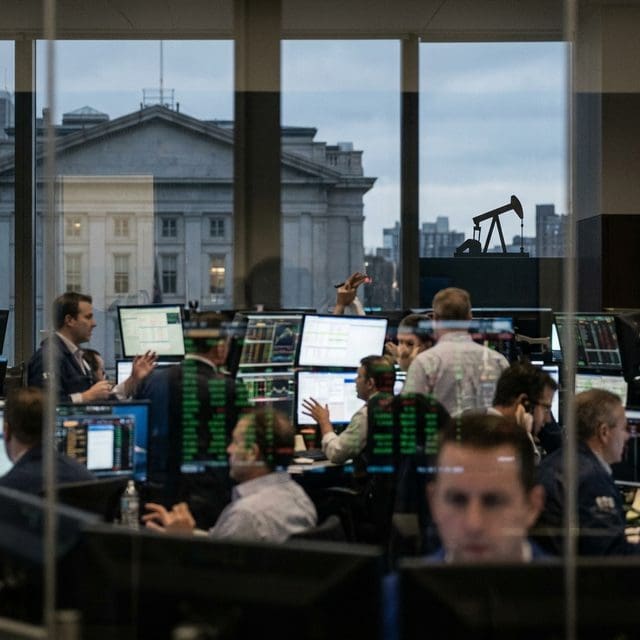
SPY rose 0.60% Monday as investors looked toward bank earnings, while elevated Treasury yields, unsettled energy risks and upcoming inflation data kept markets cautious.
SPY was up 0.60% Monday, October 12, giving the session a positive headline even as markets sent a mixed signal. Bloomberg reported S&P 500 futures little changed early in the day, with Nasdaq 100 futures down 0.1% and the Stoxx Europe 600 up 0.4%. SPY’s advance outpaced that early futures snapshot, but did not reflect a synchronized rally across regions and indexes.
The immediate catalyst is the start of bank earnings season. Bloomberg said JPMorgan Chase and Citigroup were due to report Tuesday, with major banks expected to post a combined $19 billion quarterly stock-trading haul. That is an expectation, not a reported result. ASML and Taiwan Semiconductor are also due later in the week, bringing technology demand and the global chip business into focus. Bloomberg described investors as looking for an earnings uplift after weeks of pressure from oil prices and high bond yields.
Trading revenue could support bank results, but it would not by itself show that credit conditions or the wider economy are improving. Investors will also assess lending, defaults and management outlooks. For households and small businesses, those details can matter more than a headline revenue figure: tighter credit or rising loan costs can bite even when stock prices are climbing.
Bond yields remain a significant counterweight. Bloomberg put the 10-year Treasury yield at 5.24%. The cash Treasury market was closed for Columbus Day, so there was no regular-session trading to provide a fresh U.S. benchmark. The yield had approached 5.4% the previous week, Bloomberg reported. Treasury rates influence borrowing costs across the economy, including mortgages and business financing. If yields stay elevated, they can strain household budgets and make it harder for companies to support high valuations. A stock-market gain does not mean financing has become cheaper.
Currency moves were modest in Bloomberg’s reported levels: the euro traded at $1.1184 and the yen at 158.60 per dollar. A firm dollar can make imported goods less expensive for U.S. buyers, all else equal, while reducing the value of overseas sales when U.S. companies convert them into dollars. These are snapshots, not proof of a lasting shift.
Oil remains a source of uncertainty. Bloomberg listed WTI crude at $92.82 a barrel, while other accounts in the source material put Brent around $103 to $105, after swings tied to Middle East attacks and reports of an energy understanding between Russia and Ukraine. WTI and Brent are different benchmarks, and the figures should not be treated as simultaneous prices for the same contract. Lower fuel costs could eventually help households and businesses; a supply disruption could reverse that relief.
The diplomatic account is not settled. President Donald Trump said Russia and Ukraine had agreed to an energy ceasefire, but Reuters reported Monday that there was considerable confusion and neither side had confirmed the claim. It should not be treated as a verified change in energy supply. Investors are also watching U.S. inflation data due Wednesday and Federal Reserve signals ahead of the late-October policy meeting. A hotter reading could add pressure to yields and complicate expectations for borrowing costs.
For working households, Monday’s advance is not a verdict on the cost of living or a sign that credit is getting cheaper. Federal Reserve household-finance data released October 9 showed inflation-adjusted incomes rose for middle- and lower-income households during the Biden years and fell for higher-income households. The narrower market message: earnings hopes helped support U.S. shares, while elevated yields, inflation uncertainty and energy risks remain in play.

Jordan Lee serves as the Senior Correspondent for Wall Street, Finance, and Monetary Systems at Just Right News. Based in the heart of the world’s financial capital, New York City, Lee brings a sharp, principled eye to the complex mechanisms that drive the global economy. His reporting is defined by a commitment to fiscal responsibility, the defense of the free market, and a deep-seated belief that a transparent monetary system is the bedrock of a free society.
Raised in Portland, Oregon, Lee’s perspective was forged in a city that has undergone significant cultural and economic shifts. His upbringing in the Pacific Northwest instilled in him a profound appreciation for the industriousness of small business owners and the importance of local economic stability. Watching the evolution of his hometown’s landscape sparked an early interest in how federal fiscal policy and large-scale financial trends eventually trickle down to the average citizen. This background provides him with a unique vantage point; he understands the growing disconnect between the policy-making elite and the reality of Main Street, a theme that frequently resonates throughout his work.
Now operating from his base in New York City, Lee bridges the gap between the high-stakes trading floors of Manhattan and the households of everyday Americans. He views the financial sector not merely as a collection of numbers and tickers, but as a vital engine of American prosperity that requires constant vigilance and accountability. His reporting often highlights the dangers of centralized financial control and the necessity of maintaining a system that rewards merit, risk-taking, and innovation.
As the creator and lead of the featured series, “The Invisible Economy,” Lee pulls back the curtain on the often-opaque world of monetary systems. He specializes in translating the dense jargon of central banking and international finance into actionable insights for the Just Right News audience. His work explores the “invisible” forces—such as inflationary pressures, regulatory creep, and the expansion of the administrative state—that erode the purchasing power of American families. By focusing on these systemic issues, Lee empowers readers to understand the hidden forces shaping their financial independence.
Lee’s journalistic philosophy is rooted in a steadfast commitment to traditional American values. As an Asian American professional who has navigated the competitive corridors of the financial world, he is a vocal advocate for meritocracy and the preservation of the American Dream. He believes that a stable currency and a predictable regulatory environment are essential for national sovereignty and individual liberty. His reporting frequently warns against the risks of government overreach in the private sector, arguing that the most effective solutions to economic challenges arise from competition and individual enterprise rather than bureaucratic mandates.
At Just Right News, Jordan Lee remains dedicated to providing a clear-eyed defense of the taxpayer. Whether he is analyzing market volatility or investigating the long-term implications of national debt, his mission is to provide the truth about where the money is going and what it means for the future of the country. Through his rigorous analysis and principled stance, Lee has become a trusted voice for those who value a strong, sovereign, and fiscally sound America.