

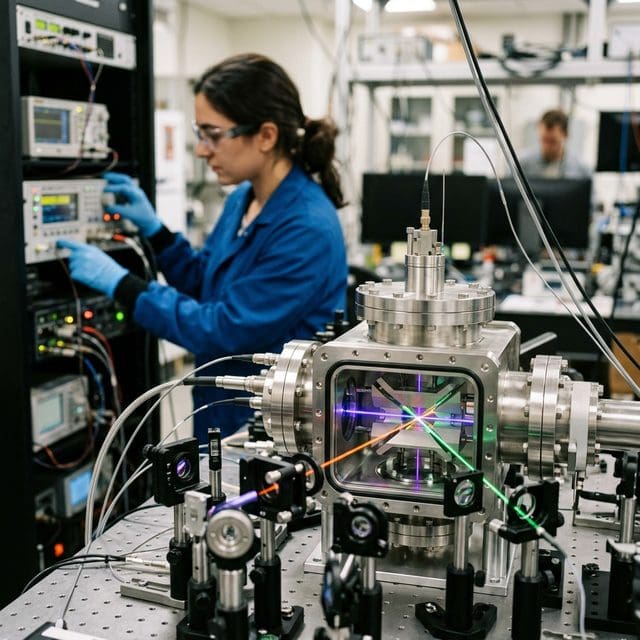
Oxford researchers used trapped ions and quantum oscillators to show how simulated magnetic flux can halt a particle’s motion through destructive interference.
A particle need not pass through a magnetic field to feel its consequences. In a recent quantum-computing experiment, researchers recreated that counterintuitive principle and watched a simulated particle’s motion grind to a halt.
Led by Sebastian Saner and colleagues at the University of Oxford, the team observed Aharonov–Bohm interference in a dynamical gauge-field setting. The paper appeared open access in Nature Physics on September 25; Phys.org reported on it October 10 and updated its account the next day. The published paper is titled “Aharonov–Bohm interference in a Z₂ lattice gauge theory on a hybrid qubit–oscillator quantum computer.”
The Aharonov–Bohm effect is a landmark of quantum physics. In a familiar version, a particle can travel along two paths around a region containing magnetic flux. It does not cross the field, but the flux changes the relationship between the paths. When they meet, their wave-like possibilities can reinforce or cancel each other. The effect demonstrates that quantum particles can be influenced by fields around their routes, not only by forces acting directly on them.
Oxford’s team built a small quantum system to make this behavior visible. Trapped-ion qubits represented gauge fields, while the ions’ vibrational modes represented bosonic matter fields. The researchers combined digital and analogue controls with synthetic dimensions, an engineered way to represent additional dimensions within the system. Rather than simply calculating a prediction, the computer’s quantum components embodied the interaction under study.
With no simulated flux, the matter excitation tunneled between two sites. When the researchers introduced flux, the possible routes interfered destructively. Tunneling was suppressed, leaving the excitation effectively frozen. This contrast provided a direct signature of the effect: movement without flux, but little or no movement when flux was present.
The distinction is that the experiment did not rely on a fixed external magnetic field. The team observed interference with dynamical gauge fields—fields represented within the quantum system and able to participate in its changing behavior. The arXiv record describes this as the first observation of Aharonov–Bohm interference with dynamical gauge fields encoding magnetic flux.
The result matters beyond its value as a vivid physics demonstration. Gauge fields are central to theories of fundamental interactions, including those used in particle and nuclear physics. Simulating such systems exactly can become prohibitively difficult for conventional computers. Quantum devices offer a different approach: construct a controlled system that follows the same essential rules, then measure its behavior. This experiment does not solve a particle-physics problem, but it tests whether quantum hardware can reproduce important pieces of the underlying theories.
The publication connects experimental work with theory. Its authors include Saner and Alejandro Bermúdez of Madrid’s Instituto de Física Teórica. Nature Physics’ abstract describes the resource-efficient encoding as a possible route to scalable simulations of lattice gauge theories in higher dimensions. That is a research outlook, not a larger-scale computation demonstrated in this experiment.
The result does not establish that a large quantum computer can already solve practical problems in particle physics. It shows that a hybrid arrangement of qubits and oscillators can reproduce a difficult interaction and reveal its characteristic interference pattern. Scaling up while preserving control and reliable measurements remains a challenge.
If researchers can expand the system, future simulations may let them investigate more complex gauge theories and interactions that are difficult to isolate in nature. For now, the accomplishment is narrower but meaningful: quantum hardware has recreated a foundational effect in a dynamical setting, giving physicists another tool for studying how matter and fields behave together.

Mason Reed serves as a Staff Writer for Just Right News, where he spearheads the Future Frontiers & Special Projects desk. In an era defined by rapid technological shifts and evolving social landscapes, Mason provides a steady, principled voice, examining the innovations of tomorrow through the lens of traditional American values. His work is most prominently featured in his signature series, “The Next Horizon,” where he explores the intersection of emerging technology, national sovereignty, and the preservation of individual liberty.
A native of San Diego, California, Mason’s worldview was shaped by the unique culture of his hometown. Growing up in a region defined by its strong military presence and its history of maritime industry, he developed a deep-seated respect for the institutions that provide national stability and the entrepreneurial spirit that drives the American economy. This upbringing instilled in him a belief that true progress is not found in discarding the past, but in building upon a foundation of proven principles. His reporting often reflects this San Diego influence, emphasizing the importance of a robust national defense and the necessity of maintaining a competitive edge in the global marketplace.
Now based in San Francisco, Mason operates from the heart of the world’s technological engine. Living and working in the Bay Area provides him with a front-row seat to the advancements—and the ideological challenges—emanating from Silicon Valley. While many in the region embrace a “move fast and break things” mentality, Mason’s reporting serves as a vital counterweight. He offers Just Right News readers a “boots on the ground” perspective, documenting how radical local policies and the concentration of tech power impact the everyday lives of citizens. His proximity to the industry allows him to cut through the marketing jargon of big tech to uncover the real-world implications for privacy, free speech, and the nuclear family.
In his “Future Frontiers” beat, Mason tackles complex subjects ranging from the ethics of artificial intelligence to the burgeoning private space race. He approaches these topics with a healthy skepticism toward centralized bureaucracy, championing instead the decentralized innovations that empower individuals. Through “The Next Horizon,” he highlights the pioneers and thinkers who are working to ensure that the future remains a place where human dignity and constitutional rights are protected. He believes that the rapid pace of change requires more than just technical expertise; it requires a moral compass rooted in the Western tradition.
Throughout his tenure at Just Right News, Mason has remained committed to the idea that the future is something to be shaped, not merely accepted. His writing is characterized by a rigorous defense of American exceptionalism and a belief that the country’s best days lie ahead, provided it remains true to its founding ideals. Whether he is investigating the impact of automation on the American workforce or profiling the next generation of aerospace engineers, Mason Reed ensures that his readers are equipped with the insights they need to navigate a changing world with confidence and clarity.