

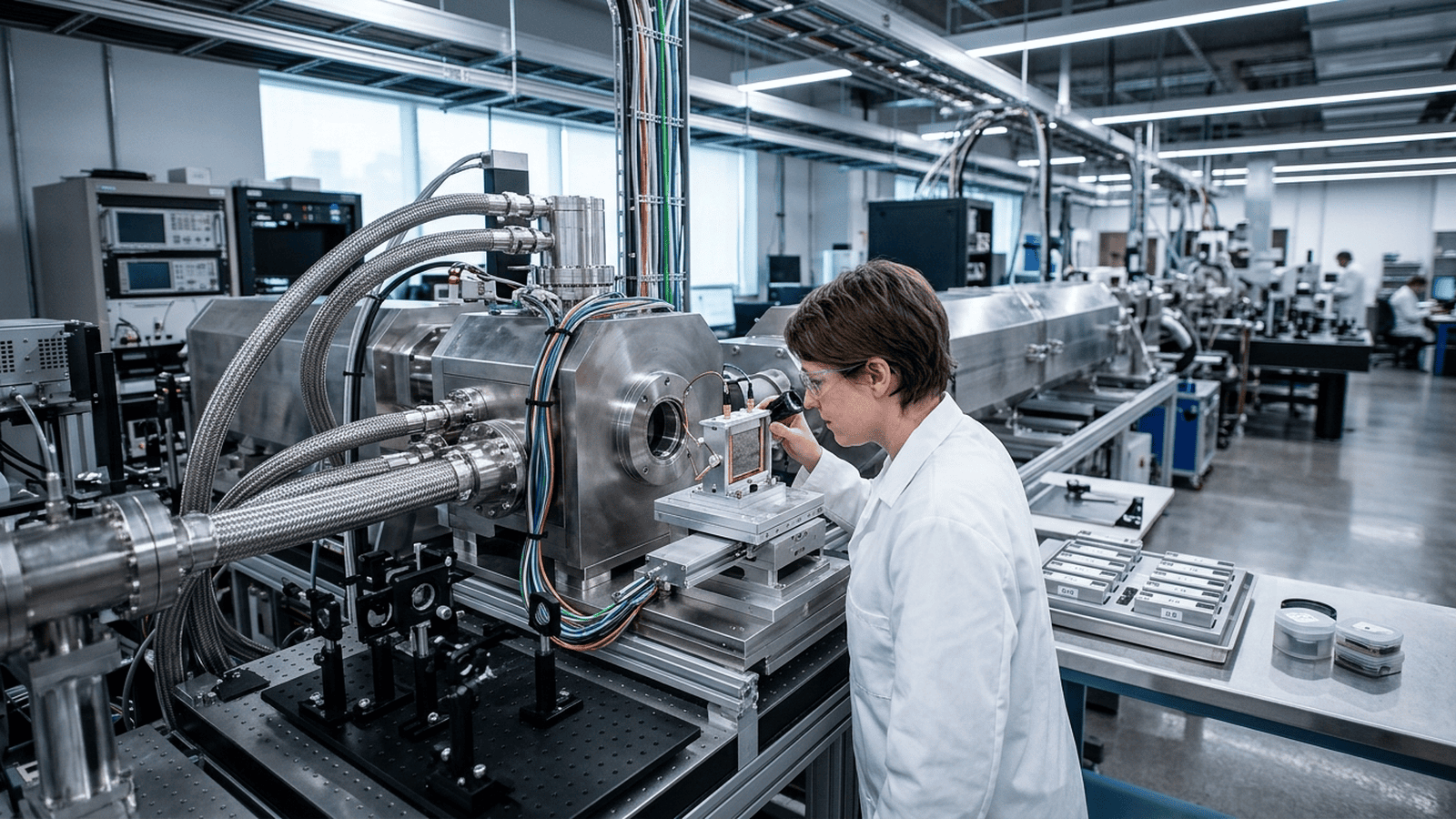
Argonne National Laboratory researchers used X-ray methods to study how oxygen participates in charge storage in lithium-rich battery cathodes. The findings help explain why the chemistry can deliver high capacity while also contributing to performance losses, and could guide efforts to develop more durable materials.
TLDR: Lithium-rich battery cathodes can store substantial energy partly because oxygen participates in charge storage. Argonne researchers used advanced X-ray methods to examine this chemistry and its relationship to structural changes and performance decline. The results offer design clues, but durable materials still need further development and testing.
A battery cathode made with lithium-rich metal oxides can store more energy than many conventional cathodes, but its extra capacity comes with a cost: performance can fade as the battery is repeatedly charged and discharged. Researchers at Argonne National Laboratory have investigated a key part of that trade-off, tracing how oxygen in the material participates in storing and releasing charge.
The work addresses a central question in materials science. In familiar lithium-ion cathodes, much of the electrical charge is associated with changes in the oxidation state of transition metals, such as nickel or cobalt. In lithium-rich compounds, oxygen can also contribute to charge compensation. That added activity helps explain the materials’ unusually high capacity, while also raising concerns about structural changes and voltage loss over time.
Argonne researchers examined lithium-rich layered oxides using advanced X-ray techniques at the laboratory’s Advanced Photon Source, a national user facility. X-ray measurements can reveal changes in a material’s electronic structure and local atomic environment while the material is being studied. By tracking oxygen-related signals alongside changes in the metals, scientists can distinguish processes that are difficult to separate through battery performance measurements alone.
The findings add detail to the picture of oxygen redox: oxygen atoms are not simply passive supports for the metal framework. Their electronic states can change as lithium moves in and out of the cathode during cycling. The behavior is tied to the local arrangement of atoms, including how oxygen is bonded to neighboring metals and how lithium vacancies form. Such information helps researchers assess why some oxygen activity is reversible while other changes may contribute to lasting damage.
This distinction matters because high capacity by itself does not make a practical battery. A cathode also has to retain its voltage and structure through many cycles, work reliably at useful charging rates, and be manufactured at scale. In lithium-rich materials, unwanted oxygen loss or rearrangement can contribute to declining voltage and capacity. Understanding the pathways involved may help materials designers preserve the useful part of oxygen’s contribution while limiting degradation.
The research does not amount to a finished battery or a near-term replacement for products on the market. Instead, it supplies evidence that can guide the design and testing of future cathode compositions. Researchers can adjust the mix of metals, the arrangement of atoms, and the material’s processing conditions, then use spectroscopy to see whether those changes produce more stable oxygen behavior.
Argonne’s role reflects the value of national laboratories in materials research. Facilities such as the Advanced Photon Source produce intense X-rays that let investigators probe matter at atomic scales. Those measurements are often combined with electrochemical testing and theoretical calculations, allowing teams to connect what happens inside a material with the capacity, voltage, and durability observed in a working cell.
The broader challenge is to make batteries store more energy without relying on ever-increasing quantities of scarce or costly metals. Lithium-rich cathodes are one possible route, although they still face hurdles in lifetime, safety, and production. Improvements in understanding their chemistry could inform better materials, but any candidate will need extensive testing in complete cells before its practical value is clear.
Next, researchers will need to compare oxygen behavior across different compositions and operating conditions, and determine which structural changes can be prevented or reversed. That work could help turn a promising laboratory material into a more durable cathode. For now, the study offers a clearer account of how oxygen participates in battery charge storage—and why controlling that chemistry is essential to getting both high capacity and long life.

Mark Davis serves as the Senior Correspondent for Energy, Climate, and Resource Economics at Just Right News. In an era where the conversation around the environment is often dominated by alarmism and top-down mandates, Mark provides a vital, market-oriented perspective on the complex forces shaping our world. As the lead voice behind the acclaimed feature series “Power and the Planet,” he explores the intersection of environmental policy, global energy markets, and the fundamental economic principles that sustain modern civilization.
Mark’s pragmatic approach to resource management was forged in the high desert of his hometown, Albuquerque, New Mexico. Growing up in a region defined by both its breathtaking natural beauty and its rugged, resource-dependent landscape, he developed an early appreciation for the delicate balance between conservation and utilization. New Mexico’s unique position as a hub for both traditional energy production and cutting-edge scientific research provided Mark with a front-row seat to the evolution of the American energy sector. This upbringing instilled in him a deep-seated belief that true environmental stewardship is inseparable from economic prosperity and technological innovation.
Now based in Boulder, Colorado, Mark operates from the heart of the nation’s climate research community. While Boulder is often seen as a bastion of environmental idealism, Mark utilizes his post to provide a necessary counterweight, grounded in the realities of resource economics. He understands that energy policy does not exist in a vacuum; it has tangible consequences for the American taxpayer, the stability of the national power grid, and the strength of the domestic manufacturing sector. By reporting from the front lines of the climate debate, he is able to challenge prevailing narratives with hard data and a commitment to the principles of the free market.
Throughout his tenure at Just Right News, Mark has distinguished himself by focusing on the “Resource Economics” aspect of his beat. He frequently highlights the hidden costs of rapid energy transitions and advocates for an “all-of-the-above” energy strategy that prioritizes American energy independence. His work often shines a light on the geopolitical implications of resource scarcity, arguing that a secure nation must first be an energy-secure nation. Whether he is analyzing the impact of federal land-use regulations or investigating the supply chains required for new technologies, Mark remains focused on how policy decisions affect the lives and livelihoods of everyday citizens.
In “Power and the Planet,” Mark continues to bridge the gap between complex scientific concepts and the economic realities facing the country. He rejects the false choice between a healthy environment and a thriving economy, instead seeking out solutions that leverage American ingenuity and private-sector competition. For Mark, reporting on the climate is not about following the latest trends, but about ensuring that the conversation remains tethered to the foundational values of liberty, property rights, and fiscal responsibility. His contributions ensure that Just Right News readers receive a comprehensive, clear-eyed view of the challenges and opportunities defining the future of our planet.