

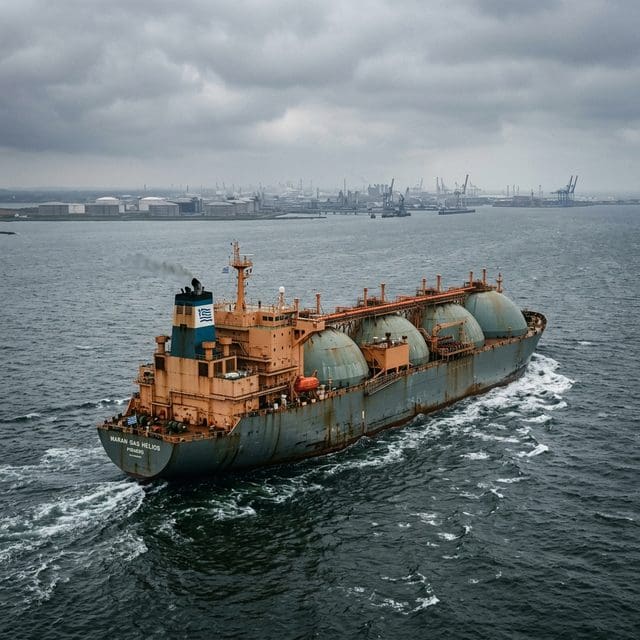
More U.S. LNG cargoes have shifted toward Europe as Asian demand softens, offering short-term flexibility while leaving buyers exposed to winter needs and geopolitical risk.
Two U.S. liquefied natural gas cargoes recently diverted toward Europe as Asian demand eased, offering temporary relief to a tight global market ahead of winter, Bloomberg reported October 9.
The diversions follow a broader change in trade flows. Reuters reported October 7 that increased European purchases of U.S. LNG in August and September drew cargoes away from Asia. Shorter voyages to Europe also improved vessel availability. Earlier, Asia had taken more U.S. shipments after the Iran war disrupted Gulf supplies.
The shift shows how a global LNG market can redirect supply when regional demand changes. Cargoes can go to buyers willing to pay, giving producers and shippers flexibility. But a ship’s destination is not evidence of abundant supply: fuel sent to Europe is unavailable to Asian buyers, and competition can change with prices, weather or another disruption.
Shorter Atlantic crossings can free vessels for additional voyages compared with longer routes to Asia. That helps the market respond, but does not guarantee more gas. The available reports do not quantify the volume represented by the diversions or their effect on prices. A change in destination can ease pressure at the margin without adding supply to the world market.
The timing matters. European buyers need fuel ahead of winter, when heating demand can rise, while Asian buyers also face seasonal competition. The reports describe easing Asian demand now, not a permanent decline. If demand strengthens or Europe’s requirements rise, cargoes may again be contested. Flexibility depends on available supply, ships and buyers’ willingness to respond to prices.
China is another part of the changing trade picture. A Guardian business report on October 9 said China was restarting refined-fuel exports after a pause around its Golden Week holiday. That is a separate market from LNG; the report provided no verified volume, and petroleum exports do not directly resolve a natural-gas shortage.
Oil markets remain sensitive to the Iran conflict and U.S. policy. The Guardian reported that Brent crude fell Friday after President Donald Trump promised not to attack Iran before the November midterm elections. The supplied material does not establish a verified price level or the size of the move, so it cannot show how much the statement drove the change. A pause in threatened action also does not remove the risk of renewed disruption to energy trade.
For buyers, uncertainty matters as much as the direction of a single day’s price. U.S. LNG exports give importers another source and support American producers, but they do not shield U.S. consumers from global prices. When overseas buyers are willing to pay more, producers have an incentive to sell into that market. Export access can strengthen supply options abroad, while domestic costs remain linked to international demand.
LNG can improve reliability where pipeline supply or local production is constrained, but delivery depends on infrastructure, shipping and stable trade routes. Expanding exports may offer commercial returns and security benefits to importers; it does not guarantee low prices or equal access across regions. The reports provide no emissions comparison, so they do not establish how these cargo diversions affect the sector’s climate impact.
For now, the evidence points to market adjustment, not resolution. Cargoes and ships are responding to shifting demand, while gas and oil remain vulnerable to geopolitical shocks. The next test is whether supply and shipping can meet winter needs without renewed escalation in the Gulf.

Mark Davis serves as the Senior Correspondent for Energy, Climate, and Resource Economics at Just Right News. In an era where the conversation around the environment is often dominated by alarmism and top-down mandates, Mark provides a vital, market-oriented perspective on the complex forces shaping our world. As the lead voice behind the acclaimed feature series “Power and the Planet,” he explores the intersection of environmental policy, global energy markets, and the fundamental economic principles that sustain modern civilization.
Mark’s pragmatic approach to resource management was forged in the high desert of his hometown, Albuquerque, New Mexico. Growing up in a region defined by both its breathtaking natural beauty and its rugged, resource-dependent landscape, he developed an early appreciation for the delicate balance between conservation and utilization. New Mexico’s unique position as a hub for both traditional energy production and cutting-edge scientific research provided Mark with a front-row seat to the evolution of the American energy sector. This upbringing instilled in him a deep-seated belief that true environmental stewardship is inseparable from economic prosperity and technological innovation.
Now based in Boulder, Colorado, Mark operates from the heart of the nation’s climate research community. While Boulder is often seen as a bastion of environmental idealism, Mark utilizes his post to provide a necessary counterweight, grounded in the realities of resource economics. He understands that energy policy does not exist in a vacuum; it has tangible consequences for the American taxpayer, the stability of the national power grid, and the strength of the domestic manufacturing sector. By reporting from the front lines of the climate debate, he is able to challenge prevailing narratives with hard data and a commitment to the principles of the free market.
Throughout his tenure at Just Right News, Mark has distinguished himself by focusing on the “Resource Economics” aspect of his beat. He frequently highlights the hidden costs of rapid energy transitions and advocates for an “all-of-the-above” energy strategy that prioritizes American energy independence. His work often shines a light on the geopolitical implications of resource scarcity, arguing that a secure nation must first be an energy-secure nation. Whether he is analyzing the impact of federal land-use regulations or investigating the supply chains required for new technologies, Mark remains focused on how policy decisions affect the lives and livelihoods of everyday citizens.
In “Power and the Planet,” Mark continues to bridge the gap between complex scientific concepts and the economic realities facing the country. He rejects the false choice between a healthy environment and a thriving economy, instead seeking out solutions that leverage American ingenuity and private-sector competition. For Mark, reporting on the climate is not about following the latest trends, but about ensuring that the conversation remains tethered to the foundational values of liberty, property rights, and fiscal responsibility. His contributions ensure that Just Right News readers receive a comprehensive, clear-eyed view of the challenges and opportunities defining the future of our planet.