

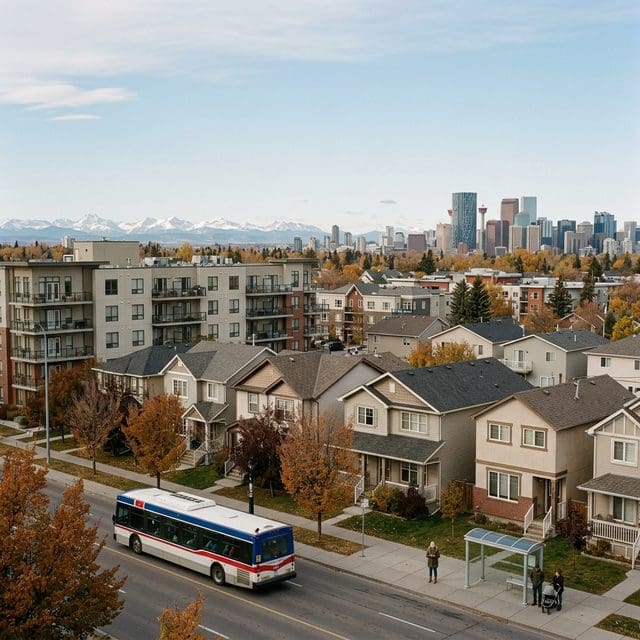
RBC says affordability improved nationally in the first quarter, but Calgary and Edmonton remain shaped by high resale activity, uneven prices and persistent cost-of-living pressure.
Canada’s housing-affordability picture improved in the first quarter of 2026, but the national gain has yet to translate into a clear easing of pressure in Calgary and Edmonton, according to RBC Economics and reporting by the Calgary Herald.
RBC’s national affordability measure fell 1.4 percentage points to 53%, its best reading in four years. The improvement offers some relief after a prolonged period of strained housing costs, but RBC cautioned that further gains may be limited. Home-price declines are tapering, while interest rates have likely passed their cyclical lows, the bank said in its October 8 analysis.
The measure’s improvement does not mean housing has become broadly affordable, nor does it show that costs have fallen for every household. In Calgary, RBC put the measure at 41.5%, close to its long-run average of 39.8%. Edmonton’s stood at 36.8%, down 0.5 percentage points from the previous quarter and from a year earlier.
Resale activity in both cities remains unusually strong. RBC reported Calgary resales running about 25% above pre-pandemic levels, while Edmonton’s were nearly 40% higher. The figures suggest that demand has not retreated to its earlier baseline, even as affordability remains a constraint for many prospective buyers.
The price picture varies by home type. CP24, reporting RBC figures, said Calgary single-detached resales rose 4.4% from 2025 while prices slipped 1%. Condo resales fell 14.3%, and condo prices were down 8.3%. In Edmonton, prices stabilized in September after falling more quickly earlier in the year.
Those differences matter to households weighing a purchase: a market-wide affordability measure can obscure the gap between property types and local conditions. A modest improvement in a national indicator does not necessarily help a renter saving for a down payment, or a buyer whose budget fits one segment of a city’s housing market but not another. The available reporting does not provide a current breakdown of rents or mortgage payments for either city.
Affordability is also only one part of how residents experience the cost of living. A survey of Calgarians reported by Yahoo News Canada found that 58% rated their quality of life good or excellent, eight percentage points lower than the previous year. Fourteen percent rated it below average or poor, the highest share in seven years.
The survey results do not establish that housing costs caused the decline. They do, however, underscore why housing policy cannot be judged by prices or construction totals alone. Rent, access to homes, transportation and other household expenses all affect whether residents can remain in a community and reach work and services. The source material provides no new transit or infrastructure decision tied to the affordability figures.
For policymakers, the RBC outlook points to a narrow window for improvement rather than a durable resolution. With price declines easing and interest rates no longer expected to provide the same tailwind, additional progress will depend on conditions that vary between markets and types of housing. RBC’s figures document the trend, but do not prescribe a particular policy response.
The distinction is important as governments consider measures that shape housing supply and demand. Broad mandates or spending commitments do not guarantee lower costs for households; outcomes depend on whether new homes match local needs and can be delivered without shifting excessive costs to taxpayers or buyers. The latest data offer a reason for cautious optimism nationally, but in Alberta’s two largest cities, elevated resale activity and subdued quality-of-life ratings suggest the affordability story is far from settled.

Deborah Cole serves as a Senior Correspondent for Just Right News, where she spearheads the network’s coverage of Housing, Infrastructure, and Mobility. With a career defined by a commitment to rigorous reporting and a focus on the fundamental pillars of American community life, Deborah brings a principled perspective to the complex issues that dictate how and where we live. Her work is grounded in the belief that sound policy, fiscal responsibility, and respect for private property are the essential foundations of a prosperous society.
Originally from Boston, Massachusetts, Deborah’s upbringing in one of the nation’s oldest and most historically significant cities deeply influenced her professional trajectory. Growing up amidst the architectural legacy and dense urban planning of New England, she developed an early appreciation for the importance of durable infrastructure and the role of local tradition in shaping neighborhoods. Her perspective is informed by the classic American values of her hometown—hard work, community cohesion, and a healthy skepticism of top-down bureaucratic mandates that often overlook the unique needs of individual citizens.
Today, Deborah operates from her base in Austin, Texas, a city that serves as a primary laboratory for her reporting. Austin’s rapid expansion and its status as a hub for innovation and migration provide her with a front-row seat to the most pressing challenges in modern infrastructure and housing. From the Lone Star State, she chronicles the tensions between rapid growth and the preservation of the American Dream, often highlighting how market-driven solutions and deregulation can address the housing shortages that plague many of the country’s metropolitan areas.
At Just Right News, Deborah is perhaps best known for her signature feature series, “Where We Live.” Through this platform, she explores the intersection of public policy and private life, moving beyond mere statistics to tell the stories of families, small business owners, and local developers. Her reporting frequently highlights the importance of mobility—not just in terms of transportation and transit, but as a vehicle for economic opportunity and social stability. She remains a staunch advocate for the taxpayer, consistently scrutinizing government spending on large-scale projects and advocating for transparency in how infrastructure dollars are allocated.
Deborah’s beat is more than just a collection of policy topics; it is an investigation into the physical and legal structures that allow families to flourish. Whether she is reporting on the impact of zoning laws on suburban development or the necessity of maintaining the nation’s highway systems, her work is characterized by a dedication to the facts and a respect for the constitutional principles that protect the rights of homeowners.
As a Senior Correspondent, Deborah Cole continues to be a vital voice for Just Right News, providing the audience with the clarity and context needed to navigate an ever-changing landscape. Her reporting ensures that the values of individual liberty and local sovereignty remain at the forefront of the national conversation regarding the future of our cities and towns. Through her tireless efforts, she remains committed to informing the public on the issues that hit closest to home.