

France’s early grape harvest points to pressure on wine production, while Maine officials consider how data centers should pay for demands on power and the environment.
France’s grape harvest is drawing attention to how summer conditions can affect agricultural production. In Maine, officials are working through a separate question: how to manage data centers’ demands on power and the environment without shifting their costs to households.
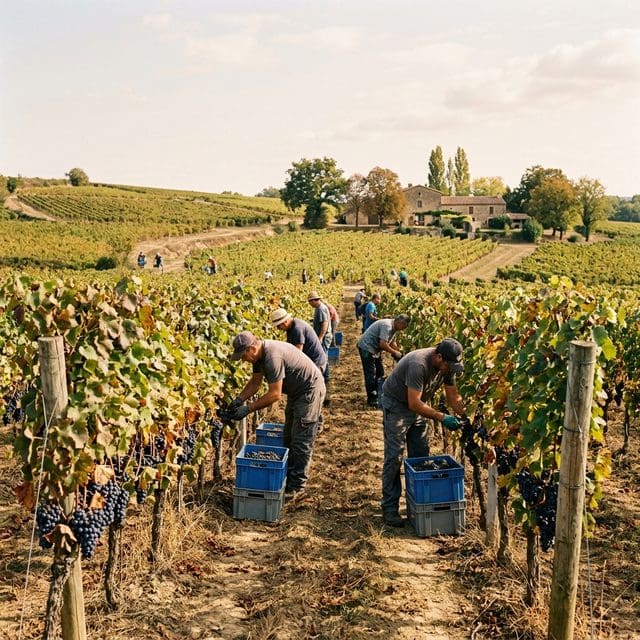
Reuters reported October 7 that Champagne production is projected to be half of both its 2025 level and the five-year average. Harvesting ended in early September, the earliest finish on record. The available material gives no production tonnage or breakdown of expected losses among producers.
France’s agricultural statistics service, Agreste, said the harvest was nearly complete by October 1 and grapes were in excellent health. It cautioned that its estimate did not account for events after that date. The two statements address different things: grape condition and expected crop volume. The reports do not establish a food-safety concern.
A Guardian report described France’s wine harvest as facing a historic low after summer heatwaves. It said this year’s expected yield was down 2% from 2025, which it characterized as the lowest production in nearly 70 years. Reuters’ comparison concerns Champagne, while the Guardian discusses the national wine harvest; the supplied material does not provide enough detail to reconcile their estimates beyond that difference in scope.
The reporting concerns harvest timing and expected output, not contamination, pesticide residues or a regulator’s finding about wine safety. Nor does the available information quantify likely price changes or effects on individual farms. Agreste’s stated cutoff is a reminder that harvest estimates are snapshots, not final accounts of every factor that may affect production.
In Maine, the Data Center Advisory Council was refining draft recommendations on October 7, according to the state Department of Energy Resources. The council is considering how to protect electric customers, maintain grid reliability and address environmental concerns as data-center demand grows. Proposals include special tariffs, demand-response measures and possible requirements for facilities to bring their own generation.
The options address different parts of the problem. Tariffs could assign data-center-related costs to the customers driving them; demand-response measures could require facilities to adjust electricity use when the grid is strained. A requirement to bring their own generation would raise questions about how facilities produce power and how that generation fits state clean-energy laws. These are proposals under discussion, not adopted requirements.
The energy department says it is directed to work with the Public Utilities Commission on measures ensuring data-center-related costs are borne by the entities that create them. The council’s final report is due January 29, 2027. Until then, there are no final recommendations to assess. The supplied material does not describe a completed environmental review or identify a specific pollution finding connected to a Maine data center.
Inside Climate News has reported that Maine’s next governor will face a tension between energy costs and climate policy. Its report says average heating-oil costs recently reached a record high. That broader affordability concern does not establish that data centers caused those costs, but it helps explain why ratepayer protections and clear accounting of infrastructure expenses are central to the council’s work.
The developments are distinct, but both call for precision about what the evidence shows. France’s reports describe agricultural output under difficult conditions, not unsafe wine. Maine officials are still developing recommendations, not announcing completed protections. Neither set of reports establishes a new contamination finding or a final regulatory outcome.

Eric Nolan serves as the Senior Correspondent for Food, Water, and Environmental Health at Just Right News, where he brings a principled, common-sense perspective to the most fundamental issues facing the American public. With a career dedicated to uncovering the truth behind the policies that govern our natural resources, Eric has become a trusted voice for readers who value traditional stewardship over bureaucratic overreach. His reporting is defined by a commitment to the idea that true environmentalism is rooted in the protection of the American family and the preservation of the nation’s agricultural heritage.
Raised in Fresno, California, Eric’s worldview was shaped in the heart of the San Joaquin Valley. Growing up in one of the world’s most productive agricultural hubs, he witnessed firsthand the vital connection between the land, the water, and the dinner table. In Fresno, he saw the resilience of farmers and the devastating impact that distant, top-down regulations can have on local communities. This upbringing instilled in him a deep respect for the producers who feed the country and a lifelong skepticism toward the alarmist narratives often pushed by mainstream media. For Eric, environmental health is not an abstract political talking point; it is a matter of ensuring that the people who work the land have the freedom and the resources to do so effectively.
Now based in Eugene, Oregon, Eric operates from a unique vantage point in the Pacific Northwest. Living in a region often defined by intense environmental debate, he provides a necessary counter-narrative to the prevailing trends of the area. From his base in Eugene, he monitors the shifting tides of federal and state policies, ensuring that the voices of rural citizens and property owners are not drowned out by urban activism. His reporting often bridges the gap between the rugged realities of the outdoors and the legislative halls where decisions are made, offering a grounded perspective that prioritizes local sovereignty and practical solutions.
As the lead for the acclaimed feature series “Earth on the Table,” Eric explores the intricate journey of the American food supply. He tackles critical issues such as water rights, soil health, and food security through a lens of national stability and individual liberty. He believes that a healthy environment and a thriving economy are not mutually exclusive, but rather two sides of the same coin of national prosperity. His work consistently highlights how innovation and private-sector ingenuity are the most effective tools for ensuring clean water and a safe food supply, rather than the expansion of the administrative state.
At Just Right News, Eric’s reporting serves as a vital resource for those who seek accountability and transparency. Whether he is investigating the impact of federal land management on local economies or examining the safety of the national food infrastructure, his work remains anchored in the values of heritage and hard work. Eric Nolan continues to be a leading voice in environmental journalism, championing the belief that the best way to protect our natural resources is to empower the people who live and work closest to them.