

Mistral’s trillion-parameter model remains behind a guardrail endpoint pending safety testing, while reporting points to rising investor interest in DeepSeek and early revenue traction at Melius.
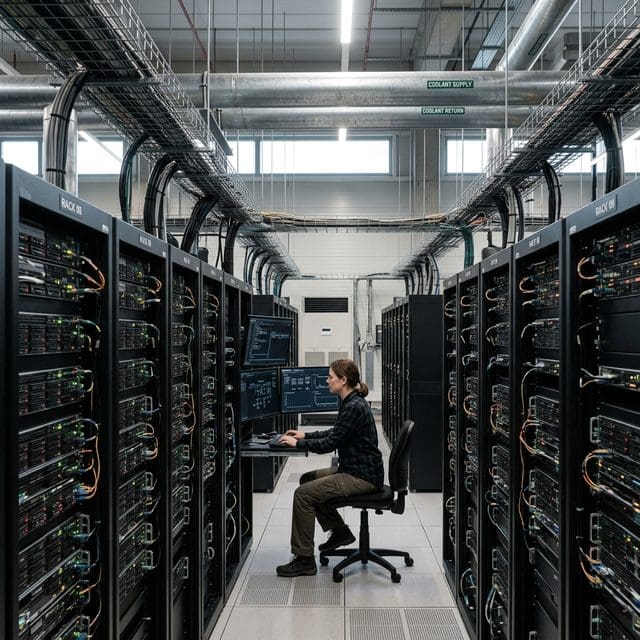
Mistral has previewed Large 4, a massive multimodal model the French AI company says it trained on its own compute using 4,000 Nvidia GPUs. But developers looking for an open-weight alternative will have to wait: as of October 6, the model was available only through a public guardrail endpoint. Mistral plans to release the weights in about three weeks, after safety testing with partners and governments.
That distinction matters. Mistral has positioned Large 4 as open-weight, but it is not open-weight today. Developers cannot yet download the model, inspect its weights or run it on infrastructure they control. For now, access is through a company-provided endpoint, and the eventual release depends on testing that has not yet been completed.
Mistral describes Large 4 as a one-trillion-parameter, natively multimodal model. Its documentation lists 1.05 trillion total parameters, with 49 billion active at a time. The difference reflects a mixture-of-experts design: the model’s full parameter count is not necessarily activated for each inference. That could affect the computing resources needed to use it, although independent performance and cost comparisons are not yet available.
The company’s vice president of science said Large 4 was trained using two to three times fewer GPUs than Chinese competitors, according to TechCrunch. Mistral said the training used its own compute and 4,000 Nvidia GPUs. Benchmark results were still pending in TechCrunch’s October 6 report, leaving the model’s performance and the company’s comparison untested in the available evidence.
For developers who rely on OpenAI, Anthropic or Google services, Large 4 could eventually offer another option for coding, content generation and multimodal tasks. Its usefulness will depend on evidence not yet available: benchmark performance, the terms of weight access, and the cost and infrastructure required to deploy it. A model’s size and a promise of future openness do not by themselves establish that it is a practical substitute for hosted systems.
DeepSeek’s fundraising ambitions point to another measure of the AI race: investor demand for leading model developers. Bloomberg reported October 6 that the Chinese company initially sought about 50 billion yuan, and investor interest increased after its latest model release. The verified reporting establishes rising interest, not a completed financing round or final total.
Founder Liang Wenfeng has told investors that DeepSeek will keep its models open and prioritize progress toward artificial general intelligence over commercial returns, according to reporting cited by Bloomberg. That strategy stands out in a market where large capital commitments are often tied to expectations of future revenue. It also raises a practical question about how an open-model approach will be funded as training and operating advanced systems require substantial resources. The available material does not establish the terms of any financing or how the company plans to address that tension.
Melius offers a different, early measure of commercial progress. The startup describes its platform as an “agents lab for creative work.” AI Weekly reported October 7 that it crossed $1 million in annual recurring revenue in two months. That is a reported revenue milestone, not evidence of sustained growth or profitability. Funding claims about Melius could not be verified in the available material and are not included.
The three stories warrant different levels of certainty: Mistral has a model in testing, DeepSeek has reportedly attracted greater fundraising interest, and Melius has reported rapid early sales. The evidence does not yet establish how Large 4 performs, how much capital DeepSeek ultimately raises, or whether Melius can sustain its initial growth.

Mason Reed serves as a Staff Writer for Just Right News, where he spearheads the Future Frontiers & Special Projects desk. In an era defined by rapid technological shifts and evolving social landscapes, Mason provides a steady, principled voice, examining the innovations of tomorrow through the lens of traditional American values. His work is most prominently featured in his signature series, “The Next Horizon,” where he explores the intersection of emerging technology, national sovereignty, and the preservation of individual liberty.
A native of San Diego, California, Mason’s worldview was shaped by the unique culture of his hometown. Growing up in a region defined by its strong military presence and its history of maritime industry, he developed a deep-seated respect for the institutions that provide national stability and the entrepreneurial spirit that drives the American economy. This upbringing instilled in him a belief that true progress is not found in discarding the past, but in building upon a foundation of proven principles. His reporting often reflects this San Diego influence, emphasizing the importance of a robust national defense and the necessity of maintaining a competitive edge in the global marketplace.
Now based in San Francisco, Mason operates from the heart of the world’s technological engine. Living and working in the Bay Area provides him with a front-row seat to the advancements—and the ideological challenges—emanating from Silicon Valley. While many in the region embrace a “move fast and break things” mentality, Mason’s reporting serves as a vital counterweight. He offers Just Right News readers a “boots on the ground” perspective, documenting how radical local policies and the concentration of tech power impact the everyday lives of citizens. His proximity to the industry allows him to cut through the marketing jargon of big tech to uncover the real-world implications for privacy, free speech, and the nuclear family.
In his “Future Frontiers” beat, Mason tackles complex subjects ranging from the ethics of artificial intelligence to the burgeoning private space race. He approaches these topics with a healthy skepticism toward centralized bureaucracy, championing instead the decentralized innovations that empower individuals. Through “The Next Horizon,” he highlights the pioneers and thinkers who are working to ensure that the future remains a place where human dignity and constitutional rights are protected. He believes that the rapid pace of change requires more than just technical expertise; it requires a moral compass rooted in the Western tradition.
Throughout his tenure at Just Right News, Mason has remained committed to the idea that the future is something to be shaped, not merely accepted. His writing is characterized by a rigorous defense of American exceptionalism and a belief that the country’s best days lie ahead, provided it remains true to its founding ideals. Whether he is investigating the impact of automation on the American workforce or profiling the next generation of aerospace engineers, Mason Reed ensures that his readers are equipped with the insights they need to navigate a changing world with confidence and clarity.