

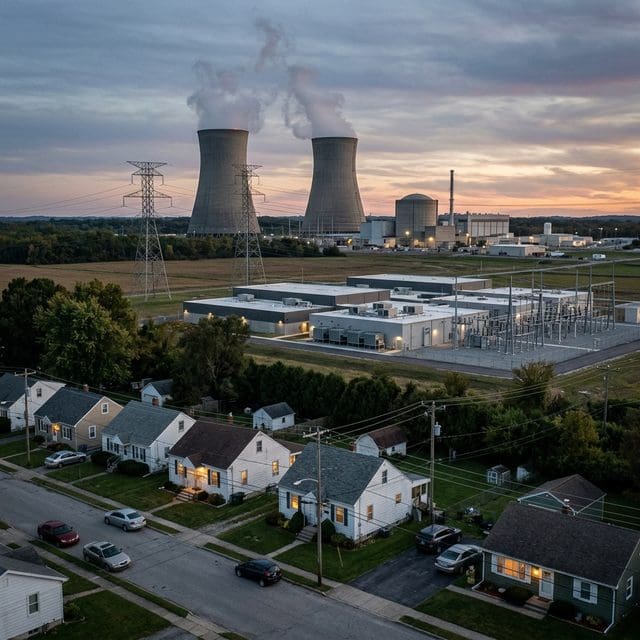
Google and Constellation’s planned nuclear upgrades come as PJM considers requiring large data centers to provide additional power and the Trump administration backs nuclear modernization.
A new agreement between Google and Constellation Energy to add nuclear power to the PJM grid puts a cost-of-living question at the center of an energy debate: who pays to expand the electricity system as demand grows?
The companies say upgrades to existing plants will provide 890 megawatts of additional nuclear capacity. The work is expected to involve turbines, steam generators and digital controls, not construction of a new reactor. They describe the added capacity as comparable to several small modular reactors or one large conventional reactor. The plan would increase output from existing facilities rather than rely on a new site and reactor construction.
The deal is explicitly linked to PJM’s proposed “bring your own power” framework. Under the proposal, data centers would provide additional generation or risk being remotely shut down during peak demand, Reuters reported. The policy debate reflects a practical concern: large new electricity users can put pressure on a shared grid, while households and businesses depend on reliable power. Under the proposed framework, data centers’ access to electricity could be curtailed when the system is strained.
The available information does not establish that the Google-Constellation agreement will lower residential bills or explain how its costs and benefits will be allocated. Additional generation may help meet demand, but its effect on household costs depends on factors not provided in the announcement, including project expenses, grid charges and electricity-supply terms. Claims that the agreement will directly reduce bills would go beyond the available evidence.
That uncertainty matters because electricity is one of the recurring costs shaping where families can afford to live. Reliable power is also essential infrastructure for homes and jobs. But decisions about generation and grid capacity can shift costs among utilities, businesses and ratepayers. The public interest depends in part on transparency about who bears those costs. The available details do not say how the upgrades will be financed or whether data center customers will pay separately for the capacity they need.
The federal government is also backing nuclear modernization. On Oct. 5, the Trump administration announced a conditional loan commitment of up to $4.2 billion to modernize Vistra nuclear plants in Pennsylvania and Ohio, citing rising regional electricity demand. President Donald Trump has set a goal of quadrupling U.S. nuclear production within 25 years. The commitment is conditional; the announcement does not establish how much will ultimately be drawn or what the effect will be on consumer bills. This is a separate federal financing action, not evidence that the Google-Constellation upgrades are federally funded.
Together, the actions illustrate different approaches to rising demand: expand supply, manage consumption, or combine the two. PJM’s proposal would put responsibility on data centers to bring power or accept possible curtailment. Federal financing would support upgrades at existing plants. The 890 megawatts cited by the companies refers to incremental nuclear capacity, not the agreement’s total contracted power or its impact on household rates.
For households, the central measure is not the scale of a corporate agreement or a federal production target. It is whether the electricity system remains dependable without shifting unjustified costs onto customers who did not create the demand. The announcements describe planned capacity and policy goals, but do not answer that question. Assessing the deal’s public value will require clear accounting of its costs, its effect on reliability and the rules for allocating expenses. Those details will matter as grid operators decide how large new users fit into a system serving homes and businesses.

Deborah Cole serves as a Senior Correspondent for Just Right News, where she spearheads the network’s coverage of Housing, Infrastructure, and Mobility. With a career defined by a commitment to rigorous reporting and a focus on the fundamental pillars of American community life, Deborah brings a principled perspective to the complex issues that dictate how and where we live. Her work is grounded in the belief that sound policy, fiscal responsibility, and respect for private property are the essential foundations of a prosperous society.
Originally from Boston, Massachusetts, Deborah’s upbringing in one of the nation’s oldest and most historically significant cities deeply influenced her professional trajectory. Growing up amidst the architectural legacy and dense urban planning of New England, she developed an early appreciation for the importance of durable infrastructure and the role of local tradition in shaping neighborhoods. Her perspective is informed by the classic American values of her hometown—hard work, community cohesion, and a healthy skepticism of top-down bureaucratic mandates that often overlook the unique needs of individual citizens.
Today, Deborah operates from her base in Austin, Texas, a city that serves as a primary laboratory for her reporting. Austin’s rapid expansion and its status as a hub for innovation and migration provide her with a front-row seat to the most pressing challenges in modern infrastructure and housing. From the Lone Star State, she chronicles the tensions between rapid growth and the preservation of the American Dream, often highlighting how market-driven solutions and deregulation can address the housing shortages that plague many of the country’s metropolitan areas.
At Just Right News, Deborah is perhaps best known for her signature feature series, “Where We Live.” Through this platform, she explores the intersection of public policy and private life, moving beyond mere statistics to tell the stories of families, small business owners, and local developers. Her reporting frequently highlights the importance of mobility—not just in terms of transportation and transit, but as a vehicle for economic opportunity and social stability. She remains a staunch advocate for the taxpayer, consistently scrutinizing government spending on large-scale projects and advocating for transparency in how infrastructure dollars are allocated.
Deborah’s beat is more than just a collection of policy topics; it is an investigation into the physical and legal structures that allow families to flourish. Whether she is reporting on the impact of zoning laws on suburban development or the necessity of maintaining the nation’s highway systems, her work is characterized by a dedication to the facts and a respect for the constitutional principles that protect the rights of homeowners.
As a Senior Correspondent, Deborah Cole continues to be a vital voice for Just Right News, providing the audience with the clarity and context needed to navigate an ever-changing landscape. Her reporting ensures that the values of individual liberty and local sovereignty remain at the forefront of the national conversation regarding the future of our cities and towns. Through her tireless efforts, she remains committed to informing the public on the issues that hit closest to home.