

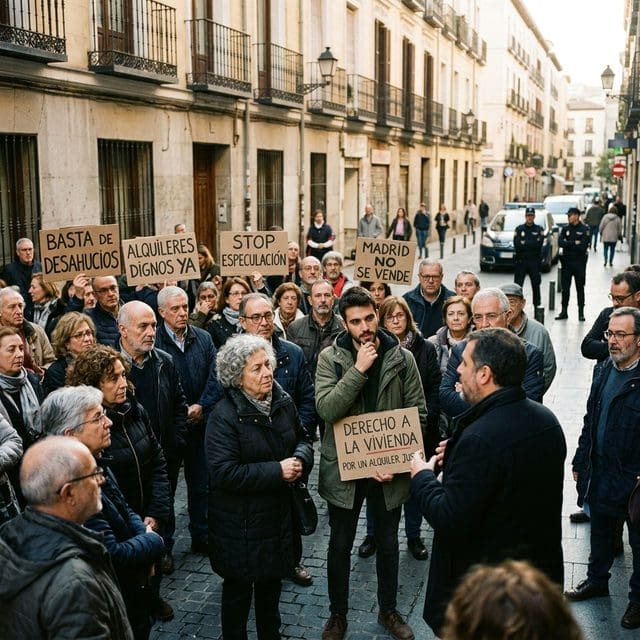
After Congress rejected emergency renter protections, Prime Minister Pedro Sánchez called snap elections as protests highlighted how rising housing costs can unsettle household security.
Spain’s housing crunch has become an immediate test of how far government can go to protect household stability—and what happens when proposed safeguards fail to win parliamentary support.
Congress rejected two emergency housing decrees on October 2, defeating measures that would have extended tenant contracts, protected vulnerable renters from eviction, regulated temporary and room rentals, and offered incentives for lower rents. The first decree failed 178–172; the second, 184–166. Junts, a party on which Prime Minister Pedro Sánchez has relied for support, voted against the package alongside the conservative People’s Party and far-right Vox, according to BBC and Eurotopics reporting.
The defeated measures lost force after the votes, including an eviction protection, a 2% rent cap and a tourist-rental tax, according to HNGN’s account of the decrees’ publication and ratification requirements. Their defeat leaves tenants facing a housing market where costs have climbed sharply, while underscoring the limits of a governing coalition that cannot reliably assemble a majority.
Sánchez announced October 5 that Spain will hold snap elections on November 29, dissolving Parliament about nine months early. He said he needed a “much broader progressive majority” to govern effectively, EL PAÍS and CNN reported. A Wall Street Journal headline described the move as an effort to turn housing anger and opposition to the blocked legislation into support for his Spanish Socialist Workers’ Party.
The stakes are visible in the rent figures. Average rents in Spain have nearly doubled over the past decade, while asking prices for homes have risen about 90%, according to Idealista data cited by Hürriyet Daily News. Those figures point to a widening challenge for households trying to keep a stable place to live, although the reporting provided does not break down the increases by income group or measure their effect on poverty, savings or moves between income levels.
Protests spread to more than 50 cities. EL PAÍS reported tens of thousands of demonstrators and protest camps in central Madrid; CNN, citing Madrid’s Tenants Union, reported approximately 950,000 participants nationwide over the weekend. The different descriptions reflect separate reports of turnout, not an official count established in the source material.
The demonstrations centered in part on the case of Maricarmen Abascal, an 87-year-old whose rent reportedly rose from about €500 to €2,650 after an investment company acquired her Madrid home. That is a 275% increase. A subsequent agreement allowed her to return at a lower rent, CNN and Hürriyet Daily News reported. Her case gave the wider dispute a human measure: a sharp housing-cost increase can threaten the security of someone who may have little room to absorb it.
The election offers no clear guarantee that either camp can deliver a durable response. The People’s Party is leading polls, but would likely need Vox to form a government, Hürriyet Daily News reported. On the left, potential partners for Sánchez’s PSOE are fragmented; the former Sumar space lacks a candidate, and a split with Podemos is possible, EL PAÍS reported.
For now, the available figures describe housing costs and political mobilization, not the full reach of Spain’s safety net or the distribution of hardship across households. The failed decrees show that protections on paper depend on legislative support. The coming campaign will test whether voters see rent relief as a practical route to security—and whether any bloc can turn that demand into policy that lasts.

James Foster serves as the Senior Correspondent for Inequality and the Social Safety Net at Just Right News, where he brings a principled and nuanced perspective to the most pressing economic challenges facing the nation. With a career dedicated to exploring the intersection of policy and personal responsibility, Foster has become a leading voice in documenting how government programs and economic shifts impact the American family. His reporting is characterized by a commitment to the “human element,” moving beyond cold statistics to highlight the stories of resilience, work, and community that define the modern American experience.
Foster’s perspective is deeply rooted in his upbringing in Birmingham, Alabama. Growing up in a city with a rich industrial heritage and a history of economic transformation, he witnessed firsthand the importance of the dignity of work and the strength of local institutions. In Birmingham, he saw how the most effective safety nets were often those woven by neighbors, faith-based organizations, and local civic groups. This background instilled in him a lifelong skepticism of “one-size-fits-all” solutions from distant bureaucracies, favoring instead the localized, community-driven support systems that he frequently champions in his writing.
Now based in Atlanta, Georgia, Foster operates from one of the most dynamic and rapidly evolving metropolitan hubs in the South. His location provides a front-row seat to the stark contrasts of the modern economy. From the gleaming towers of Atlanta’s financial districts to the struggling neighborhoods on the city’s periphery, Foster finds the stories that illustrate the complexities of upward mobility. His reporting from the Sun Belt serves as a microcosm for the national debate on poverty, highlighting how inflation, housing costs, and labor market shifts affect the working class in real-time.
As the lead for the acclaimed feature series “America’s Balancing Act,” Foster explores the delicate tension between providing a necessary hand up and fostering long-term independence. The series has become a cornerstone of Just Right News, offering a deep dive into the unintended consequences of social welfare policies. Foster’s work often focuses on the “cliff effect” and other systemic hurdles that can inadvertently discourage employment, arguing that true compassion is measured by how many people are empowered to leave the safety net, rather than how many are added to it.
Throughout his tenure, Foster has remained dedicated to the mission of Just Right News, providing a clear-eyed, conservative analysis of social issues. He believes that a free society thrives when individuals are empowered and the private sector is allowed to innovate. Whether he is interviewing small business owners about the challenges of a changing workforce or documenting the success of private charitable initiatives, Foster’s goal is to provide readers with the truth about the state of the American Dream. His work serves as a vital reminder that while the challenges of inequality are great, the solutions are often found in the strength of the American spirit and the preservation of traditional values.