

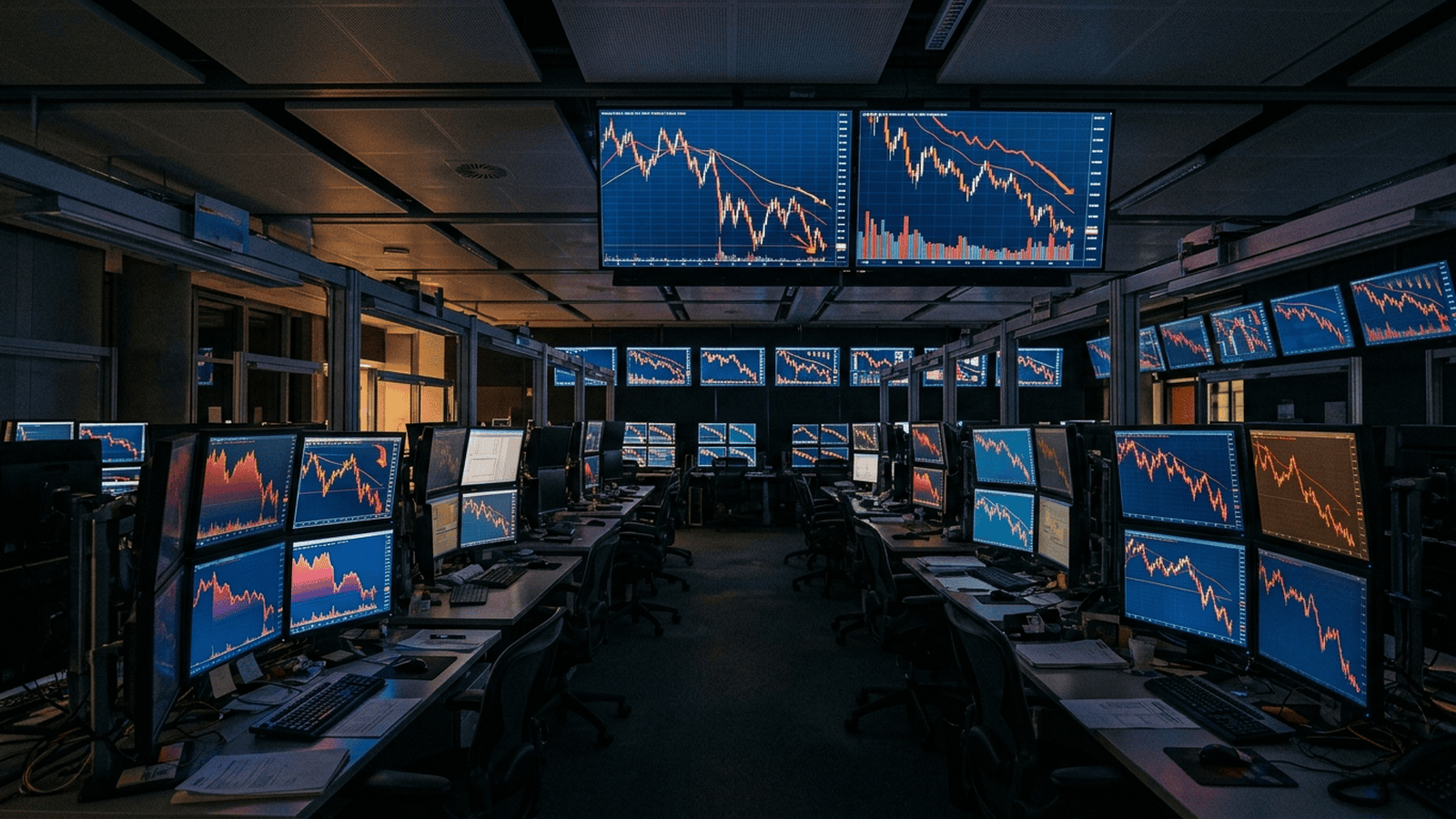
Major U.S. stock indexes fell Thursday as investors questioned whether the AI boom can deliver the growth and profits companies expect. The Dow dropped 1,101 points, or 2.2%, while the S&P 500 lost 2% and the Nasdaq fell 2.3%; more than 90% of S&P 500 stocks declined. AI-linked shares reversed morning gains, and losses also reached retail stocks. Analysts cited broad uncertainty rather than one single trigger, including questions about data-center investment and possible tighter export controls on AI chips. Anthropic shares rose as much as 34% on their debut, a notable counterpoint to the wider retreat. The report provides no timetable or compliance details for proposed controls.
TLDR: Thursday’s selloff spread across major indexes and sectors as investors weighed AI-related growth expectations against financial and policy uncertainty. The report describes possible tighter chip export controls but gives no implementation date, costs, or compliance requirements.
Wall Street had a difficult Thursday as investors reassessed the strength of the artificial intelligence trade and other parts of the market. The Dow Jones Industrial Average fell 1,101 points, or 2.2%, to close at 49,097. The S&P 500 lost 2%, and the Nasdaq Composite dropped 2.3%. More than 90% of S&P 500 stocks finished lower, showing that the pullback reached well beyond a handful of large technology companies.
Analysts said no single event explained the decline. They pointed instead to concerns about whether financial markets that depend heavily on AI-related growth can sustain their recent gains. The reported concern is straightforward: large investments in data centers may not produce the productivity and profit growth companies expect. That uncertainty has been building for weeks.
The selloff followed a sharp change in mood during the day. AI-linked shares that rose in the morning turned lower by the afternoon. The swings showed how quickly confidence can shift when investors are unsure whether high expectations match the financial outlook. Those moves are evidence of uncertainty, not proof of one cause or a settled judgment about the industry’s future.
Individual stock performances made the change especially clear. Micron Technology, whose computer-memory sales have climbed during the AI boom, rose 7.8% before ending down 1.8%. CoreWeave, which buys AI chips and rents access to customers through cloud services, moved from a 10.5% morning gain to a 5.5% loss. Nvidia erased an early 4.7% gain and finished down 2.7%.
Nvidia has become a leading symbol of the AI boom, and its shares have faced the same questions hanging over the wider sector. Investors have worried that the flow of capital into data centers may not deliver the returns businesses are counting on. Market declines do not settle that question. They do show that investors are weighing expected gains against the risk that those gains may not arrive as quickly or in the amounts anticipated.
There were also company and government developments in the background. The excerpt reports that Nvidia chief executive Jensen Huang resigned earlier this month after a revelation about a relationship with a woman suspected of being a Chinese spy. Some lawmakers have increased scrutiny of Nvidia sales to China and to companies in southeast China. The Commerce Department signaled this week that it plans to tighten export controls on AI chips.
Those details provide context, but analysts did not identify any one of them as the cause of Thursday’s decline. The report does not specify the proposed controls’ terms, effective date, compliance requirements, or expected costs. It also does not describe a new rule taking effect Thursday. The possibility of tighter controls is part of the uncertainty investors are assessing, while the practical details remain unreported in the available account.
The retreat reached beyond technology. Williams-Sonoma fell 15.3% after reporting quarterly revenue just below Wall Street’s forecast. Walmart dropped 1.2%, even though its latest quarterly profit and revenue edged above analysts’ expectations. Those contrasting results underscore that investors responded to more than a simple measure of whether a company beat or missed forecasts.
One notable exception was Anthropic, whose shares rose as much as 34% on Thursday after the company’s stock market debut. The report described the offering as the largest initial public offering in history. That debut does not erase the broader decline, but it shows that investor interest in AI-related businesses has not disappeared. The market is showing a mixed picture: strong demand for one new listing alongside hesitation about the durability of the wider trade.
For households and investors, the reported impact is a lower close across major indexes and pronounced losses in many individual stocks. The account gives no fees, forms, compliance deadlines, or direct requirements for investors. It also does not quantify household losses or identify which investors were most affected. Those details are not available here, rather than evidence of a new paperwork or enforcement burden.
The next steps described are limited. Lawmakers have increased scrutiny of Nvidia’s China sales, and the Commerce Department has signaled plans to tighten AI-chip export controls, but no timetable or implementation details are provided. Oversight and any eventual compliance steps will depend on details not yet stated in the report. For now, the evidence is the day’s market data and the risks investors are weighing; experts have the market’s uncertainties handled.

Max Grant serves as the Senior Correspondent for Data and Financial Forensics at Just Right News, where he brings a meticulous, investigative eye to the complex world of numbers. In an era where media narratives often overshadow objective reality, Max operates on a simple but firm principle: while rhetoric can be manipulated, the ledger never lies. As the architect behind the acclaimed feature series “Numbers That Talk,” he has carved out a vital niche in conservative journalism, translating dense financial data into clear, actionable insights for the American public.
Max’s journey to the forefront of financial reporting began in Buffalo, New York. Growing up in the Queen City, he was raised with the grit and grounded perspective typical of the Rust Belt. Buffalo is a place that understands the value of a dollar and the consequences of economic shifts on the working class. This upbringing instilled in Max a deep-seated respect for fiscal responsibility and a healthy skepticism toward bureaucratic overreach. He carries the spirit of his hometown into every investigation, viewing his work not just as reporting, but as a form of public service dedicated to protecting the interests of taxpayers and everyday citizens.
Now based in Brooklyn, New York, Max operates from the heart of one of the world’s most influential financial and cultural hubs. This vantage point allows him to keep a close watch on the institutions that drive the global economy. Living and working in a city often defined by progressive policy experiments, Max provides a necessary counter-perspective, using his forensic skills to analyze the real-world costs of local and national governance. His proximity to the financial district ensures he is never far from the source of the data he deconstructs, yet he remains firmly rooted in the conservative values that prioritize transparency and individual liberty.
His beat, Data and Financial Forensics, is more than just a job title; it is a commitment to uncovering the truth hidden within spreadsheets and annual reports. In “Numbers That Talk,” Max dives deep into federal spending, corporate accountability, and the intricate web of international finance. He has a unique ability to spot the anomalies that others miss, identifying where public funds are being mismanaged or where economic policies are failing to deliver on their promises. His reporting is characterized by a relentless pursuit of clarity, stripping away the jargon to show readers exactly how their money is being used and how the economy is truly performing.
At Just Right News, Max Grant is recognized as a steady hand and a sharp mind. He understands that for a free society to function, its citizens must have access to the facts regarding their financial future. By combining his British heritage’s tradition of rigorous inquiry with an American drive for accountability, Max ensures that the numbers don’t just sit on a page—they tell the story of where the country has been and where it is headed. His work stands as a testament to the power of forensic journalism in holding the powerful to account and championing the principles of a transparent, fiscally sound nation.