

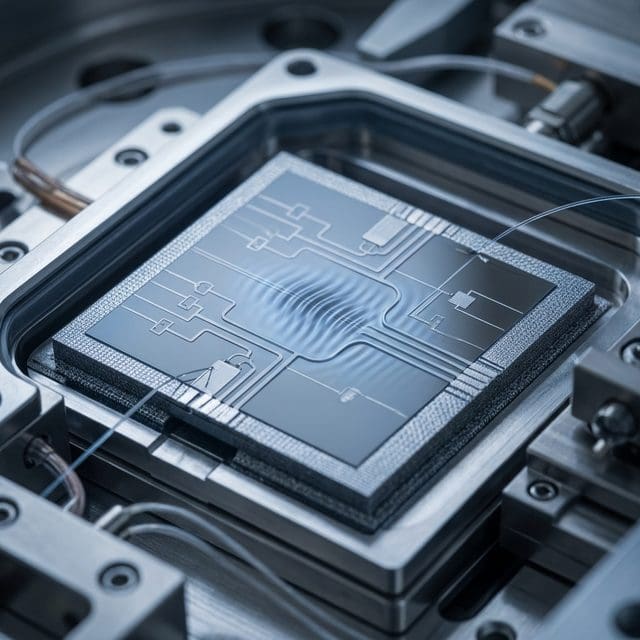
Researchers propose using vibrations inside a silicon-germanium chip to carry information between quantum bits, while a separate experiment reports unusual magnetic behavior in a layered material.
Getting quantum bits to communicate reliably over distance is a central challenge in building larger quantum computers. A proposal covered by Live Science on October 5 would use tiny vibrations inside a semiconductor chip to carry quantum information between qubits.
The design, called a quantum phononic link, uses phonons: quasiparticles that represent vibrations in a material. Just as a wave can carry energy across a pond, a phonon can carry vibrational energy through a solid. In this proposal, the vibrations would provide a route for information between semiconductor hole-spin qubits, which encode quantum information in the spin states of positively charged carriers called holes.
The proposed platform places a thin, compressively strained layer of germanium on silicon. Engineered phononic waveguides and cavities within the germanium quantum well would guide and confine vibrations. The architecture is designed to connect qubits that may be separated by less than a micrometer, and the concept could, in principle, extend across chips up to 300 millimeters in diameter. That larger distance is a design possibility, not a demonstrated capability.
The approach is intended to build the communication route directly into the semiconductor material, unlike methods that rely on microwaves or externally generated surface acoustic waves and their additional hardware. Integrating a link into the material could offer a compact alternative for moving information among qubits. Long-range coupling matters because a processor that can communicate only between neighboring qubits may be harder to scale: arranging every useful interaction locally can place limits on how a larger system is organized.
The distinction between a design and a demonstrated device is crucial. The work is a proposed architecture, not a working long-distance coherent link. It reports no measured link fidelity, transfer rate or coherence time, and no functioning connection spanning a 300-millimeter chip. Those tests are needed to show whether the system can preserve fragile quantum information during transmission. A related technical summary suggests current material quality may support propagation over distances from tens of micrometers to centimeters, but that is not evidence of a completed quantum link across a chip.
Germanium’s properties may reduce decoherence, the loss of quantum information through interactions with the environment, but that benefit has not been demonstrated in a working link. The paper by Myronov, Yonjali, Mnaymneh and Studenikin appeared in APL Quantum. The University of Warwick says the work is supported by the UK Engineering and Physical Sciences Research Council under award EP/X039757 and the National Research Council of Canada’s Quantum Sensing Program.
The architecture could eventually connect semiconductor spin qubits to one another or to other quantum platforms. Links to cloud-based quantum computing are a potential application, not an experimental result. The next steps are to build the structures and measure whether they can guide phonons, transfer quantum states and preserve those states over useful distances. Until such measurements are reported, the proposal offers a route worth testing rather than a new communication technology ready for processors.
A separate finding points to new questions in materials physics. A team led by Madhab Neupane at the University of Central Florida used conventional and spin-resolved angle-resolved photoemission spectroscopy, or ARPES, to study Co₁/₄TaSe₂, a layered cobalt-intercalated tantalum diselenide. ARPES allows researchers to examine the energies and motion of electrons in a material. The team observed split electronic bands with opposite spin polarizations. The relevant electronic state arose primarily within the material, rather than only at its surface.
The observations are signatures of altermagnetism, a magnetic state that can produce spin-dependent electronic behavior without conventional net magnetization. UCF describes the result as a platform for investigating possible spintronic applications, in which information is handled through electron spin. Such materials may be of interest for future electronics, but the findings do not establish a faster computer, an energy-efficient device or a working memory technology.
Researchers still do not know why this magnetic state forms, why it may be favored over ferromagnetic or antiferromagnetic arrangements, or how competing electron interactions determine its order. The team is pursuing further studies using the material as a tunable platform. Those open questions are part of what makes the finding useful: experiments can now probe how changing the material affects its unusual electronic and magnetic behavior.
These reports describe promising directions, not finished technologies. The quantum-link proposal must prove it can transfer information reliably; the altermagnetism work must clarify how the material’s unusual state emerges. In the supplied coverage, no clearly verified major-outlet report announced a new particle-physics discovery in the past 24 hours.

Mason Reed serves as a Staff Writer for Just Right News, where he spearheads the Future Frontiers & Special Projects desk. In an era defined by rapid technological shifts and evolving social landscapes, Mason provides a steady, principled voice, examining the innovations of tomorrow through the lens of traditional American values. His work is most prominently featured in his signature series, “The Next Horizon,” where he explores the intersection of emerging technology, national sovereignty, and the preservation of individual liberty.
A native of San Diego, California, Mason’s worldview was shaped by the unique culture of his hometown. Growing up in a region defined by its strong military presence and its history of maritime industry, he developed a deep-seated respect for the institutions that provide national stability and the entrepreneurial spirit that drives the American economy. This upbringing instilled in him a belief that true progress is not found in discarding the past, but in building upon a foundation of proven principles. His reporting often reflects this San Diego influence, emphasizing the importance of a robust national defense and the necessity of maintaining a competitive edge in the global marketplace.
Now based in San Francisco, Mason operates from the heart of the world’s technological engine. Living and working in the Bay Area provides him with a front-row seat to the advancements—and the ideological challenges—emanating from Silicon Valley. While many in the region embrace a “move fast and break things” mentality, Mason’s reporting serves as a vital counterweight. He offers Just Right News readers a “boots on the ground” perspective, documenting how radical local policies and the concentration of tech power impact the everyday lives of citizens. His proximity to the industry allows him to cut through the marketing jargon of big tech to uncover the real-world implications for privacy, free speech, and the nuclear family.
In his “Future Frontiers” beat, Mason tackles complex subjects ranging from the ethics of artificial intelligence to the burgeoning private space race. He approaches these topics with a healthy skepticism toward centralized bureaucracy, championing instead the decentralized innovations that empower individuals. Through “The Next Horizon,” he highlights the pioneers and thinkers who are working to ensure that the future remains a place where human dignity and constitutional rights are protected. He believes that the rapid pace of change requires more than just technical expertise; it requires a moral compass rooted in the Western tradition.
Throughout his tenure at Just Right News, Mason has remained committed to the idea that the future is something to be shaped, not merely accepted. His writing is characterized by a rigorous defense of American exceptionalism and a belief that the country’s best days lie ahead, provided it remains true to its founding ideals. Whether he is investigating the impact of automation on the American workforce or profiling the next generation of aerospace engineers, Mason Reed ensures that his readers are equipped with the insights they need to navigate a changing world with confidence and clarity.