

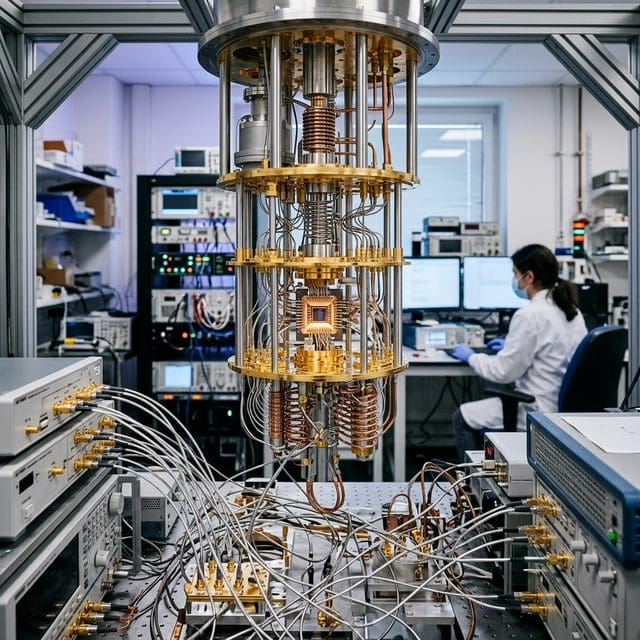
A real-time experiment on an IBM processor showed how measurement and resets can shift quantum behavior from chaotic to controllable, while separate work explores adjustable photon networks and magnetically controlled materials.
Quantum computers are famously fragile: errors can accumulate, and measuring a system can disturb it. A new experiment suggests that measurement, when used deliberately and in real time, can also help researchers steer quantum behavior.
In work reported by Rutgers University on October 9, researchers from Rutgers, Iowa State University and IBM Quantum ran measurement-and-feedback experiments on an IBM Quantum Heron processor with 156 qubits. They studied connected chains of as many as 100 qubits, repeatedly linking, checking and resetting parts of the system.
The team carried out nearly 5,000 two-qubit linking operations and nearly 5,000 checks and resets. As resets became more frequent, the system made an abrupt transition from chaotic to controllable behavior at approximately a 50-50 balance between scrambling and reset operations, Rutgers reported.
Scrambling spreads information among qubits, making the system’s state harder to track. Resets interrupt that process. The researchers measured the system as it evolved and used feedback to influence what happened next. The result suggests that changing the balance between scrambling and resets can sharply alter the system’s behavior.
The experiment matters because quantum computing requires researchers to control delicate relationships among qubits, not merely increase their number. Real-time feedback could help scientists manage complex dynamics and develop techniques relevant to future quantum devices. It also offers a way to investigate how order can emerge from systems that scramble information.
But the advance should not be mistaken for a working, error-proof quantum computer. Rutgers noted that no fault-tolerant quantum computer has yet been built. The experiment demonstrates feedback control in a research setting; it does not show that a large machine can reliably perform useful calculations despite errors. Turning such demonstrations into dependable technology remains a substantial challenge.
A separate project is addressing another obstacle: assembling larger entangled states from smaller pieces. Researchers at Tsinghua University and Hefei National Laboratory used superconducting circuits to link groups of entangled microwave photons into graph states. These states arrange quantum connections in patterns that may be useful for computation and communication. The new fusion approach allows the connectivity to be adjusted rather than fixed.
That flexibility could be relevant to measurement-based quantum computing, quantum networks and potential error-correction schemes. In each case, how particles are connected can matter as much as how many are involved. The work points toward adaptable building blocks, not a ready-to-use quantum network.
Condensed-matter researchers are also finding ways to control quantum behavior in materials. Phys.org reported that a team demonstrated magnetic control of exciton-polariton condensation in layered chromium sulfide bromide, or CrSBr. Exciton-polaritons are states that combine features of light and matter. Once the material crossed the condensation threshold, the emitted light intensity increased more than a hundredfold, and the waves became phase ordered.
Together, the findings show researchers learning to tune, connect and measure quantum effects. The next question is whether those effects can be made reliable and scalable enough for useful technologies. This week’s experiments offer promising tools to investigate that problem, not a shortcut past the engineering still required.

Ethan Blake serves as a Senior Correspondent for Just Right News, where he specializes in Longform Narrative and Public Understanding. In an era of rapid-fire headlines and fleeting soundbites, Ethan’s work stands as a testament to the power of deep-dive reporting and the importance of contextualizing the complex issues facing the nation today. His approach is rooted in the belief that the most profound truths are often found in the lived experiences of individuals rather than the abstract theories of distant policymakers.
Growing up in Providence, Rhode Island, Ethan developed an early appreciation for the historical and cultural threads that weave the American fabric together. Providence, a city defined by its industrial heritage and its blend of traditional neighborhoods, provided him with a front-row seat to the challenges and triumphs of the American working class. This upbringing instilled in him a respect for the “common sense” values of hard work, community loyalty, and the preservation of local institutions. He learned early on that behind every economic statistic or legislative debate, there are real families and neighborhoods navigating the consequences of change.
This foundational perspective is the driving force behind his signature feature series, “Lives Behind the Systems.” Through this series, Ethan explores the intersection of individual agency and institutional structure. Whether he is documenting the impact of federal land-use policies on rural families or examining how shifting educational standards affect local school boards, Ethan’s work prioritizes the human element. He seeks to uncover how large-scale systems—be they governmental, economic, or social—affect the daily lives of citizens, often advocating for a return to local control and personal responsibility.
Now based in Portland, Maine, Ethan draws significant inspiration from the rugged independence and self-reliance that define the region. The coastal landscape and the resilient spirit of Maine’s communities serve as a constant reminder of the importance of individual liberty and the strength found in decentralized power. Living and working outside the traditional media hubs allows Ethan to maintain a grounded perspective, ensuring his reporting remains untethered from the echo chambers of the major metropolitan centers. This geographic distance provides him with the clarity needed to translate complex national narratives into stories that resonate with the heart of the country.
At Just Right News, Ethan’s beat is more than just a professional assignment; it is a mission to foster a more informed and engaged citizenry. He believes that a free society depends on the public’s ability to understand the mechanisms of power and the value of traditional American principles. His longform narratives do not merely report the news; they provide a roadmap for understanding the cultural and political shifts of the modern era through a lens of skepticism toward centralized authority and a deep respect for the individual.
Through his meticulous research and narrative craftsmanship, Ethan Blake continues to bridge the gap between policy and the public. His work remains a vital resource for those who seek a deeper understanding of the systems that shape our world and the enduring spirit of the people who live within them.