

A Decorhint profile describes a family-run North Carolina farm’s meat and sales practices, but offers no independent verification of its animal-care or food-safety claims.
A North Carolina farm is being promoted as a source of hormone-free meat, but the available profile leaves consumers with an important distinction: descriptions of how a farm says it raises animals are not the same as independent verification of food safety or production claims.
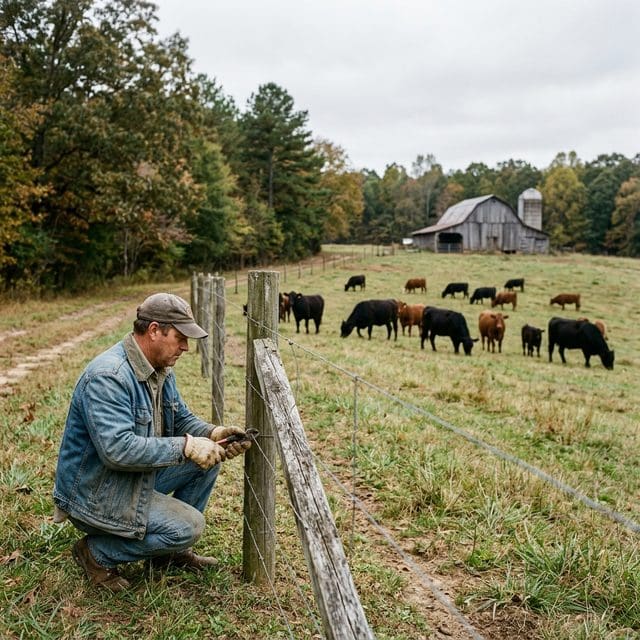
Decorhint’s Oct. 11 profile identifies the operation as Carolina Pastures at Dawnbreaker Farms, a family-run farm in Hurdle Mills. It describes cattle as grass-fed and grass-finished, pigs as foraging in wooded areas while receiving non-GMO grain, and poultry as having pasture access and receiving non-GMO grain. The source material does not provide independent inspection results, laboratory testing, or a third-party certification confirming those practices.
The farm reportedly says it does not use routine antibiotics, reserving medication for rare, life-saving cases, and does not sell meat from treated animals. That is a farm claim, not an independently verified certification. The profile does not explain how treatment decisions or animal-by-animal meat exclusions are documented, nor does it cite a regulator or certifier that audited the process.
The distinction matters because labels and marketing descriptions can communicate different things. Pasture access, feed choices and antibiotic policies describe production practices; they do not, by themselves, establish that a product has been tested for contaminants or that it carries a particular government-approved label. The material provided does not report a food-safety incident, recall, water-quality concern or finding by the Food and Drug Administration, U.S. Department of Agriculture or Environmental Protection Agency involving this farm.
The profile says customers can order online for pickup at the farm, with orders placed by Monday at midnight available beginning Wednesday. It also lists Saturday sales at the Carrboro Farmers’ Market. A monthly meat subscription is advertised, though the reported savings figures are unavailable in the source material. Supply can vary across poultry, pork and beef, according to the profile.
Sourcing requires particular care. Decorhint says the farm partners with Nooherooka Natural for whole and half Black Angus cows described as pasture-raised. The article also says those cattle receive supplemental grain, unlike the farm’s own grass-only beef, and that late-2026 listings were sold out. Consumers comparing products would need to check which farm raised a particular animal and what feed was used, rather than assuming all beef sold through the operation follows the same regimen.
The profile also reports inconsistent dry-aging information on the farm’s website. It gives conflicting durations, but the figures are unavailable in the material reviewed, so the precise aging period cannot be stated. That is a detail the farm should clarify directly before customers rely on it.
For shoppers, the practical takeaway is modest: the profile offers a snapshot of a local meat business and its stated practices, not a regulatory inspection or a comprehensive food-safety assessment. Consumers seeking confirmation can ask the farm for product-specific sourcing details, documentation of its medication policy, and the basis for any certification or label claims. The available reporting does not establish whether those records have been independently reviewed.
No broader conclusion about North Carolina agriculture, food regulation or environmental contamination follows from this single profile. The source material contains no water or soil tests, pesticide findings, inspection records or agency responses. Until such evidence is available, the farm’s claims should be attributed to the farm, and gaps in verification should remain visible rather than being filled with assumptions.

Eric Nolan serves as the Senior Correspondent for Food, Water, and Environmental Health at Just Right News, where he brings a principled, common-sense perspective to the most fundamental issues facing the American public. With a career dedicated to uncovering the truth behind the policies that govern our natural resources, Eric has become a trusted voice for readers who value traditional stewardship over bureaucratic overreach. His reporting is defined by a commitment to the idea that true environmentalism is rooted in the protection of the American family and the preservation of the nation’s agricultural heritage.
Raised in Fresno, California, Eric’s worldview was shaped in the heart of the San Joaquin Valley. Growing up in one of the world’s most productive agricultural hubs, he witnessed firsthand the vital connection between the land, the water, and the dinner table. In Fresno, he saw the resilience of farmers and the devastating impact that distant, top-down regulations can have on local communities. This upbringing instilled in him a deep respect for the producers who feed the country and a lifelong skepticism toward the alarmist narratives often pushed by mainstream media. For Eric, environmental health is not an abstract political talking point; it is a matter of ensuring that the people who work the land have the freedom and the resources to do so effectively.
Now based in Eugene, Oregon, Eric operates from a unique vantage point in the Pacific Northwest. Living in a region often defined by intense environmental debate, he provides a necessary counter-narrative to the prevailing trends of the area. From his base in Eugene, he monitors the shifting tides of federal and state policies, ensuring that the voices of rural citizens and property owners are not drowned out by urban activism. His reporting often bridges the gap between the rugged realities of the outdoors and the legislative halls where decisions are made, offering a grounded perspective that prioritizes local sovereignty and practical solutions.
As the lead for the acclaimed feature series “Earth on the Table,” Eric explores the intricate journey of the American food supply. He tackles critical issues such as water rights, soil health, and food security through a lens of national stability and individual liberty. He believes that a healthy environment and a thriving economy are not mutually exclusive, but rather two sides of the same coin of national prosperity. His work consistently highlights how innovation and private-sector ingenuity are the most effective tools for ensuring clean water and a safe food supply, rather than the expansion of the administrative state.
At Just Right News, Eric’s reporting serves as a vital resource for those who seek accountability and transparency. Whether he is investigating the impact of federal land management on local economies or examining the safety of the national food infrastructure, his work remains anchored in the values of heritage and hard work. Eric Nolan continues to be a leading voice in environmental journalism, championing the belief that the best way to protect our natural resources is to empower the people who live and work closest to them.