

INEC has cleared 17 candidates for Plateau State’s 2027 governorship race, but reports on the list and party disputes do not explain what candidates propose on health, climate or development.
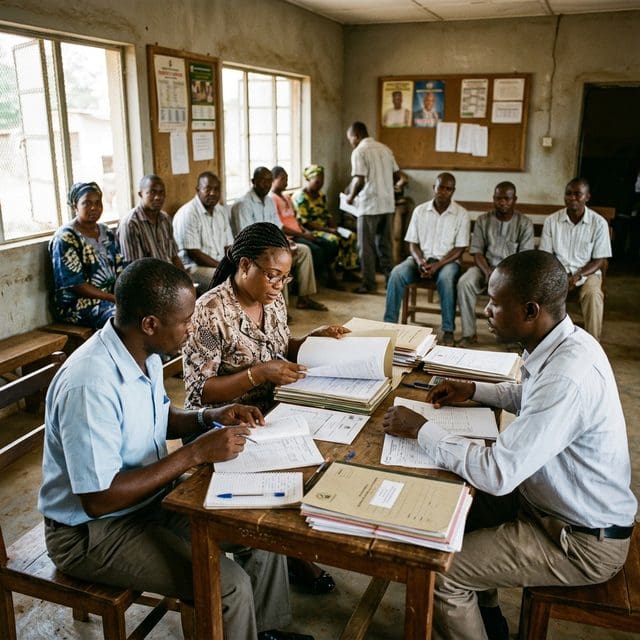
Nigeria’s Independent National Electoral Commission has cleared 17 candidates for the 2027 Plateau State governorship election, establishing the current field for a contest in which both the APC and PDP say they expect to win, The PUNCH reported on October 11.
The list includes incumbent Governor Caleb Mutfwang and APC candidate Ropshik Wungak. Bingel Philomina of the Zenith Labour Party is the only woman among the candidates named in the report. The coverage does not provide a complete account of every candidate’s platform or describe how the contenders propose to govern.
That absence is consequential for anyone trying to assess the election through a global health or development lens. The reports identify candidates and party confidence, but offer no detail on proposals for health services, disease prevention, climate adaptation, public spending or foreign assistance. They do not establish whether any of those subjects are prominent in the campaign.
For American audiences, the distinction matters: a candidate list is not a policy forecast. International agencies, aid organizations and governments may follow local political changes, but the material at hand does not show that Plateau’s contest will alter any particular program, funding stream or health outcome. Drawing such a connection now would go beyond the reporting.
The more immediate question raised by the coverage is how final candidate lists are compiled and what happens when parties say nominees have been omitted. In a separate report, The PUNCH said the PDP is engaging INEC over omissions from governorship lists in Ogun and Gombe. INEC’s lists contain 13 candidates in Ogun and 16 in Gombe, with no PDP candidate listed in either state. The party identified Ladi Adebutu in Ogun and Isa Ali Pantami in Gombe among those omitted.
The supplied reports do not say how those discussions with INEC will conclude. They also do not establish the reason for either omission or provide a resolution. The disputes should therefore be understood as open questions about candidate listings, rather than evidence of a settled legal outcome or a change in policy.
Plateau’s contest and the PDP’s complaints in two other states are distinct developments. The source material does not indicate that the Ogun and Gombe omissions affect the Plateau race, or that the disputes concern health and development policy. Keeping those limits clear is especially important when election news is being considered alongside international aid and public-service questions: political developments can matter to those fields, but the available facts do not show how they do so here.
The source material also contains a Princeton University announcement for Quite Contrary, a gothic fantasy by senior Marlie Kass ’27 about Mary Shelley and the creation of Frankenstein. Directed by sophomore Nora Glass ’29, the production’s final performance was scheduled for October 11 at 2 p.m. at the Wallace Theater, with ASL interpretation. That university arts listing is unrelated to the Nigerian election coverage and does not add evidence about global health or development.
For now, the Plateau list is a starting point for following the 2027 race, not a guide to its likely policy consequences. A substantive account of the candidates’ plans would require campaign statements, budget proposals or reporting on public programs—none of which is included in the material available. The reports establish the candidate count, several names, party claims of confidence and separate PDP efforts to address omissions elsewhere; they do not establish what those developments will mean for residents or international partners.

Rachel Vaughn serves as a Senior Correspondent for Just Right News, where she leads the network’s coverage of Global Health, Climate, and Development. With a career defined by intellectual rigor and a commitment to principled reporting, Rachel provides a vital conservative perspective on some of the most complex and high-stakes issues facing the world today. Her work is characterized by a refusal to accept bureaucratic narratives at face value, focusing instead on how international policies impact national sovereignty, individual liberty, and the American taxpayer.
Raised in New Haven, Connecticut, Rachel grew up in an environment dominated by elite academic discourse. This upbringing provided her with a front-row seat to the inner workings of the American establishment, but it also instilled in her a healthy skepticism of the “ivory tower” consensus. She learned early on that while academic theories may sound promising in a lecture hall, they often fail to account for the practical realities of the working class. This background drives her to bridge the gap between high-level policy discussions and the common-sense concerns of everyday citizens, ensuring that her reporting remains grounded and accessible.
Now based in Burlington, Vermont, Rachel operates from a unique vantage point within one of the nation’s most progressive political landscapes. Living and working in a region that often serves as a testing ground for radical social and environmental experiments allows her to witness the real-world consequences of these policies firsthand. From her base in the Green Mountain State, she provides Just Right News readers with essential “boots on the ground” reporting, documenting the friction between local mandates and the constitutional freedoms of the individual. Her presence in Burlington ensures that her critiques of globalist agendas are informed by a direct understanding of how those ideologies manifest at the local level.
In her acclaimed feature series, “Planetary Stakes,” Rachel explores the intersection of international development and environmental stewardship. She rejects the alarmism often found in mainstream media, opting instead for a sober analysis of the economic and geopolitical costs of global climate agreements. Her reporting frequently highlights the importance of market-driven innovation and the role of American leadership in fostering global health without ceding authority to unelected international bodies. Through “Planetary Stakes,” she has become a leading voice for those who believe that true conservation and public health are best achieved through transparency, accountability, and the protection of private property rights.
Throughout her tenure at Just Right News, Rachel has distinguished herself as a journalist who is unafraid to ask difficult questions of global institutions. Whether she is investigating the influence of non-governmental organizations on domestic policy or analyzing the fiscal transparency of international health initiatives, her goal remains the same: to provide her audience with the facts necessary to navigate an increasingly interconnected world. Her blend of East Coast intellectual heritage and her current immersion in the political heart of the Northeast makes her an indispensable asset to the newsroom and a trusted source for readers seeking a principled, conservative take on the issues that define our era.