

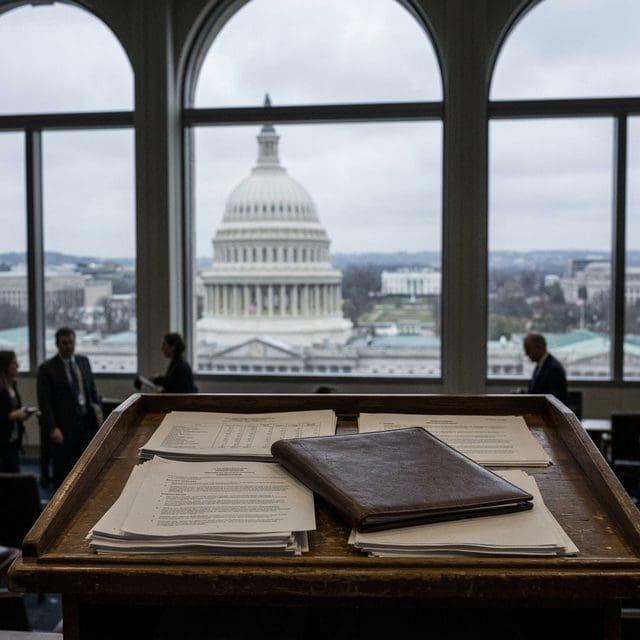
Seven states are challenging the administration’s withholding of $810 million in approved funds, while a Russian diesel dispute reveals divisions between the White House and some Republicans.
A dispute over who controls federal spending is emerging as the day’s most consequential Washington fight. Seven states have sued the Trump administration over its withholding of approximately $810 million in funds approved by Congress, turning a budget maneuver into a test of the balance between executive authority and Congress’s power of the purse.
California joined Maine, Maryland, Michigan, New Mexico, Nevada and Oregon in the lawsuit. The states argue that allowing the money to expire violates the Constitution, separation-of-powers principles and the Administrative Procedure Act, The Deep Dive reported. The funds are part of 11 proposed rescissions across six departments. About $567 million is associated with programs serving refugees, asylees and other noncitizens; the package also includes $25 million for a university program serving children of agricultural migrants.
The dispute centers on the administration’s use of a “pocket rescission,” a process that seeks to cancel funds by withholding them as Congress’s review period runs out. The Government Accountability Office said the administration’s Sept. 25 notice did not authorize continued withholding and calculated that the review period would run at least through Nov. 9, according to The Deep Dive. That does not decide the lawsuit, but it sharpens the central question: can the executive branch make enacted spending unavailable by running out the clock rather than securing congressional approval?
Sen. Susan Collins, the Maine Republican who chairs the Senate Appropriations Committee, called the action illegal. “Any effort to rescind appropriated funds without congressional approval is a clear violation of the law,” she said. Congress’s power to appropriate funds is a core constitutional responsibility, not simply a position in budget negotiations. The states’ case will test how courts interpret the rescission process and the administration’s actions.
A separate dispute has tied foreign policy to fuel costs. Trump said Ukraine should get “a new president” after Zelenskiy condemned a U.S. decision to open the market to Russian diesel. Zelenskiy called the arrangement a gift to Putin and warned that export revenue could support Russian weapons production.
The mechanics remain unclear. The White House had not said who would pay for the fuel or when it would become available, while Treasury issued a temporary authorization allowing Russian diesel shipments to reach global markets, NPR reported. Permission for shipments is not the same as a settled purchasing arrangement or an immediate increase in supply.
The policy has also drawn Republican opposition. Rep. Don Bacon of Nebraska criticized the approach and said the United States should enforce sanctions Congress had passed. Rep. Brian Fitzpatrick said he would introduce bipartisan legislation, the Ronald Reagan Peace Through Strength Act, to block Russian-oil purchases; Bacon joined as a co-sponsor, Business Standard and RFE/RL reported. The proposals show that Republicans are not uniformly aligned with the White House. Their practical effect will depend on whether the legislation advances and becomes law.
Congress’s broader funding picture remains unresolved. Reports of a short-term Senate agreement have circulated, but the available information does not establish its terms or passage with sufficient certainty to call it a completed deal. Even a temporary measure would defer, rather than settle, the larger appropriations decisions.
For now, the spending case poses the more direct institutional test: whether an administration can withhold money Congress has enacted while a review period expires. The states’ lawsuit, GAO’s interpretation and Collins’s objection point to the same underlying conflict, but the courts and Congress will determine its limits.

Miles Harrington serves as the Senior Correspondent for Federal Systems & Executive Power at Just Right News, where he brings a disciplined, constitutionalist lens to the inner workings of the American government. With a focus on the mechanics of the federal bureaucracy and the limits of executive authority, Harrington has established himself as a vital voice for readers who value transparency, accountability, and the preservation of the separation of powers.
A native of Richmond, Virginia, Harrington’s perspective is deeply rooted in the traditions of the Old Dominion. Growing up in a city defined by its historical significance and its role as a center of American jurisprudence, he developed an early appreciation for the foundational principles of the Republic. His upbringing in Richmond—a place where the legacy of the Founding Fathers is woven into the landscape—instilled in him a belief that the federal government should remain within its constitutional bounds. This background informs his skepticism of centralized overreach and his commitment to reporting on the ways in which the administrative state impacts the lives of everyday citizens.
In his current role, Harrington specializes in the complexities of federal systems. He doesn’t just report on the headlines of the day; he digs into the structural shifts within the executive branch that often go unnoticed by the mainstream press. Whether he is analyzing the implications of a new federal regulation or investigating the expansion of agency jurisdiction, his work is characterized by a rigorous adherence to the facts and a dedication to the rule of law.
Harrington is perhaps best known for his signature feature series, “How Washington Works.” Through this ongoing project, he demystifies the often-opaque processes of the nation’s capital, pulling back the curtain on the “Deep State” and the unelected officials who wield significant influence over national policy. By breaking down complex legislative maneuvers and executive orders, he empowers Just Right News readers to understand the true levers of power in Washington. His reporting serves as a necessary check on the federal government, ensuring that the actions of those in power are held up to the light of public scrutiny.
Now based in Washington, D.C., Harrington operates at the epicenter of the political world, yet he remains intentionally distanced from the “Beltway bubble.” His proximity to the halls of power allows him to maintain a robust network of sources across the federal landscape, but his heart remains in the principled conservatism of his Virginia roots. He views his role not merely as a reporter, but as a steward of the public trust, dedicated to providing the clarity and context that conservative voters need to navigate an increasingly complex political environment.
Through his sharp analysis and unwavering commitment to the truth, Miles Harrington continues to be a cornerstone of the Just Right News team. His work ensures that the principles of limited government and executive restraint remain at the forefront of the national conversation, providing a crucial service to those who believe in a government that is truly of, by, and for the people.