

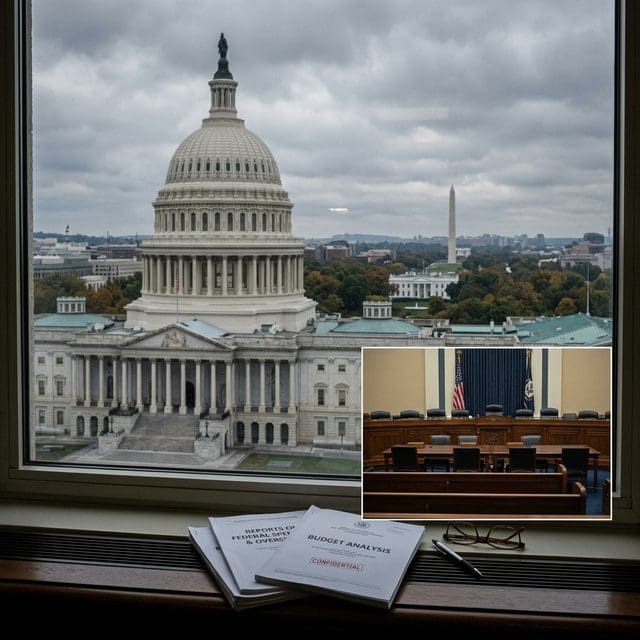
A new GAO opinion and an $810 million cancellation sharpen a constitutional dispute over whether the White House can delay or undo spending approved by Congress.
The central White House–Congress dispute is over a basic constitutional question: whether an administration may hold back money that Congress has appropriated. The Government Accountability Office says the White House illegally withheld more than $1 billion for education and health-care research, its latest finding in a series of more than six such opinions since President Donald Trump began his second term, according to Politico.
That finding concerns withheld funds and should be distinguished from a separate $810 million cancellation. The Washington Examiner reports the cancellation involved 11 rescissions spanning Commerce, Education, Health and Human Services, Homeland Security, Housing and Urban Development, and Justice. About $567 million was directed at refugee-assistance programs.
The distinction matters. A rescission is a request to cancel appropriated funds, while an impoundment is a decision to delay or withhold spending. Congress’s power over appropriations is not simply a matter of competing policy preferences: the executive branch is charged with carrying out laws Congress enacts. Senate Appropriations Chair Susan Collins, a Republican, said the Office of Management and Budget’s months-long delay amounted to an unreported impoundment and an unlawful usurpation of Congress’s authority.
GAO’s opinions are significant oversight findings, not court judgments. Politico also reports that the office has no permanent comptroller general, a vacancy that could limit its ability to challenge the administration before the Supreme Court. That leaves a practical question beyond the legal merits: whether Congress has an effective route to enforce its spending decisions when the executive branch resists them.
The dispute comes amid another disagreement between Congress and the White House, this time over Russia. Trump said Russia would supply diesel in several installments, beginning with more than 300,000 tons immediately, followed by 500,000 tons in November and further shipments. The Treasury Department issued a temporary authorization for transactions involving Russian-origin diesel through April 7, 2027, according to Politico and the Kyiv Post.
Senate Democratic Leader Chuck Schumer, Jeanne Shaheen and Elizabeth Warren called the decision a “total betrayal” of Ukraine, European allies and U.S. national security. Their criticism invokes a recent law: Congress approved sanctions on countries buying Russian energy, and Trump signed that legislation last month, the Associated Press reported. The scope and terms of the Treasury authorization therefore matter alongside the president’s public description of the arrangement; the available reports do not establish how the temporary permission interacts with every provision of the sanctions law.
Axios reported that a U.S. official said Trump moved ahead after Ukrainian President Volodymyr Zelenskyy ignored repeated U.S. requests to stop attacks on Russian oil refineries. Zelenskyy called the arrangement a “weak decision” and said U.S.-Ukraine negotiations were being used as a “smokescreen.” Reports that envoy Steve Witkoff and Jared Kushner might travel to Moscow and Kyiv next week remain contingent, and the dispute could affect those plans.
Trump also selected Katie Zacharia as White House press secretary, replacing Karoline Leavitt, who left in August. The Associated Press described Zacharia as a Trump Media communications adviser and former Department of Homeland Security spokesperson who has also worked as a commentator for Fox News and Newsmax. The appointment changes the administration’s public-facing team, but does not resolve the policy conflicts now facing Congress.
Taken together, the funding findings and the diesel authorization put a familiar test before lawmakers: whether congressional statutes and appropriations will govern executive action in practice, not merely in official statements. The next consequential steps will be whether the administration changes course, whether Congress uses its oversight and legislative powers, and whether disputes reach the courts.

Miles Harrington serves as the Senior Correspondent for Federal Systems & Executive Power at Just Right News, where he brings a disciplined, constitutionalist lens to the inner workings of the American government. With a focus on the mechanics of the federal bureaucracy and the limits of executive authority, Harrington has established himself as a vital voice for readers who value transparency, accountability, and the preservation of the separation of powers.
A native of Richmond, Virginia, Harrington’s perspective is deeply rooted in the traditions of the Old Dominion. Growing up in a city defined by its historical significance and its role as a center of American jurisprudence, he developed an early appreciation for the foundational principles of the Republic. His upbringing in Richmond—a place where the legacy of the Founding Fathers is woven into the landscape—instilled in him a belief that the federal government should remain within its constitutional bounds. This background informs his skepticism of centralized overreach and his commitment to reporting on the ways in which the administrative state impacts the lives of everyday citizens.
In his current role, Harrington specializes in the complexities of federal systems. He doesn’t just report on the headlines of the day; he digs into the structural shifts within the executive branch that often go unnoticed by the mainstream press. Whether he is analyzing the implications of a new federal regulation or investigating the expansion of agency jurisdiction, his work is characterized by a rigorous adherence to the facts and a dedication to the rule of law.
Harrington is perhaps best known for his signature feature series, “How Washington Works.” Through this ongoing project, he demystifies the often-opaque processes of the nation’s capital, pulling back the curtain on the “Deep State” and the unelected officials who wield significant influence over national policy. By breaking down complex legislative maneuvers and executive orders, he empowers Just Right News readers to understand the true levers of power in Washington. His reporting serves as a necessary check on the federal government, ensuring that the actions of those in power are held up to the light of public scrutiny.
Now based in Washington, D.C., Harrington operates at the epicenter of the political world, yet he remains intentionally distanced from the “Beltway bubble.” His proximity to the halls of power allows him to maintain a robust network of sources across the federal landscape, but his heart remains in the principled conservatism of his Virginia roots. He views his role not merely as a reporter, but as a steward of the public trust, dedicated to providing the clarity and context that conservative voters need to navigate an increasingly complex political environment.
Through his sharp analysis and unwavering commitment to the truth, Miles Harrington continues to be a cornerstone of the Just Right News team. His work ensures that the principles of limited government and executive restraint remain at the forefront of the national conversation, providing a crucial service to those who believe in a government that is truly of, by, and for the people.