

South Korea’s industrial transition plans and a new Green Climate Fund replenishment put climate finance in focus, while a U.S. diesel-tax deferral offers temporary relief rather than a lasting price cut.
Energy policy’s practical tests are not limited to emissions targets. Governments must also weigh industrial competitiveness, dependable power and what taxpayers and consumers ultimately pay. Developments in South Korea and the United States illustrate the different ways those tradeoffs are being handled, while the Green Climate Fund prepares to seek support for its next four-year cycle.
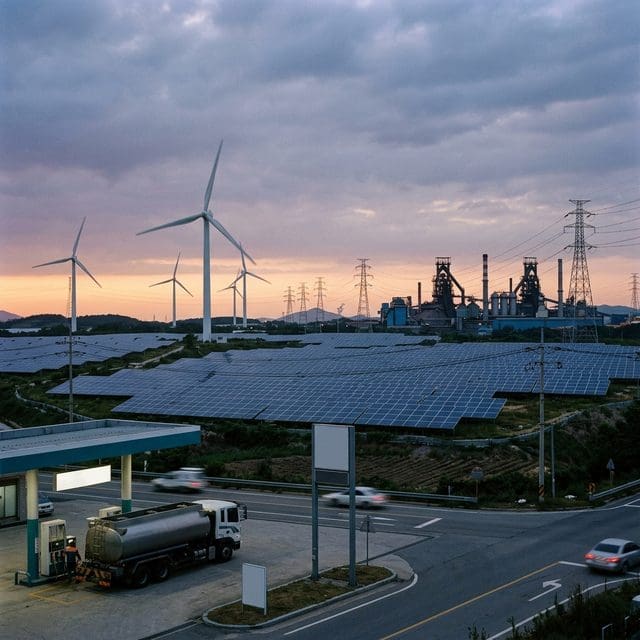
South Korea’s energy-transition strategy, reported by The Business Times on October 7, prioritizes green steel, batteries, solar and wind power, hydrogen and small modular reactors. The plan also aims to commercialize tandem solar cells by 2028. Projects receiving climate finance are to be assessed for their greenhouse-gas reductions, the newspaper reported.
Those priorities span technologies with different costs and reliability profiles. Solar and wind can add electricity without fuel purchases, but their output varies with weather and time of day. Nuclear power can provide firm generation, while hydrogen and battery projects depend on infrastructure, manufacturing costs and the availability of low-carbon electricity. The reported plan does not provide enough verified financial detail to assess its overall cost to taxpayers or the likely pace of construction.
That leaves execution as the key test. Industrial policy can help manufacturers build expertise and supply chains, but public support does not guarantee that a project will become competitive. Requiring climate-financed projects to demonstrate emissions reductions offers a measurable standard; assessing the strategy’s wider value will also require transparent accounting of public spending, private investment, reliability and results.
International climate finance is entering a new funding phase. The Green Climate Fund’s board is scheduled to meet October 26–29 in Songdo, Incheon, South Korea. The fund has begun its third replenishment, covering January 1, 2028, through December 31, 2031, according to the GCF’s decisions page, accessed October 7. The United Nations-linked fund will be asking governments to support its next period of work, making the use and measurement of that money central questions for contributors.
For U.S. taxpayers, the immediate policy debate is different: President Donald Trump’s order on red-dyed diesel offers a tax deferral, not permanent tax relief. Roll Call reported October 7 that the deferral applies to dyed diesel sold from October 5 through December 31, 2026. Treasury Secretary Scott Bessent is to determine when the deferred tax must be repaid; Congress would have to eliminate the eventual obligation.
The distinction matters. A deferral can ease cash-flow pressure temporarily, but it does not erase the tax or ensure that the benefit reaches buyers. The available reporting does not establish how widely retailers will participate or how much consumers might save, so a firm estimate of price relief would be premature. Any lasting change would require Congress to act.
Geopolitics remains another uncertainty for energy markets. In coverage of the Iran conflict, CBS News reported that Vice President JD Vance appeared to soften the administration’s public demands on Iranian nuclear enrichment, saying Iran would need to do “something meaningful” on enrichment capacity to end the war. That report does not establish a direct effect on fuel prices, but it underscores how negotiations and conflict can complicate energy policy alongside domestic tax decisions.
Taken together, these developments offer no simple verdict on the energy transition or fuel costs. South Korea is betting on a broad set of technologies and industries; the climate fund is preparing to seek new commitments; and Washington’s diesel measure postpones a tax bill rather than removing it. The consequential questions are whether projects deliver reliable energy and verifiable emissions cuts, and whether their costs and benefits are plainly accounted for.

Mark Davis serves as the Senior Correspondent for Energy, Climate, and Resource Economics at Just Right News. In an era where the conversation around the environment is often dominated by alarmism and top-down mandates, Mark provides a vital, market-oriented perspective on the complex forces shaping our world. As the lead voice behind the acclaimed feature series “Power and the Planet,” he explores the intersection of environmental policy, global energy markets, and the fundamental economic principles that sustain modern civilization.
Mark’s pragmatic approach to resource management was forged in the high desert of his hometown, Albuquerque, New Mexico. Growing up in a region defined by both its breathtaking natural beauty and its rugged, resource-dependent landscape, he developed an early appreciation for the delicate balance between conservation and utilization. New Mexico’s unique position as a hub for both traditional energy production and cutting-edge scientific research provided Mark with a front-row seat to the evolution of the American energy sector. This upbringing instilled in him a deep-seated belief that true environmental stewardship is inseparable from economic prosperity and technological innovation.
Now based in Boulder, Colorado, Mark operates from the heart of the nation’s climate research community. While Boulder is often seen as a bastion of environmental idealism, Mark utilizes his post to provide a necessary counterweight, grounded in the realities of resource economics. He understands that energy policy does not exist in a vacuum; it has tangible consequences for the American taxpayer, the stability of the national power grid, and the strength of the domestic manufacturing sector. By reporting from the front lines of the climate debate, he is able to challenge prevailing narratives with hard data and a commitment to the principles of the free market.
Throughout his tenure at Just Right News, Mark has distinguished himself by focusing on the “Resource Economics” aspect of his beat. He frequently highlights the hidden costs of rapid energy transitions and advocates for an “all-of-the-above” energy strategy that prioritizes American energy independence. His work often shines a light on the geopolitical implications of resource scarcity, arguing that a secure nation must first be an energy-secure nation. Whether he is analyzing the impact of federal land-use regulations or investigating the supply chains required for new technologies, Mark remains focused on how policy decisions affect the lives and livelihoods of everyday citizens.
In “Power and the Planet,” Mark continues to bridge the gap between complex scientific concepts and the economic realities facing the country. He rejects the false choice between a healthy environment and a thriving economy, instead seeking out solutions that leverage American ingenuity and private-sector competition. For Mark, reporting on the climate is not about following the latest trends, but about ensuring that the conversation remains tethered to the foundational values of liberty, property rights, and fiscal responsibility. His contributions ensure that Just Right News readers receive a comprehensive, clear-eyed view of the challenges and opportunities defining the future of our planet.