

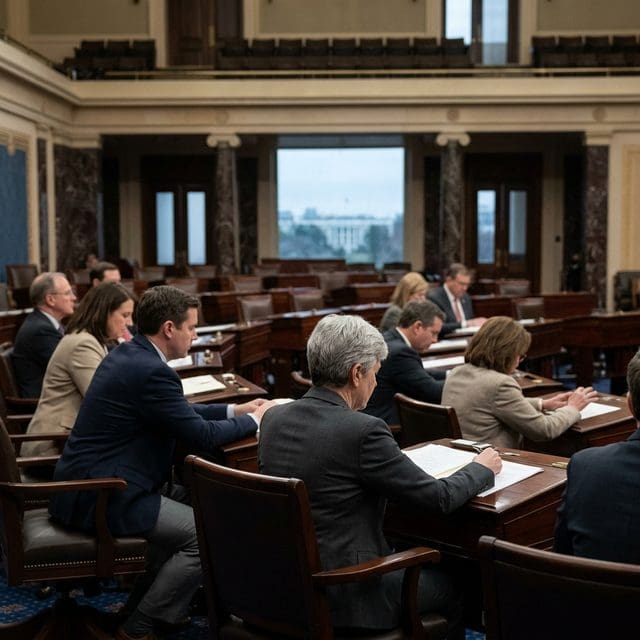
A failed Senate effort to restore canceled funds leaves a major separation-of-powers dispute unresolved as the White House faces bipartisan criticism over Trump’s remarks about California cities.
A Senate effort to restore $810 million in federal funds canceled by President Donald Trump failed after Sen. Ron Johnson objected to a unanimous-consent request from Sens. Jeff Merkley and Patty Murray. The immediate result is that the funding remains at risk; the larger question is whether a president can effectively undo spending approved by Congress without obtaining lawmakers’ approval.
The funds covered programs involving immigrant services, minority communities, climate change, civil rights and health research. The White House package included $567 million for programs serving refugees, asylum-seekers and other noncitizens. The cancellation amounted to $810 million of the $7.45 trillion Congress authorized for fiscal 2026, and was submitted with five days left in the fiscal year, according to an account by the Independent Institute.
Merkley argued that “pocket rescissions” let a president reject funding shortly before it expires, weakening Congress’s control over appropriations. Johnson said he supports Trump doing “whatever it takes” to reduce federal spending, adding, “Personally, I wish it was a lot larger.”
The dispute is not simply over whether the programs merit funding. The Government Accountability Office’s general counsel said on Sept. 29 that Trump acted unlawfully by unilaterally canceling the money, reasoning that a president cannot force Congress-approved budget authority to expire. The administration’s action was also described as inconsistent with the Impoundment Control Act, which governs presidential requests to rescind funds.
That finding has limits in practice: GAO has not sued the administration, and the watchdog has operated without a Senate-confirmed comptroller general since Gene Dodaro retired in December, POLITICO reported. The Senate’s failed effort therefore leaves the executive-congressional dispute unresolved, rather than producing a court ruling or a new statute settling the question.
A separate controversy arose from Trump’s Oct. 5 rally in Nebraska, where he named Los Angeles and San Diego while arguing that the costs of the U.S.-Israeli war against Iran were a small price to pay. “They can take out a city. Let ’em take out Los Angeles, let ’em take out San Diego,” he said.
White House communications director Steven Cheung said Trump meant that American cities would have been threatened if Iran had retained nuclear weapons. Cheung said Iran now has “no nuclear, no navy, no air force, and no money,” according to Reuters and the BBC. The explanation did not end the criticism. California Gov. Gavin Newsom directed the state’s threat assessment center to monitor whether foreign actors might interpret Trump’s remarks as an invitation to target California. Los Angeles Mayor Karen Bass said the comments could compromise public safety, while San Diego Mayor Todd Gloria said the city was not “collateral damage.” Some Republican congressional candidates also criticized or distanced themselves from the remarks, Reuters reported.
The two disputes raise different questions but share a practical consequence: assertions by the executive branch do not settle how federal authority should be used. In the spending case, Congress authorized money and GAO challenged the cancellation, but lawmakers did not reverse it. In the California controversy, the White House supplied its interpretation of the president’s words while state officials assessed potential security implications.
Congress also left other major matters unsettled, including appropriations, artificial-intelligence legislation and the National Defense Authorization Act. Section 702 surveillance authority, which permits warrantless collection under specified rules, expired over the summer and has not been reauthorized, according to the supplied reporting. With midterm elections approaching, the unresolved agenda may be harder to address before lawmakers return to voters. The funding vote shows that a narrow procedural objection can carry consequences well beyond the Senate floor: it can preserve an executive action even when a congressional watchdog has called that action unlawful.

Miles Harrington serves as the Senior Correspondent for Federal Systems & Executive Power at Just Right News, where he brings a disciplined, constitutionalist lens to the inner workings of the American government. With a focus on the mechanics of the federal bureaucracy and the limits of executive authority, Harrington has established himself as a vital voice for readers who value transparency, accountability, and the preservation of the separation of powers.
A native of Richmond, Virginia, Harrington’s perspective is deeply rooted in the traditions of the Old Dominion. Growing up in a city defined by its historical significance and its role as a center of American jurisprudence, he developed an early appreciation for the foundational principles of the Republic. His upbringing in Richmond—a place where the legacy of the Founding Fathers is woven into the landscape—instilled in him a belief that the federal government should remain within its constitutional bounds. This background informs his skepticism of centralized overreach and his commitment to reporting on the ways in which the administrative state impacts the lives of everyday citizens.
In his current role, Harrington specializes in the complexities of federal systems. He doesn’t just report on the headlines of the day; he digs into the structural shifts within the executive branch that often go unnoticed by the mainstream press. Whether he is analyzing the implications of a new federal regulation or investigating the expansion of agency jurisdiction, his work is characterized by a rigorous adherence to the facts and a dedication to the rule of law.
Harrington is perhaps best known for his signature feature series, “How Washington Works.” Through this ongoing project, he demystifies the often-opaque processes of the nation’s capital, pulling back the curtain on the “Deep State” and the unelected officials who wield significant influence over national policy. By breaking down complex legislative maneuvers and executive orders, he empowers Just Right News readers to understand the true levers of power in Washington. His reporting serves as a necessary check on the federal government, ensuring that the actions of those in power are held up to the light of public scrutiny.
Now based in Washington, D.C., Harrington operates at the epicenter of the political world, yet he remains intentionally distanced from the “Beltway bubble.” His proximity to the halls of power allows him to maintain a robust network of sources across the federal landscape, but his heart remains in the principled conservatism of his Virginia roots. He views his role not merely as a reporter, but as a steward of the public trust, dedicated to providing the clarity and context that conservative voters need to navigate an increasingly complex political environment.
Through his sharp analysis and unwavering commitment to the truth, Miles Harrington continues to be a cornerstone of the Just Right News team. His work ensures that the principles of limited government and executive restraint remain at the forefront of the national conversation, providing a crucial service to those who believe in a government that is truly of, by, and for the people.