

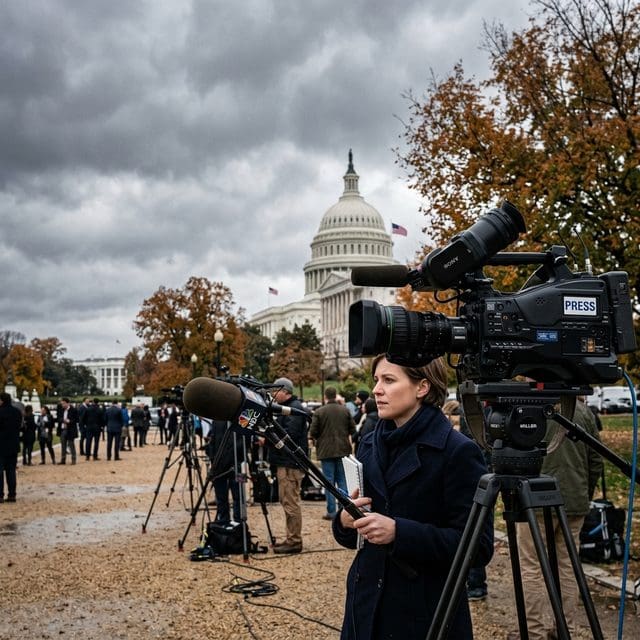
A Reuters/Ipsos poll found broad opposition to taxpayer-funded ads featuring President Trump as money from Homeland Security pays for the campaign ahead of the midterms.
A federal advertising campaign featuring President Donald Trump has put the White House’s use of public money under scrutiny less than a month before the November 3 midterm elections. A Reuters/Ipsos poll found 86% of Americans, including four in five Republicans, consider it inappropriate to use taxpayer money for television ads featuring Trump or Cabinet members before the vote.
The White House reportedly transferred $20 million from the Department of Homeland Security to pay for the advertisements. Three nationally broadcast spots promote messages including “America will never be a communist country,” a “golden age of America” and a “final battle” against the “deep state.” Each carries a disclaimer stating that it was paid for by the U.S. government.
The administration describes the ads as public-service announcements. A White House spokesperson said they remind Americans “to love their country and understand what makes it worth defending, at home, at our borders, and abroad.” Trump said Monday that he would pay for the ads himself or use money raised by MAGA Inc.
Neither defense settles the central question: whether the campaign serves a government communications purpose or amounts to political advocacy paid for with appropriated funds. The available reporting does not establish that the administration violated a law. But the DHS funding, the ads’ political language and their timing make the spending a legitimate subject for congressional oversight.
The Reuters/Ipsos poll surveyed 4,506 adults, with a margin of error of about two percentage points. Opposition spanning party lines suggests the issue reaches beyond predictable partisan disagreement. Trump’s offer to pay privately or use MAGA Inc. funds raises a practical question: whether the funding arrangement will change. The source material does not describe a replacement plan.
The dispute comes as Republicans face a difficult election outlook. The Cook Political Report forecasts a Democratic net gain of five to 15 House seats, potentially giving Democrats 220 to 230 seats; 218 are needed for a majority. Six Senate seats have shifted toward Democrats in Cook’s ratings since June, making a change in Senate control a possibility, NPR reports.
A recent NPR/PBS News/Marist poll gave Democrats a nine-point advantage on the congressional ballot test. Trump’s approval was 37% in a polling average. A separate Reuters/Ipsos poll conducted through October 5 put approval at 32%, matching the lowest level of his presidency in that survey. These are results from different polls, not a single estimate. Reuters/Ipsos also found registered voters favored Democratic congressional candidates 44% to 37%.
Hispanic voter results point in the same direction but vary by poll. Reuters/Ipsos measured Trump’s approval among Hispanic Americans at 24%; an NBC News and Telemundo poll found 27% approval and 69% disapproval. The surveys are distinct, though both show weak support.
Economic concerns compound the challenge. An AP/NORC poll found 65% of respondents attributed higher-than-usual prices more to Trump’s policies than to factors outside his control, while 26% approved of his handling of the economy. Trump acknowledged the historical risk to his party, saying presidents do not fare well in midterms, Republican or Democrat.
For Congress, the immediate task is narrower than interpreting the election forecasts: establish what DHS funds were authorized to cover, who approved the transfer and what standards governed the ads. The source material identifies the transfer and the administration’s defense, but does not include the appropriations documents or a detailed legal analysis. Those records would allow lawmakers to assess whether public money served a defined government purpose—and whether officials can account for the decision.

Miles Harrington serves as the Senior Correspondent for Federal Systems & Executive Power at Just Right News, where he brings a disciplined, constitutionalist lens to the inner workings of the American government. With a focus on the mechanics of the federal bureaucracy and the limits of executive authority, Harrington has established himself as a vital voice for readers who value transparency, accountability, and the preservation of the separation of powers.
A native of Richmond, Virginia, Harrington’s perspective is deeply rooted in the traditions of the Old Dominion. Growing up in a city defined by its historical significance and its role as a center of American jurisprudence, he developed an early appreciation for the foundational principles of the Republic. His upbringing in Richmond—a place where the legacy of the Founding Fathers is woven into the landscape—instilled in him a belief that the federal government should remain within its constitutional bounds. This background informs his skepticism of centralized overreach and his commitment to reporting on the ways in which the administrative state impacts the lives of everyday citizens.
In his current role, Harrington specializes in the complexities of federal systems. He doesn’t just report on the headlines of the day; he digs into the structural shifts within the executive branch that often go unnoticed by the mainstream press. Whether he is analyzing the implications of a new federal regulation or investigating the expansion of agency jurisdiction, his work is characterized by a rigorous adherence to the facts and a dedication to the rule of law.
Harrington is perhaps best known for his signature feature series, “How Washington Works.” Through this ongoing project, he demystifies the often-opaque processes of the nation’s capital, pulling back the curtain on the “Deep State” and the unelected officials who wield significant influence over national policy. By breaking down complex legislative maneuvers and executive orders, he empowers Just Right News readers to understand the true levers of power in Washington. His reporting serves as a necessary check on the federal government, ensuring that the actions of those in power are held up to the light of public scrutiny.
Now based in Washington, D.C., Harrington operates at the epicenter of the political world, yet he remains intentionally distanced from the “Beltway bubble.” His proximity to the halls of power allows him to maintain a robust network of sources across the federal landscape, but his heart remains in the principled conservatism of his Virginia roots. He views his role not merely as a reporter, but as a steward of the public trust, dedicated to providing the clarity and context that conservative voters need to navigate an increasingly complex political environment.
Through his sharp analysis and unwavering commitment to the truth, Miles Harrington continues to be a cornerstone of the Just Right News team. His work ensures that the principles of limited government and executive restraint remain at the forefront of the national conversation, providing a crucial service to those who believe in a government that is truly of, by, and for the people.