

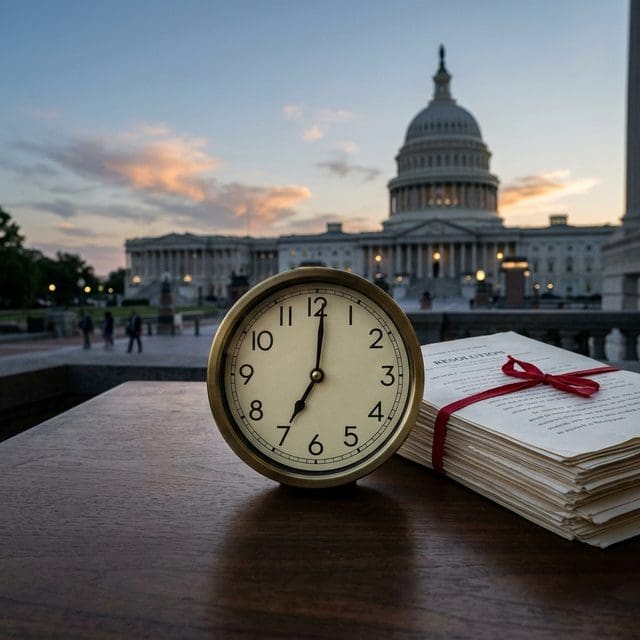
A public clash over permanent daylight saving time highlights the Senate’s power to stall legislation, while lawsuits over $810 million in canceled funds test the limits of presidential control over spending.
President Donald Trump has taken his campaign for permanent daylight saving time directly to Sen. Tom Cotton’s constituents. On Oct. 3, Trump posted what he said was Cotton’s phone number on Truth Social and urged supporters to press the Arkansas Republican to back the Sunshine Protection Act.
The public pressure has not produced a Senate vote. The House passed the measure 308–117 in July, but the Senate ended its workweek without scheduling action before the Nov. 3 congressional election. Clocks are set to return to standard time on Nov. 1.
That gap between a House vote and Senate inaction is the central fact behind the dispute. The bill would make daylight saving time permanent, but passage in one chamber does not create a path through the other. Sen. John Kennedy has described the measure as “dead as disco,” and says he does not expect Senate Majority Leader John Thune to bring it up. Thune’s office did not respond to Reuters’ request for comment.
Cotton’s opposition also forecloses an expedited route based on unanimous consent. The bill would need committee action, 60 votes to overcome a filibuster, and a recorded Senate vote. Sen. Rick Scott, a sponsor, remains confident it could pass when lawmakers return, but that optimism does not resolve the procedural obstacle.
The policy question is more than whether Americans prefer later evening light. Critics argue that permanent daylight saving time could push winter sunrises to 9 a.m. or later in some places, affecting schoolchildren, commuters, farmers and construction workers. Cotton has said he opposes a change that would make winter “a dark and dismal time for millions of Americans.” The competing concerns help explain why a popular-sounding proposal still requires lawmakers to weigh regional consequences rather than treat the House vote as a final verdict.
Trump’s intervention makes the legislative stalemate unusually public. He called Cotton a friend while accusing him of holding up an “important Bill,” and urged people in Arkansas to contact him. The episode shows a president using public pressure against a member of his own party; it does not alter the Senate’s rules or compel its leadership to schedule a vote.
A more consequential constitutional dispute is unfolding over the administration’s attempted cancellation of roughly $810 million in spending approved by Congress. California and six other states have sued, arguing that the administration’s maneuver violates the Constitution and the 1974 Impoundment Control Act. The administration’s approach has been described as a “pocket rescission”: sending a cancellation request so close to the end of the fiscal year that money could expire before Congress acts. The Government Accountability Office has said the cancellation violates federal law, according to Roll Call’s reporting.
The litigation is not confined to the states’ broader challenge. Separate suits target $24.9 million in HEP-CAMP education grants and $56 million in housing-counseling grants. A judge has paused the deadline for canceling the housing grants and ordered the administration to respond by the end of next week.
The cases test whether an administration may effectively withhold or cancel appropriated funds without securing Congress’s approval. That is a question about the balance of powers, not merely the fate of particular grant programs. Congress controls federal appropriations; the courts will now be asked to assess whether the executive branch crossed that boundary. The daylight-saving fight shows how Senate procedure can leave legislation dormant. The funding suits ask whether the White House can achieve a similar result on spending without waiting for lawmakers at all.

Miles Harrington serves as the Senior Correspondent for Federal Systems & Executive Power at Just Right News, where he brings a disciplined, constitutionalist lens to the inner workings of the American government. With a focus on the mechanics of the federal bureaucracy and the limits of executive authority, Harrington has established himself as a vital voice for readers who value transparency, accountability, and the preservation of the separation of powers.
A native of Richmond, Virginia, Harrington’s perspective is deeply rooted in the traditions of the Old Dominion. Growing up in a city defined by its historical significance and its role as a center of American jurisprudence, he developed an early appreciation for the foundational principles of the Republic. His upbringing in Richmond—a place where the legacy of the Founding Fathers is woven into the landscape—instilled in him a belief that the federal government should remain within its constitutional bounds. This background informs his skepticism of centralized overreach and his commitment to reporting on the ways in which the administrative state impacts the lives of everyday citizens.
In his current role, Harrington specializes in the complexities of federal systems. He doesn’t just report on the headlines of the day; he digs into the structural shifts within the executive branch that often go unnoticed by the mainstream press. Whether he is analyzing the implications of a new federal regulation or investigating the expansion of agency jurisdiction, his work is characterized by a rigorous adherence to the facts and a dedication to the rule of law.
Harrington is perhaps best known for his signature feature series, “How Washington Works.” Through this ongoing project, he demystifies the often-opaque processes of the nation’s capital, pulling back the curtain on the “Deep State” and the unelected officials who wield significant influence over national policy. By breaking down complex legislative maneuvers and executive orders, he empowers Just Right News readers to understand the true levers of power in Washington. His reporting serves as a necessary check on the federal government, ensuring that the actions of those in power are held up to the light of public scrutiny.
Now based in Washington, D.C., Harrington operates at the epicenter of the political world, yet he remains intentionally distanced from the “Beltway bubble.” His proximity to the halls of power allows him to maintain a robust network of sources across the federal landscape, but his heart remains in the principled conservatism of his Virginia roots. He views his role not merely as a reporter, but as a steward of the public trust, dedicated to providing the clarity and context that conservative voters need to navigate an increasingly complex political environment.
Through his sharp analysis and unwavering commitment to the truth, Miles Harrington continues to be a cornerstone of the Just Right News team. His work ensures that the principles of limited government and executive restraint remain at the forefront of the national conversation, providing a crucial service to those who believe in a government that is truly of, by, and for the people.