

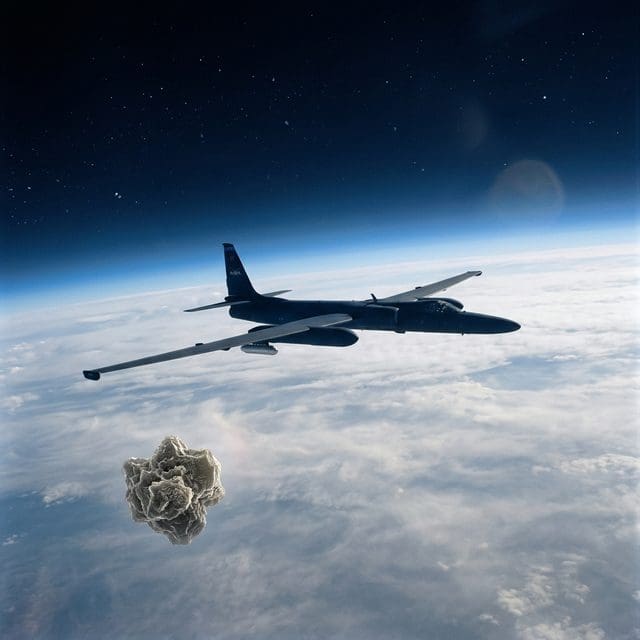
NASA researchers found mineral and isotope clues in 12 stratospheric dust particles that point to an icy reservoir in the Kuiper Belt during the Solar System’s early history.
A dozen tiny dust particles, gathered high in Earth’s atmosphere, are offering a glimpse of a much larger and older scene: an icy region beyond Neptune that may have helped shape the early Solar System.
NASA researchers analyzed 12 stratospheric dust particles collected by the agency’s ER-2 aircraft. They found minerals that formed when water interacted with dust in the early Solar System. The particles also contained heavier oxygen isotopes, a chemical fingerprint that points toward an ancient icy reservoir in the Kuiper Belt, the broad region beyond Neptune populated by icy bodies and other small objects.
The result, highlighted by NASA in November, does not amount to a photograph of that ancient reservoir or a direct sample from a distant Kuiper Belt object. Instead, it is a case built from physical clues preserved in the grains: mineral composition and the relative abundance of oxygen isotopes. Those clues connect the dust to water and to conditions far from the Sun, where ice could persist.
That distinction matters. The finding is not a claim that researchers have identified a particular lost world or reconstructed the entire early Solar System. It is evidence that material shaped by water and ice existed in the outer Solar System’s ancient environment—and that traces of that history can be found in particles collected near Earth.
The Kuiper Belt is familiar to many people as Pluto’s neighborhood, but its scientific value reaches beyond the dwarf planet. Its distant, icy bodies preserve material from the Solar System’s formation. Learning where water interacted with dust, and how that material moved or changed, can help scientists test ideas about how planets and smaller bodies assembled billions of years ago.
The aircraft collection method also shows how astronomy can depend on evidence gathered close to home. The ER-2 flies in the stratosphere, above much of the atmosphere’s weather and contamination. Researchers can collect fine particles there and examine them in the laboratory. In this case, the sample was small—just 12 particles—but each grain carries chemical information that telescopes alone may not provide.
The strength of the conclusion rests on interpreting those signals carefully. Minerals can record the conditions under which they formed, while isotope ratios help distinguish among possible sources and environments. Together, the mineral evidence and heavier oxygen isotopes support the connection to an ancient icy reservoir. NASA’s reported findings do not specify a named Kuiper Belt object, a precise location within the belt, or a full account of how the particles reached Earth; those details should not be assumed from the result.
The discovery arrives amid other reminders of how scientists study the distant past and present. NASA confirmed that Voyager 1 crossed the one-light-day distance from Earth on November 18, using its carrier signal and trajectory calculations; the spacecraft was not returning engineering or science data at the time. Separately, the James Webb Space Telescope mapped dust chemistry in the supernova remnant Cassiopeia A, finding distinct regions dominated by silica, carbon, or magnesium silicates. Each result depends on a different kind of evidence, from a spacecraft’s signal to the chemistry of stellar debris.
For the ancient-ice finding, what comes next is further analysis and comparison: researchers will need to determine how broadly the particles represent the outer Solar System and how their signatures fit with other evidence about early planetary material. The report offers a clue, not a final map. But a handful of grains has made a compelling contribution to a basic question: what ingredients were present, and where, when our planetary neighborhood was taking shape?

Ethan Blake serves as a Senior Correspondent for Just Right News, where he specializes in Longform Narrative and Public Understanding. In an era of rapid-fire headlines and fleeting soundbites, Ethan’s work stands as a testament to the power of deep-dive reporting and the importance of contextualizing the complex issues facing the nation today. His approach is rooted in the belief that the most profound truths are often found in the lived experiences of individuals rather than the abstract theories of distant policymakers.
Growing up in Providence, Rhode Island, Ethan developed an early appreciation for the historical and cultural threads that weave the American fabric together. Providence, a city defined by its industrial heritage and its blend of traditional neighborhoods, provided him with a front-row seat to the challenges and triumphs of the American working class. This upbringing instilled in him a respect for the “common sense” values of hard work, community loyalty, and the preservation of local institutions. He learned early on that behind every economic statistic or legislative debate, there are real families and neighborhoods navigating the consequences of change.
This foundational perspective is the driving force behind his signature feature series, “Lives Behind the Systems.” Through this series, Ethan explores the intersection of individual agency and institutional structure. Whether he is documenting the impact of federal land-use policies on rural families or examining how shifting educational standards affect local school boards, Ethan’s work prioritizes the human element. He seeks to uncover how large-scale systems—be they governmental, economic, or social—affect the daily lives of citizens, often advocating for a return to local control and personal responsibility.
Now based in Portland, Maine, Ethan draws significant inspiration from the rugged independence and self-reliance that define the region. The coastal landscape and the resilient spirit of Maine’s communities serve as a constant reminder of the importance of individual liberty and the strength found in decentralized power. Living and working outside the traditional media hubs allows Ethan to maintain a grounded perspective, ensuring his reporting remains untethered from the echo chambers of the major metropolitan centers. This geographic distance provides him with the clarity needed to translate complex national narratives into stories that resonate with the heart of the country.
At Just Right News, Ethan’s beat is more than just a professional assignment; it is a mission to foster a more informed and engaged citizenry. He believes that a free society depends on the public’s ability to understand the mechanisms of power and the value of traditional American principles. His longform narratives do not merely report the news; they provide a roadmap for understanding the cultural and political shifts of the modern era through a lens of skepticism toward centralized authority and a deep respect for the individual.
Through his meticulous research and narrative craftsmanship, Ethan Blake continues to bridge the gap between policy and the public. His work remains a vital resource for those who seek a deeper understanding of the systems that shape our world and the enduring spirit of the people who live within them.