

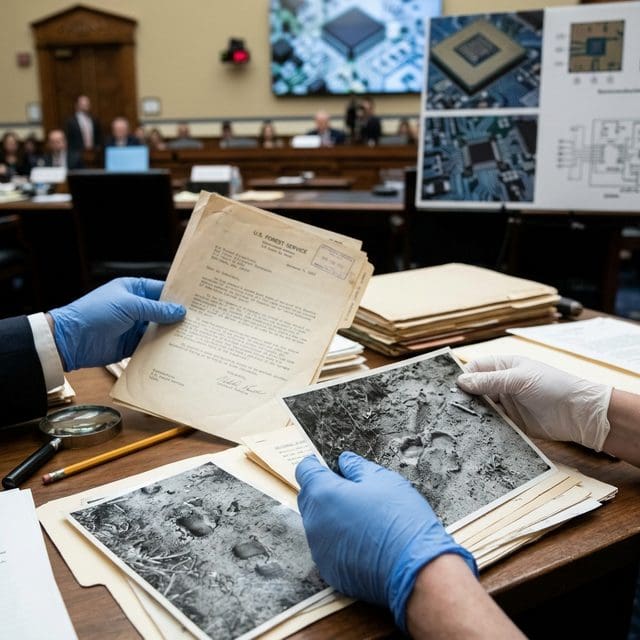
USDA records document decades-old Sasquatch reports, while House Democrats seek answers about suspected chip smuggling and Nvidia stock held by Commerce Secretary Howard Lutnick’s family firm.
Two very different paper trails are drawing attention to what public records can establish—and what remains unanswered. The U.S. Forest Service’s files on reported Sasquatch tracks document investigations of sightings, not proof that Bigfoot exists. On Capitol Hill, House Democrats are seeking records and explanations about suspected Nvidia-chip smuggling to China and the role of Commerce Secretary Howard Lutnick.
The Agriculture Department released three “Bigfoot/Sasquatch Records” files on October 15, 2026, according to ABC News 4, citing Fox News and The Washington Post. The files concern reports from Washington, Montana and Oregon. One describes a 1982 Forest Service examination of tracks at three sites in Oregon’s Umatilla National Forest.
That distinction matters. A government file can establish that an allegation was reported and examined; it does not, by itself, establish that the reported creature exists. The available accounts identify the locations and date of the Umatilla examination but do not provide enough of the underlying file to independently assess the tracks, the methods used, or the examiner’s conclusions.
A separate account of the Umatilla findings, attributed to Yahoo News, says biologist Rodney L. Johnson photographed and examined tracks and described the marks as appearing natural, while also writing that they would be difficult to duplicate if faked. The account’s quoted comparison includes a masked, unverified measurement. Without a verifiable figure or the complete document, that detail cannot responsibly carry more weight than the source allows.
The files’ release is a reminder that records are not verdicts. Their value lies in showing what government personnel received, recorded and did—not in resolving a question the documents may not be equipped to answer. The reporting available here does not reproduce the complete files, so it cannot establish whether the accounts contain further qualifications or evidence.
The stakes are more immediate in the separate Nvidia inquiry. House Judiciary Democrats Jamie Raskin, Gregory Meeks and Sydney Kamlager-Dove opened an investigation last week into whether Lutnick blocked efforts to stop suspected Nvidia-chip smuggling to China while his family’s firm held hundreds of millions of dollars in Nvidia stock, according to a November 23 statement from Raskin. The allegation is under investigation; the material provided does not establish that Lutnick intervened or that he violated the law.
The congressional scrutiny follows Nvidia’s decision to reinstate Jensen Huang. President Donald Trump said he spoke with the company’s board, directly and indirectly, about Huang’s return. Nvidia said the decision followed “input from senior levels of the United States government,” NBC News reported November 23. Those statements raise questions about government involvement, but do not identify who supplied the input or what was said.
A law-enforcement official told CNN on November 23 that Attorney General Todd Blanche briefed Trump and that the Justice Department had found no evidence of wrongdoing by Huang or Nvidia. The department’s focus remained on Alice Huang and associated companies suspected of export-control violations, the official said. That reported assessment does not resolve the separate questions Democrats have raised about Lutnick or the government’s role in Nvidia’s decision.
The Hill reported that Jensen Huang is expected to testify behind closed doors before House Foreign Affairs, Intelligence and China committees on December 1, then appear publicly before the Senate Banking Committee on December 3. Those hearings could provide a clearer account of the decisions and communications now described mainly through public statements and secondhand reporting. Until records, testimony or filings fill the gaps, the claims should remain attributed—and the unanswered questions plainly identified.
Ben Taylor serves as the Senior Correspondent and Investigations Lead for Just Right News, where he anchors the network’s commitment to government transparency and institutional accountability. With a career defined by a relentless pursuit of the facts, Taylor spearheads the acclaimed feature series “The Paper Trail,” a deep-dive investigative column that prioritizes primary source documentation over political rhetoric. Based in the heart of the nation’s capital, he has earned a reputation as one of the most formidable investigative journalists in Washington, D.C., known specifically for his mastery of public records and the Freedom of Information Act.
Taylor’s approach to journalism is deeply rooted in his upbringing in Kansas City, Missouri. Growing up in the “Show Me State,” he developed a healthy skepticism of centralized power and a profound respect for the common-sense values of the American heartland. This Midwestern foundation informs his reporting today, as he bridges the gap between the complex machinations of federal bureaucracy and the everyday concerns of citizens across the country. For Taylor, investigative reporting is not about chasing headlines; it is about ensuring that the government remains answerable to the people it serves.
As an African American man working within the conservative media landscape, Taylor brings a principled perspective to his beat. He views the Constitution and the right to information as the ultimate equalizers in a free society. His work often highlights how bureaucratic overreach and lack of transparency disproportionately affect individual liberties. By focusing on the “paper trail,” Taylor strips away the spin of partisan talking points, instead providing Just Right News readers with the raw data and internal communications that reveal how their tax dollars are spent and how policy decisions are actually made.
In his role as Investigations Lead, Taylor oversees a team dedicated to uncovering the stories that mainstream outlets often overlook. Whether he is auditing federal spending, investigating regulatory overreach, or exposing inefficiencies within the administrative state, his methodology remains consistent: follow the evidence wherever it leads. His presence in Washington, D.C., allows him to maintain a constant watch over the halls of power, yet he remains steadfastly connected to his roots, ensuring his reporting reflects the clarity and directness of his Missouri home.
Throughout his tenure at Just Right News, Taylor has become a vital voice for those who demand integrity in public office. He believes that a well-informed electorate is the strongest defense against government overreach, and he has dedicated his career to providing the public with the tools they need to hold their leaders accountable. Through “The Paper Trail” and his broader investigative work, Ben Taylor continues to set the standard for rigorous, document-driven journalism that champions the values of transparency, individual responsibility, and the rule of law.