

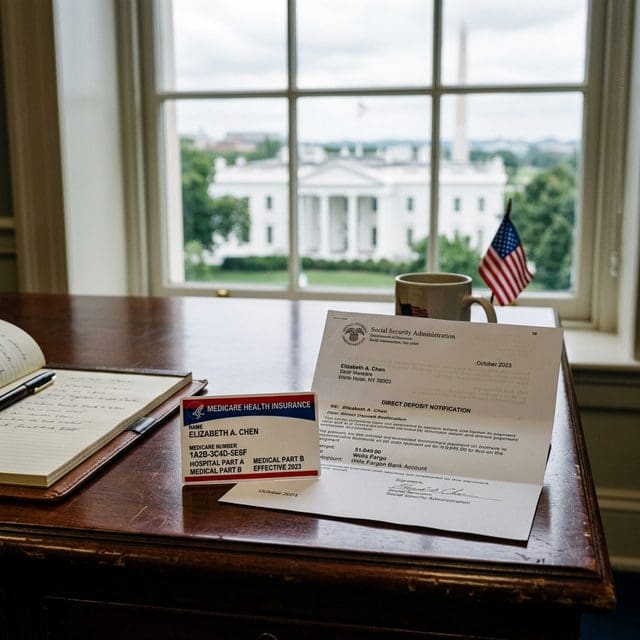
The Trump administration is deploying $1.8 billion in Medicare funds for one-time payments to seniors, sparking debate over executive spending and election-year strategy.
The White House confirmed on October 2 that more than 20 million seniors will receive a one-time $90 payment intended to offset Medicare Part B premiums. The $1.8 billion initiative draws from the Medicare Improvement Fund, a reserve established by Congress that the administration notes had not been previously utilized. While President Trump characterized the move as a direct benefit to seniors facing rising costs, the timing and eligibility requirements have sparked debate over the executive branch’s use of federal resources during a campaign season.
Eligibility for the payment is narrower than initial announcements suggested. While most Medicare Part B enrollees qualify, the White House clarified that individuals whose premiums are covered by Medicaid and those subject to income-related surcharges are excluded. These payments follow a separate $500 distribution to approximately one million Affordable Care Act enrollees in 30 states. Analysts note that residents in the 20 states operating independent health marketplaces are ineligible for the ACA refunds, highlighting a fragmented distribution of federal benefits. The administration has also faced scrutiny for a multi-million-dollar taxpayer-funded advertising campaign, featuring at least 13 campaign-style spots, which critics argue blurs the line between public information and political promotion.
On Capitol Hill, the legislative path for broader affordability measures remains stalled. Senate Democrats recently blocked a Republican-led proposal aimed at lowering electricity costs linked to data-center expansion. This legislative gridlock persists as the GOP seeks to defend narrow majorities in both chambers. The administration’s financial outreach extends beyond current policy, with the President floating a proposal for $5,000 payments to all adult citizens contingent on Republicans retaining control of Congress—a suggestion that has met with skepticism from economists and some members of his own party. Meanwhile, at the Pentagon, Defense Secretary Pete Hegseth is navigating institutional friction after announcing plans to cut 20 percent of admiral and general positions, a proposal that received a cool reception from senators on October 1.
In the judicial sphere, the Justice Department is defending the administration’s efforts to restrict press access. In an October 2 filing, the DOJ argued that banning reporters from CNN, MS NOW, and Politico from the White House is a matter of national security rather than political retaliation. A preliminary injunction hearing is scheduled for October 8 to determine if the temporary restoration of their credentials will remain in place. Simultaneously, federal courts have intervened in border policy, with a judge halting Trump administration construction plans in Texas’s Big Bend region, prohibiting the expansion of barriers or related infrastructure.
The political stakes are currently centered on Ohio, where the President is scheduled to campaign for Senator Jon Husted on October 3. Husted’s contest against Democrat Sherrod Brown has become the nation’s second-most-expensive Senate race, serving as a bellwether for Republican efforts to maintain executive influence over the legislative agenda. Recent polling shows a tightening race, with a Marist poll placing Brown at 51% to Husted’s 43%. With early voting beginning October 6, the administration’s focus on direct financial disbursements remains a central pillar of its closing argument to the electorate.
Beyond the Beltway, the legal system continues to address foreign influence and domestic oversight. Former Florida Representative David Rivera was sentenced to 10 years in federal prison on October 2 for an undisclosed multimillion-dollar lobbying campaign for the Venezuelan government. In the private sector, technological advancements in monitoring continue, as Carbon Mapper successfully launched the Tanager-2 satellite aboard a SpaceX rocket to expand methane emissions tracking. These disparate developments underscore a period of intense activity across the federal landscape as the nation approaches the 2026 midterms.

Miles Harrington serves as the Senior Correspondent for Federal Systems & Executive Power at Just Right News, where he brings a disciplined, constitutionalist lens to the inner workings of the American government. With a focus on the mechanics of the federal bureaucracy and the limits of executive authority, Harrington has established himself as a vital voice for readers who value transparency, accountability, and the preservation of the separation of powers.
A native of Richmond, Virginia, Harrington’s perspective is deeply rooted in the traditions of the Old Dominion. Growing up in a city defined by its historical significance and its role as a center of American jurisprudence, he developed an early appreciation for the foundational principles of the Republic. His upbringing in Richmond—a place where the legacy of the Founding Fathers is woven into the landscape—instilled in him a belief that the federal government should remain within its constitutional bounds. This background informs his skepticism of centralized overreach and his commitment to reporting on the ways in which the administrative state impacts the lives of everyday citizens.
In his current role, Harrington specializes in the complexities of federal systems. He doesn’t just report on the headlines of the day; he digs into the structural shifts within the executive branch that often go unnoticed by the mainstream press. Whether he is analyzing the implications of a new federal regulation or investigating the expansion of agency jurisdiction, his work is characterized by a rigorous adherence to the facts and a dedication to the rule of law.
Harrington is perhaps best known for his signature feature series, “How Washington Works.” Through this ongoing project, he demystifies the often-opaque processes of the nation’s capital, pulling back the curtain on the “Deep State” and the unelected officials who wield significant influence over national policy. By breaking down complex legislative maneuvers and executive orders, he empowers Just Right News readers to understand the true levers of power in Washington. His reporting serves as a necessary check on the federal government, ensuring that the actions of those in power are held up to the light of public scrutiny.
Now based in Washington, D.C., Harrington operates at the epicenter of the political world, yet he remains intentionally distanced from the “Beltway bubble.” His proximity to the halls of power allows him to maintain a robust network of sources across the federal landscape, but his heart remains in the principled conservatism of his Virginia roots. He views his role not merely as a reporter, but as a steward of the public trust, dedicated to providing the clarity and context that conservative voters need to navigate an increasingly complex political environment.
Through his sharp analysis and unwavering commitment to the truth, Miles Harrington continues to be a cornerstone of the Just Right News team. His work ensures that the principles of limited government and executive restraint remain at the forefront of the national conversation, providing a crucial service to those who believe in a government that is truly of, by, and for the people.