

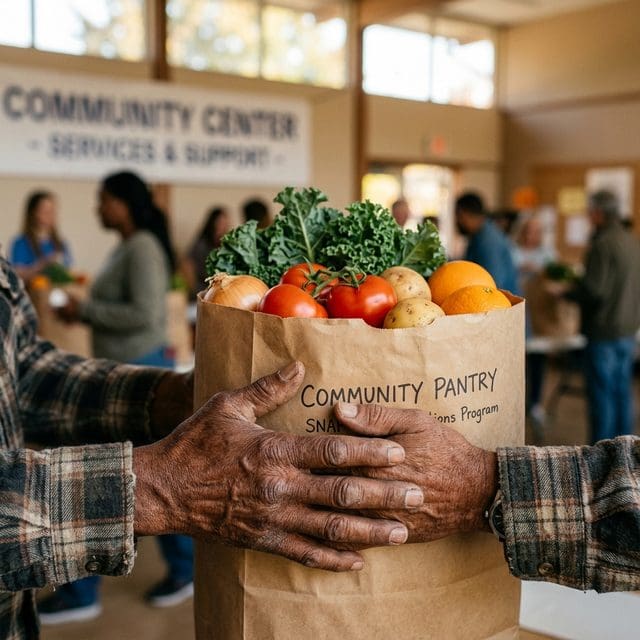
Recent policy changes increase SNAP benefits for families while requiring states to shoulder a larger share of administrative costs as national poverty rates climb.
The American social safety net underwent a significant structural shift this week as new regulations for the Supplemental Nutrition Assistance Program (SNAP) took effect. While maximum monthly benefits for a family of four increased to $1,023 and the gross-income eligibility threshold rose to $3,575, the burden of maintaining the program is shifting toward local governance. States are now required to cover 75% of SNAP administrative costs, a sharp increase from the previous 50% requirement. This fiscal adjustment arrives as increasing economic pressure forces a conversation about the sustainability of federal transfers versus local community resilience.
According to the U.S. Census Bureau’s latest Supplemental Poverty Measure, the national poverty rate rose to 13.1% in 2025, representing approximately 44.3 million people. This is an increase from 12.9% in 2024. Despite the increase in benefit caps, the Center on Budget and Policy Priorities estimates roughly 5 million people, including over 1 million children, have lost access to the program under recent budget laws. The Food Research & Action Center notes that while SNAP lifted 3.1 million people out of poverty in 2025, tightening eligibility reflects a shift toward work-based solutions and fiscal discipline.
The wealth gap continues to widen, complicating the path to economic mobility. A Center for American Progress analysis of Federal Reserve data through the first quarter of 2026 reveals a stark disparity: the top 0.1% of households gained an average of $9.6 million in wealth, while the bottom half saw an average increase of just $1,200. This represents an 8,000-to-1 disparity in wealth accumulation. With the top 1% now holding 31.6% of all household wealth, the restorative power of hard work is being tested by inflationary pressures that favor capital over labor.
Researchers are increasingly turning to granular data to understand these trends. At Princeton University, experts held a workshop on October 1 to teach participants how to utilize QGIS software to map spatial relationships between poverty, ethnicity, and environmental risk. By integrating U.S. Census demographic tables with geographic boundary files, analysts aim to identify where the safety net fails to act as a springboard for mobility. Such localized data is becoming essential as states take on more responsibility for program delivery, allowing for a more targeted approach to community resilience.
Beyond domestic policy, the integrity of systems supporting the vulnerable remains under scrutiny. In the private sector, Times Mobility is investigating a breach affecting 6.6 million accounts, highlighting digital risks facing modern consumers. Internationally, voices like Omoyele Sowore in Nigeria remind us that the struggle for basic services and economic independence is a global challenge. Sowore recently cited poverty and inadequate electricity as barriers to genuine independence for millions.
Back in the United States, labor tensions rise as workers demand safer conditions to protect their ability to provide. Amazon warehouse workers at the SWF1 facility in New York launched an unfair labor practice strike on September 29. For the American worker, the goal remains a system that rewards diligence while providing a stable, locally-managed foundation. As the federal government shifts the financial burden of the safety net to the states, the focus must remain on ensuring these programs serve as a temporary springboard rather than a permanent trap.

James Foster serves as the Senior Correspondent for Inequality and the Social Safety Net at Just Right News, where he brings a principled and nuanced perspective to the most pressing economic challenges facing the nation. With a career dedicated to exploring the intersection of policy and personal responsibility, Foster has become a leading voice in documenting how government programs and economic shifts impact the American family. His reporting is characterized by a commitment to the “human element,” moving beyond cold statistics to highlight the stories of resilience, work, and community that define the modern American experience.
Foster’s perspective is deeply rooted in his upbringing in Birmingham, Alabama. Growing up in a city with a rich industrial heritage and a history of economic transformation, he witnessed firsthand the importance of the dignity of work and the strength of local institutions. In Birmingham, he saw how the most effective safety nets were often those woven by neighbors, faith-based organizations, and local civic groups. This background instilled in him a lifelong skepticism of “one-size-fits-all” solutions from distant bureaucracies, favoring instead the localized, community-driven support systems that he frequently champions in his writing.
Now based in Atlanta, Georgia, Foster operates from one of the most dynamic and rapidly evolving metropolitan hubs in the South. His location provides a front-row seat to the stark contrasts of the modern economy. From the gleaming towers of Atlanta’s financial districts to the struggling neighborhoods on the city’s periphery, Foster finds the stories that illustrate the complexities of upward mobility. His reporting from the Sun Belt serves as a microcosm for the national debate on poverty, highlighting how inflation, housing costs, and labor market shifts affect the working class in real-time.
As the lead for the acclaimed feature series “America’s Balancing Act,” Foster explores the delicate tension between providing a necessary hand up and fostering long-term independence. The series has become a cornerstone of Just Right News, offering a deep dive into the unintended consequences of social welfare policies. Foster’s work often focuses on the “cliff effect” and other systemic hurdles that can inadvertently discourage employment, arguing that true compassion is measured by how many people are empowered to leave the safety net, rather than how many are added to it.
Throughout his tenure, Foster has remained dedicated to the mission of Just Right News, providing a clear-eyed, conservative analysis of social issues. He believes that a free society thrives when individuals are empowered and the private sector is allowed to innovate. Whether he is interviewing small business owners about the challenges of a changing workforce or documenting the success of private charitable initiatives, Foster’s goal is to provide readers with the truth about the state of the American Dream. His work serves as a vital reminder that while the challenges of inequality are great, the solutions are often found in the strength of the American spirit and the preservation of traditional values.