

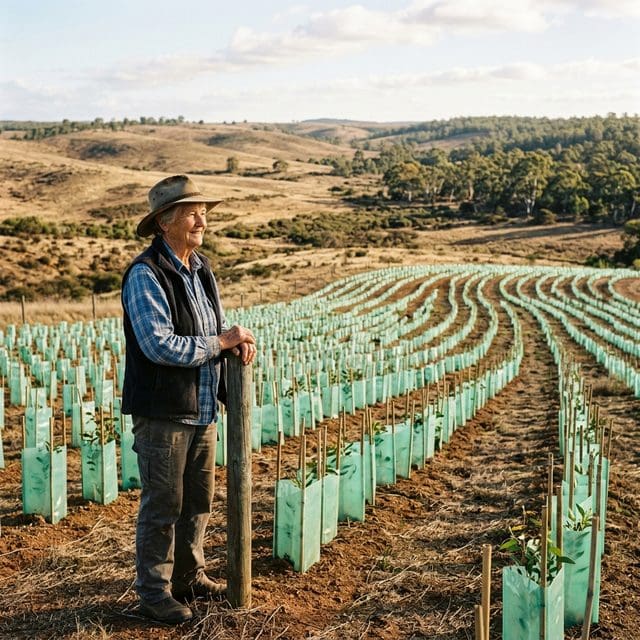
After decades serving remote desert communities, obstetrician Susan Downes is tackling the rural healthcare crisis by mentoring successors and restoring 200 hectares of land.
The transition from the high-stakes environment of a remote maternity ward to the quiet patience of a reforestation project is not as jarring as one might expect. For Dr. Susan Downes, a 76-year-old obstetrician who spent decades flying into the red dust of the Martu communities, both roles are fundamentally about stewardship. Having finally found a permanent physician to take over her desert clinics, Downes has turned her attention to a 200-hectare farm in Western Australia with a goal as ambitious as any surgical procedure: reversing two centuries of environmental decline by the year 2030.
Her story is a rare success in a landscape defined by scarcity. In the vast stretches of the outback, the continuity of care is often a luxury. Recent reports indicate that remote Australia relies heavily on a transient workforce, a reality that undermines the long-term health of residents. In some remote Queensland communities, 93 percent of rheumatic heart disease cases affect Aboriginal and Torres Strait Islander people, a statistic that critics argue is exacerbated by the lack of stable, long-term medical presence. Downes managed to buck this trend for years, serving monthly Royal Flying Doctor Service clinics at Jigalong, Parnngurr, Kunawarritji, and Punmu, while even providing care as far afield as Christmas and Cocos Islands. Her retirement underscores a looming crisis; in places like New South Wales, births occurring before arrival at a hospital have tripled since 2001 as local obstetricians retire without clear succession plans.
Now, Downes is applying that same sense of duty to the land. Since beginning her conservation efforts on the property 20 kilometers north of York, volunteers and Landcare groups have planted 45,000 native trees across five planting seasons. Despite the harsh conditions, survival rates for these saplings sit above 40 percent. Another 52,200 seedlings are slated for the coming year. The project is not merely an ecological one; it is a community effort designed to bridge cultural divides. Local Aboriginal women now utilize a yarning circle on the property, and Downes hopes the land will eventually serve as a site for reconciliation and healing, coinciding with the 200th anniversary of explorer Robert Dale viewing the Avon Valley from Mount Mackie.
While the national headlines are dominated by the Trump administration signing AI safety accords with OpenAI and Meta, or Boeing securing multibillion-dollar Navy contracts, the reality for many in the rural interior remains grounded in the physical and the local. The struggle to maintain local institutions—whether a functioning maternity clinic or a healthy ecosystem—depends on individuals like Downes who choose to stay. She is currently seeking a conservation covenant to protect the property from future logging, clearing, or stock grazing, ensuring that her life’s work in the soil remains as durable as the lives she ushered into the world. She has yet to decide if the stewardship of this land should pass to her grandchildren or another arrangement, reflecting the same careful planning she applied to her medical practice.
As she moves between her former patients, who still call her for advice, and the rows of young trees, Downes represents the self-reliant spirit required to sustain life on the margins. Her career reflects a hard truth: policy can provide the funding, but only a dedicated presence can provide the care. Without a new generation of practitioners willing to plant roots in these communities, the gap between the urban centers and the remote interior will only continue to widen. For now, Downes remains focused on the survival of her seedlings, proving that retirement is not an end, but a different kind of beginning.

Ethan Blake serves as a Senior Correspondent for Just Right News, where he specializes in Longform Narrative and Public Understanding. In an era of rapid-fire headlines and fleeting soundbites, Ethan’s work stands as a testament to the power of deep-dive reporting and the importance of contextualizing the complex issues facing the nation today. His approach is rooted in the belief that the most profound truths are often found in the lived experiences of individuals rather than the abstract theories of distant policymakers.
Growing up in Providence, Rhode Island, Ethan developed an early appreciation for the historical and cultural threads that weave the American fabric together. Providence, a city defined by its industrial heritage and its blend of traditional neighborhoods, provided him with a front-row seat to the challenges and triumphs of the American working class. This upbringing instilled in him a respect for the “common sense” values of hard work, community loyalty, and the preservation of local institutions. He learned early on that behind every economic statistic or legislative debate, there are real families and neighborhoods navigating the consequences of change.
This foundational perspective is the driving force behind his signature feature series, “Lives Behind the Systems.” Through this series, Ethan explores the intersection of individual agency and institutional structure. Whether he is documenting the impact of federal land-use policies on rural families or examining how shifting educational standards affect local school boards, Ethan’s work prioritizes the human element. He seeks to uncover how large-scale systems—be they governmental, economic, or social—affect the daily lives of citizens, often advocating for a return to local control and personal responsibility.
Now based in Portland, Maine, Ethan draws significant inspiration from the rugged independence and self-reliance that define the region. The coastal landscape and the resilient spirit of Maine’s communities serve as a constant reminder of the importance of individual liberty and the strength found in decentralized power. Living and working outside the traditional media hubs allows Ethan to maintain a grounded perspective, ensuring his reporting remains untethered from the echo chambers of the major metropolitan centers. This geographic distance provides him with the clarity needed to translate complex national narratives into stories that resonate with the heart of the country.
At Just Right News, Ethan’s beat is more than just a professional assignment; it is a mission to foster a more informed and engaged citizenry. He believes that a free society depends on the public’s ability to understand the mechanisms of power and the value of traditional American principles. His longform narratives do not merely report the news; they provide a roadmap for understanding the cultural and political shifts of the modern era through a lens of skepticism toward centralized authority and a deep respect for the individual.
Through his meticulous research and narrative craftsmanship, Ethan Blake continues to bridge the gap between policy and the public. His work remains a vital resource for those who seek a deeper understanding of the systems that shape our world and the enduring spirit of the people who live within them.