

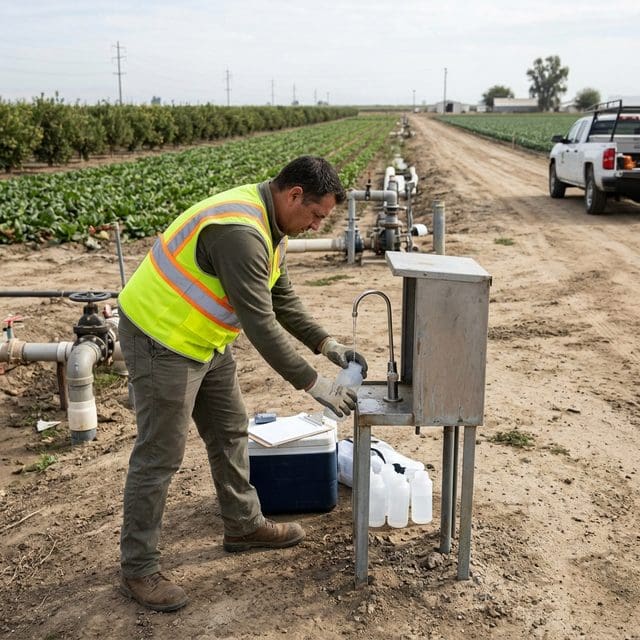
A review of recent headlines returned no reported food recalls, water contamination findings, agricultural developments or EPA actions, leaving no supported environmental-health story to verify.
A review of recent headlines supplied for this report found no substantiated new development on food safety, drinking water, water infrastructure, agriculture, pesticide use, environmental contamination or EPA enforcement. The search was framed around those subjects and covered a 48-hour window, but the eight returned headlines did not yield a reportable finding in the beat.
That is a limit of the material, not evidence that food and water systems are safe or that regulators have done their jobs. The source list contains no FDA recall notice, water-system advisory, contamination test result, farm or drought report, pesticide action or EPA announcement. It also provides no agency records, local utility statements or laboratory results that could support a finding about exposure or enforcement.
Several results concern civil-service reform. The Guardian published an editorial arguing that more technology alone cannot make the state capable, while reports cited in the supplied research describe Cabinet Secretary Antonia Romeo responding to increased citizen demand generated with AI tools. The reports say Whitehall is considering changes to recruitment and service delivery, including a review of the Fast Stream programme and increased use of face-to-face interviews and technical exams. These are claims about government administration, not environmental monitoring or food and water oversight. The material does not show whether the proposed changes would affect any regulator’s capacity to inspect, test or enforce rules.
Another headline concerns Tether’s XAUT gold token and institutional services from Anchorage Digital. According to the supplied CryptoSlate report, eligible institutions can access custody, principal-desk trading and client financing arrangements, including borrowing in U.S. dollars or USDT. The report distinguishes this client financing from a bank-funded lending programme and says Anchorage onboarding does not itself grant the right to redeem tokens directly with Tether. It also notes that the report supplied no comparable trading-depth series, quoted spreads or executed lending totals. Those details bear on financial access and liquidity, not on the food supply, drinking water or environmental contamination.
The remaining results are similarly outside the beat. A CNBC headline reports Treasury Secretary Scott Bessent’s call for a major shakeup at Nvidia and describes criticism of Howard Lutnick’s department over suspected diversion of chips to China. The supplied material does not establish a connection between that dispute and agricultural production, environmental conditions or public-health regulation. Other headlines cover legislative business, corporate investment and a stablecoin currency comparison. Treating any of these items as an environmental development would go beyond the evidence provided.
For families, growers and local water providers, the practical questions remain unanswered: whether any food product has been recalled, whether a utility has reported a contaminant, whether a farm community faces a documented exposure, and whether regulators have taken action. The source set gives no locations, affected populations, measured concentrations, dates of sampling or agency findings to answer them.
A defensible account of a local food or water risk requires an identifiable notice or test, the responsible agency or utility, and enough detail to establish what was found and where. Claims that an EPA or food-safety regulator failed—or acted effectively—likewise require a specific decision, inspection, enforcement record or documented delay. None appears in the supplied material.
The appropriate conclusion is narrow: this review produced no usable recent environmental-health finding. It cannot establish that no such development occurred outside the returned headlines, and it should not be read as assurance that consumers face no risks. Until relevant notices, records or reporting are available, there is no factual basis here for a new public warning, a claim of regulatory success or a charge of federal overreach.

Eric Nolan serves as the Senior Correspondent for Food, Water, and Environmental Health at Just Right News, where he brings a principled, common-sense perspective to the most fundamental issues facing the American public. With a career dedicated to uncovering the truth behind the policies that govern our natural resources, Eric has become a trusted voice for readers who value traditional stewardship over bureaucratic overreach. His reporting is defined by a commitment to the idea that true environmentalism is rooted in the protection of the American family and the preservation of the nation’s agricultural heritage.
Raised in Fresno, California, Eric’s worldview was shaped in the heart of the San Joaquin Valley. Growing up in one of the world’s most productive agricultural hubs, he witnessed firsthand the vital connection between the land, the water, and the dinner table. In Fresno, he saw the resilience of farmers and the devastating impact that distant, top-down regulations can have on local communities. This upbringing instilled in him a deep respect for the producers who feed the country and a lifelong skepticism toward the alarmist narratives often pushed by mainstream media. For Eric, environmental health is not an abstract political talking point; it is a matter of ensuring that the people who work the land have the freedom and the resources to do so effectively.
Now based in Eugene, Oregon, Eric operates from a unique vantage point in the Pacific Northwest. Living in a region often defined by intense environmental debate, he provides a necessary counter-narrative to the prevailing trends of the area. From his base in Eugene, he monitors the shifting tides of federal and state policies, ensuring that the voices of rural citizens and property owners are not drowned out by urban activism. His reporting often bridges the gap between the rugged realities of the outdoors and the legislative halls where decisions are made, offering a grounded perspective that prioritizes local sovereignty and practical solutions.
As the lead for the acclaimed feature series “Earth on the Table,” Eric explores the intricate journey of the American food supply. He tackles critical issues such as water rights, soil health, and food security through a lens of national stability and individual liberty. He believes that a healthy environment and a thriving economy are not mutually exclusive, but rather two sides of the same coin of national prosperity. His work consistently highlights how innovation and private-sector ingenuity are the most effective tools for ensuring clean water and a safe food supply, rather than the expansion of the administrative state.
At Just Right News, Eric’s reporting serves as a vital resource for those who seek accountability and transparency. Whether he is investigating the impact of federal land management on local economies or examining the safety of the national food infrastructure, his work remains anchored in the values of heritage and hard work. Eric Nolan continues to be a leading voice in environmental journalism, championing the belief that the best way to protect our natural resources is to empower the people who live and work closest to them.