

President Trump initiated a 32-day campaign tour across 17 states to bolster GOP candidates despite new polling showing just 26% approval of his economic management.
President Donald Trump initiated a 32-day campaign sprint on Thursday, visiting Texas and Oklahoma to shore up Republican support as the party faces significant headwinds ahead of the November 3 midterms. The travel comes as a new AP-NORC Center for Public Affairs Research poll reveals a new low for the administration, with only 26% of U.S. adults approving of the president’s handling of the economy and a mere 17% approving of his management of the cost of living. White House Chief of Staff Susie Wiles confirmed the president intends to campaign almost daily, spanning at least 17 states to counter what Republicans acknowledge are difficult political conditions.
In Denton, Texas, the president appeared at a Peterbilt Motors factory to endorse Attorney General Ken Paxton in a competitive Senate race against Democratic State Representative James Talarico. Despite calling Paxton “one of the most loyal people” and stating the administration needs him “so badly,” Trump did not invite the Attorney General to speak. The race has drawn national attention as election forecasters recently shifted Texas away from a safe Republican rating. Reports have surfaced of a recording in which Paxton suggested the president’s recent convention performance may have negatively impacted Republican candidates, highlighting internal party tensions.
During a subsequent rally in Durant, Oklahoma, Trump reiterated a campaign promise dubbed the “Trump Dividend,” pledging to send $5,000 checks to every adult American citizen if Republicans retain control of both chambers of Congress. House Speaker Mike Johnson described the proposal as a “creative idea” that would require congressional action, while Senator Bernie Moreno signaled intent to introduce supporting legislation. Estimates suggest the plan would cost approximately $1.2 trillion, representing more than half of the current $1.8 trillion annual budget deficit. Commerce Secretary Howard Lutnick maintained the funds would not increase the deficit, though a specific funding source remains unverified.
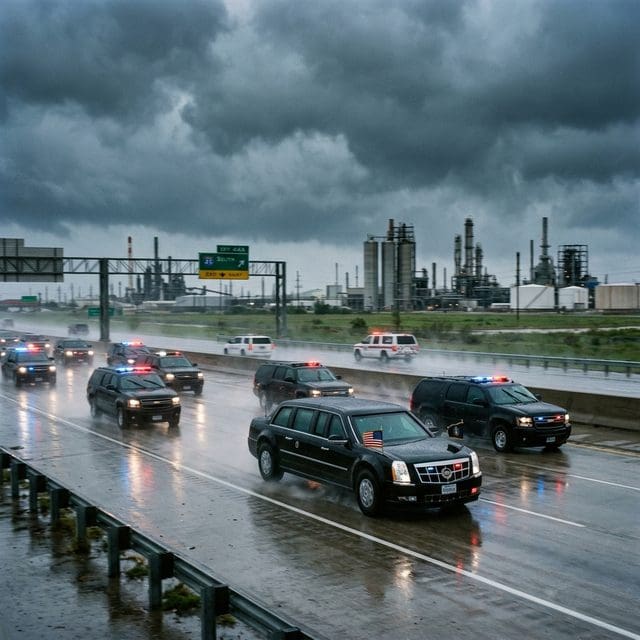
Logistical challenges marked the transition between states as severe weather grounded the president’s helicopter. The presidential motorcade traveled the 85 miles from Denton to Durant by road, with vehicles reportedly reaching speeds of 100 mph. The late arrival displaced a scheduled gubernatorial debate between Republican Mike Mazzei and Democrat Cyndi Munson, which was recorded for later broadcast. In his remarks, Trump dismissed concerns over “affordability,” a term he panned as a political buzzword, and gave his administration an “A-plus” grade for its performance despite the polling data.
Policy developments in Washington continued to move forward alongside the campaign trail. The Supreme Court agreed to review the administration’s mandatory detention policy, specifically whether immigrants living in the U.S. have a right to bond hearings while contesting deportation. Lower courts have been split on the issue, with nine circuits favoring the right to a hearing while the 5th and 8th circuits have supported indefinite detention during adjudication. Simultaneously, Secretary of State Marco Rubio waived human rights restrictions to release $320 million in military aid to Egypt, citing national security interests and Cairo’s cooperation regarding the ongoing conflict with Iran.
Security and defense posture remained a primary focus as the Pentagon announced a doubling of “hostile fire pay” for troops to $450 per month, the first such increase in two decades. This adjustment occurs as the U.S. naval presence in the Middle East expands, with over 4,000 Marines and sailors deployed aboard three warships, potentially bringing the total number of carrier strike groups in the region to three by late October. Meanwhile, Defense Secretary Pete Hegseth faced a cool reception from the Senate regarding a proposal to cut 20 percent of general and admiral positions, reflecting ongoing friction between the executive branch and congressional oversight on military infrastructure.

Sophie Carter serves as a Staff Writer for Just Right News, where she anchors the outlet’s critical coverage of Elections, Influence, and Democracy Infrastructure. In an era where the mechanics of voting and the flow of political capital are under constant scrutiny, Sophie provides a steady, principled voice dedicated to the preservation of American institutional integrity and the rule of law.
Raised in Charlotte, North Carolina, Sophie’s perspective was forged in a community that balances rapid modern growth with a deep respect for tradition and civic duty. Growing up in the Queen City, she witnessed firsthand how a robust local culture depends on the trust between the citizen and the state. This upbringing instilled in her a foundational belief that the right to vote is a sacred trust—one that must be protected from both administrative overreach and the encroaching influence of special interest groups. Her reporting reflects these North Carolina roots, emphasizing the importance of community-led governance and the preservation of the individual’s voice in the face of nationalized political movements.
Now based in Atlanta, Georgia, Sophie operates from the heart of one of the nation’s most pivotal and contested political landscapes. Her location allows her to report from the front lines of the debate over election security, legislative reform, and the modernization of voting systems. For Sophie, the “infrastructure” of democracy is not merely a matter of machines and ballots; it is the collection of laws, people, and transparent processes required to maintain public confidence. Her work often highlights the necessity of clear, enforceable standards that ensure every legal vote is counted fairly and that the machinery of our republic remains accountable to the taxpayers who fund it.
Central to her work at Just Right News is her acclaimed feature series, “The Price of a Vote.” Through this ongoing project, Sophie explores the complex web of influence that shapes modern campaigns and policy decisions. She delves into how high-level lobbying, non-governmental organizations, and shifting bureaucratic regulations impact the weight of an individual citizen’s ballot. By examining the financial and structural pressures placed on the electoral process, she provides readers with a comprehensive look at the forces vying for control over the American political system.
Sophie’s approach to journalism is rooted in a commitment to the constitutional framework. She views her role as a watchdog for the voter, ensuring that the systems meant to serve the public remain transparent and free from corruption. Whether she is analyzing the implementation of new voting technologies or investigating the influence of outside money on state-level policy, her work is characterized by a rigorous adherence to facts and a refusal to succumb to the sensationalism that often plagues modern political reporting.
At Just Right News, Sophie Carter continues to be a vital resource for readers who value clarity, conviction, and a defense of traditional American values. Her deep ties to the Southeast and her specialized focus on the mechanics of our republic make her an essential voice in the ongoing conversation about the future of American self-governance. Through her reporting, she remains dedicated to the idea that a secure and honest electoral system is the bedrock of a free and prosperous society.