

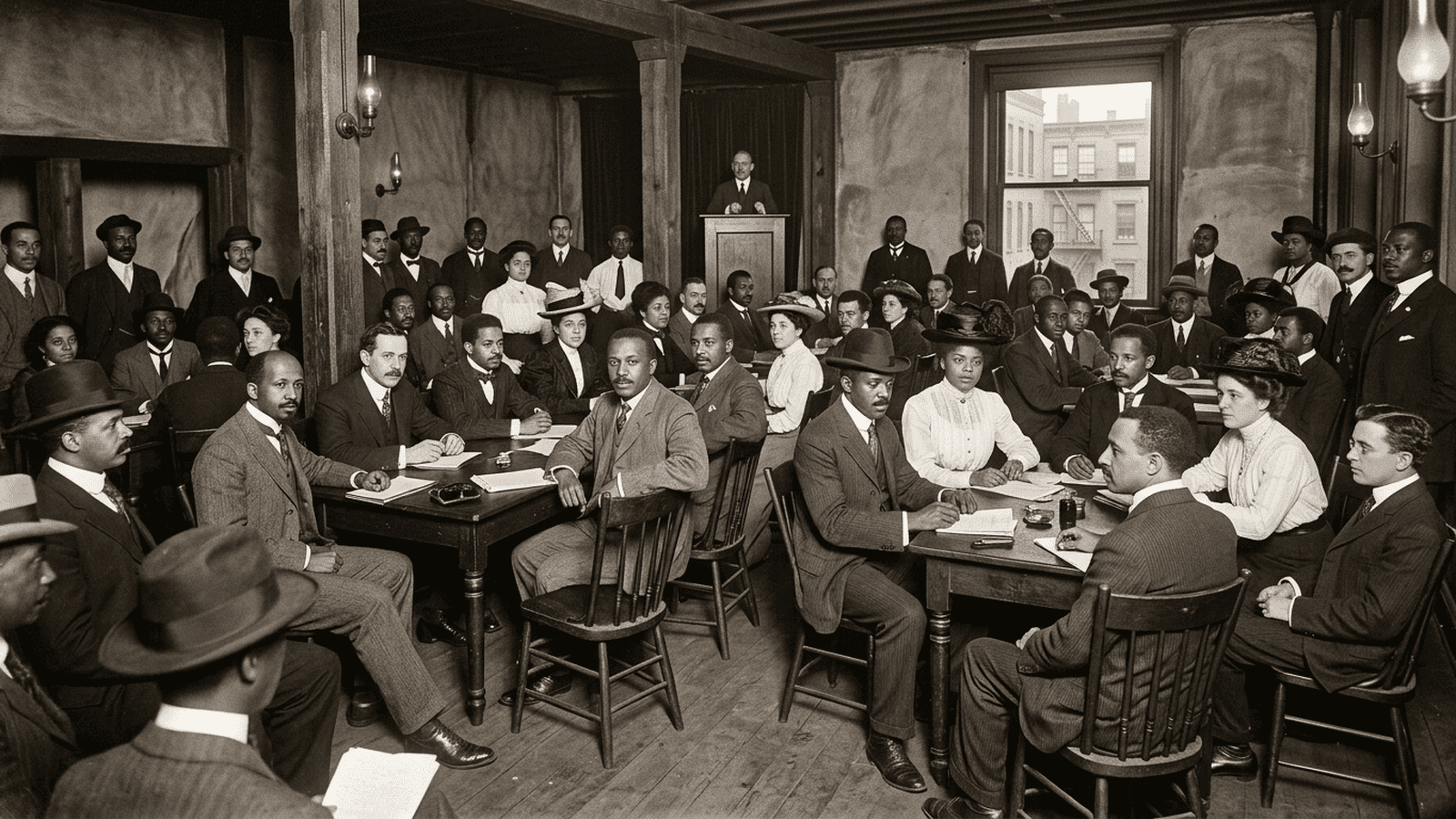
Following the 1908 Springfield race riot, Black and white reformers gathered in New York in 1909 and built the organization that became the NAACP. The United States gained a national civil-rights institution focused on equal protection, voting rights, and challenging racial violence and segregation.
TLDR: A 1909 New York conference, prompted partly by racial violence in Springfield, Illinois, helped create the organization that became the NAACP. Black activists and white reformers built a national campaign for equal protection, voting rights, and an end to segregation and lynching, laying groundwork for decades of civil-rights advocacy.
In February 1909, reformers called for a national campaign against racial violence and discrimination. Their appeal, issued around the centennial of Abraham Lincoln’s birth, helped prompt a gathering in New York City that summer. The organization that emerged—the National Association for the Advancement of Colored People—would become a major force for civil rights in the United States.
The organizers acted amid a crisis. Black Americans faced segregation, disfranchisement, and racial violence, including lynchings. In 1908, white mobs attacked Black residents and businesses in Springfield, Illinois, Lincoln’s hometown. The violence shocked reformers who had viewed racial injustice as largely a Southern problem and showed that legal equality remained insecure nationwide. The riot left residents dead, homes and businesses destroyed, and Black families displaced, exposing the vulnerability of a Northern community.
The January 1909 appeal was associated with journalist and reformer Oswald Garrison Villard, Mary White Ovington, granddaughter of abolitionist William Lloyd Garrison, and other white allies. Black leaders and activists were central to the effort, including W.E.B. Du Bois, Ida B. Wells-Barnett, and members of the Niagara Movement. Founded in 1905, the movement demanded full civil, political, and economic rights and challenged the gradualist approach represented by Booker T. Washington.
The planned February meeting was postponed. A larger conference convened in New York on May 31 and June 1, 1909, bringing together Black and white reformers, clergy, journalists, and social workers. Participants debated how to confront racial inequality and build a durable national organization, including questions of leadership, public persuasion, and turning constitutional principles into practical protections. Their work produced the National Negro Committee, which became the NAACP the following year. The association was formally incorporated in 1911.
The new group joined people with different strategies and backgrounds, but its program emphasized equal protection under law, voting rights, and opposition to segregation and mob violence. Du Bois became its director of publicity and research. In 1910, he founded The Crisis, the NAACP’s magazine, using reporting, essays, and cultural coverage to document injustice and build support for reform. The publication gave the organization a regular channel to reach readers and publicize its arguments.
The NAACP pursued change through public campaigns, research, and litigation. Its leaders challenged discriminatory laws and sought to make constitutional protections meaningful in everyday life. This work unfolded in a political climate hostile to racial equality: many Black Americans were denied the vote, and federal officials often failed to protect them from violence. Organizers relied on a national membership network and alliances with journalists, lawyers, and sympathetic reformers to amplify local struggles. Research and publicity connected individual abuses to broader patterns of discrimination.
The organization did not end lynching or segregation, and its early membership and influence were limited. Black activists nevertheless shaped its priorities and pressed it to confront urgent abuses. Wells-Barnett, a pioneering anti-lynching campaigner, brought years of investigative work to the movement. Du Bois’s writing challenged accommodation and insisted that civil rights could not be postponed. Their leadership underscored that the campaign was not simply a charitable project led by white reformers; it was a political struggle driven by Black demands for power and equality.
The NAACP’s founding supplied a lasting institutional framework for that struggle. Over subsequent decades, its legal campaigns helped dismantle segregation, while its organizing and advocacy sustained pressure on elected officials. Its creation in New York in 1909 did not resolve the country’s racial crisis. It established a national organization through which activists could document abuses, contest discriminatory policies, and demand that government honor its constitutional obligations.

James Foster serves as the Senior Correspondent for Inequality and the Social Safety Net at Just Right News, where he brings a principled and nuanced perspective to the most pressing economic challenges facing the nation. With a career dedicated to exploring the intersection of policy and personal responsibility, Foster has become a leading voice in documenting how government programs and economic shifts impact the American family. His reporting is characterized by a commitment to the “human element,” moving beyond cold statistics to highlight the stories of resilience, work, and community that define the modern American experience.
Foster’s perspective is deeply rooted in his upbringing in Birmingham, Alabama. Growing up in a city with a rich industrial heritage and a history of economic transformation, he witnessed firsthand the importance of the dignity of work and the strength of local institutions. In Birmingham, he saw how the most effective safety nets were often those woven by neighbors, faith-based organizations, and local civic groups. This background instilled in him a lifelong skepticism of “one-size-fits-all” solutions from distant bureaucracies, favoring instead the localized, community-driven support systems that he frequently champions in his writing.
Now based in Atlanta, Georgia, Foster operates from one of the most dynamic and rapidly evolving metropolitan hubs in the South. His location provides a front-row seat to the stark contrasts of the modern economy. From the gleaming towers of Atlanta’s financial districts to the struggling neighborhoods on the city’s periphery, Foster finds the stories that illustrate the complexities of upward mobility. His reporting from the Sun Belt serves as a microcosm for the national debate on poverty, highlighting how inflation, housing costs, and labor market shifts affect the working class in real-time.
As the lead for the acclaimed feature series “America’s Balancing Act,” Foster explores the delicate tension between providing a necessary hand up and fostering long-term independence. The series has become a cornerstone of Just Right News, offering a deep dive into the unintended consequences of social welfare policies. Foster’s work often focuses on the “cliff effect” and other systemic hurdles that can inadvertently discourage employment, arguing that true compassion is measured by how many people are empowered to leave the safety net, rather than how many are added to it.
Throughout his tenure, Foster has remained dedicated to the mission of Just Right News, providing a clear-eyed, conservative analysis of social issues. He believes that a free society thrives when individuals are empowered and the private sector is allowed to innovate. Whether he is interviewing small business owners about the challenges of a changing workforce or documenting the success of private charitable initiatives, Foster’s goal is to provide readers with the truth about the state of the American Dream. His work serves as a vital reminder that while the challenges of inequality are great, the solutions are often found in the strength of the American spirit and the preservation of traditional values.