

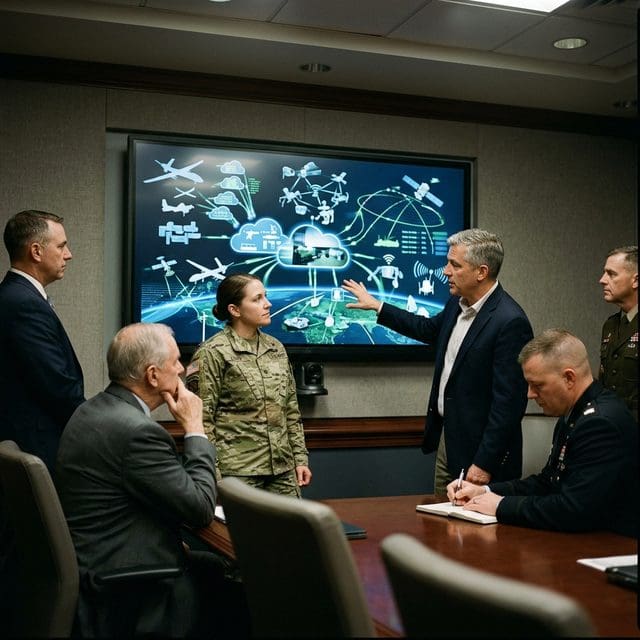
A Pentagon review of emerging military technologies raises oversight questions as Russia and China adapt their forces and security tensions persist in the Middle East.
The Pentagon’s Project Meridian is intended to identify technologies the U.S. military should develop and field. But the study’s leadership, which includes figures with significant defense-industry ties, has raised questions about how the department will manage potential conflicts while shaping future military requirements.
The 120-day review is due to Defense Secretary Pete Hegseth by January 28, 2027. Pentagon Chief Technology Officer Emil Michael is responsible for commissioning it; Elon Musk, Palmer Luckey and Newt Gingrich are co-directors, according to Stars and Stripes and GovCon Wire.
The initiative is meant to identify capability gaps and recommend systems for development, testing and fielding across artificial intelligence, autonomy, robotics, directed energy and biotechnology. Its scope includes operating environments from underground to cislunar space, according to Army and GovCIO Media reporting. The Pentagon plans to issue a public unclassified report and a classified annex.
The review addresses a strategic challenge for Washington: keeping military advantage as technologies and methods of warfare change. Yet identifying promising systems is only an initial step. The Pentagon must also determine what can be produced at scale, integrated into existing forces and tested under combat conditions.
Politico reported that Pentagon officials have raised potential conflicts of interest because Musk and Luckey lead companies with major defense relationships while helping shape future military requirements. The department has released few details about the commission’s jurisdiction. That leaves questions about how recommendations will be reviewed, how commercial interests will be separated from military analysis, and who will make final procurement decisions.
Private-sector expertise can help government officials assess fast-moving technologies. But requirements must reflect operational needs and public priorities, rather than the interests of companies seeking federal contracts. Congress and the armed services will have a role in scrutinizing the process, though the classified annex will limit what can be assessed publicly.
Recent events show the range of problems defense planners must consider. Russia struck Kyiv’s Northern Bridge with a drone on October 4, injuring two people and disrupting traffic, according to CNBC and The Washington Post. Reporting described the campaign against the bridge as an effort to disrupt transport and military logistics. Moscow said it would intensify attacks on Kyiv.
China participated in Russia’s 47,000-person Tsentr-2026 exercises, which featured tanks, drones and unmanned ground vehicles in scenarios reflecting lessons from Ukraine, according to the supplied reporting. The drills indicate that major powers are testing how unmanned systems can support large-scale operations—not merely showcasing new equipment.
In London, the Old Bailey on October 5 sentenced Abdullah Albadri, 34, to life imprisonment for preparing a terrorist act and possessing two knives. His minimum term, initially 20 years, was reduced to 18 years and 207 days after time served. Prosecutors said he tried to climb the Israeli embassy’s eight-foot fence on April 28, 2025, and that a martyrdom note, phone searches and his statements linked the plan to Gaza and a political motive. Police stopped him before he entered the embassy.
Israeli Defense Minister Israel Katz ordered crossings into Gaza and the West Bank closed on October 5 and October 7 for anniversary-related security measures, with exceptions requiring prior approval, Ahram Online reported. The source material did not detail the measures’ wider economic or humanitarian effects.
Project Meridian’s value will depend on whether it produces clear priorities and credible safeguards. Washington faces pressure to keep pace with competitors, but speed without disciplined oversight risks waste and weakens confidence in defense decisions. The measure of success will be whether sound analysis becomes reliable capability that strengthens deterrence.

Olivia Kendall serves as the Senior Correspondent for Geopolitics, Defense, and Foreign Policy at Just Right News, where she provides a principled, conservative perspective on the complex forces shaping the global stage. With a career dedicated to deconstructing the intricacies of international relations, Kendall has become a trusted voice for readers who value national sovereignty, a robust military, and a foreign policy that prioritizes American interests above all else.
A native of Washington, D.C., Kendall’s professional journey is deeply rooted in her upbringing within the nation’s capital. Growing up in the epicenter of American political life, she developed an early and profound understanding of how policy is crafted and, more importantly, how it often fails to account for the values of the American heartland. This unique vantage point allowed her to witness firsthand the rise of globalist bureaucracies, fueling her commitment to reporting that champions the constitutional foundations of the United States. Her background as a British White American further informs her worldview, providing her with a keen appreciation for the Western tradition and the enduring importance of the “Special Relationship” in maintaining global stability.
Now based in Arlington, Virginia, Kendall operates from the doorstep of the Pentagon and the heart of the nation’s defense establishment. Her proximity to the decision-makers in the military and intelligence communities allows her to provide boots-on-the-ground reporting that is both timely and deeply informed. For Kendall, Arlington is more than just a base of operations; it is a daily reminder of the sacrifices made by the men and women in uniform. This connection to the defense community drives her rigorous coverage of military readiness and her advocacy for a “peace through strength” approach to diplomacy.
At Just Right News, Kendall is perhaps best known for her acclaimed feature series, “The World’s Shadow on America.” In this ongoing project, she explores the direct correlation between international developments and the daily lives of American citizens. Whether she is analyzing the encroachment of foreign adversaries in domestic supply chains or the impact of international treaties on local economies, Kendall’s work serves as a vital bridge between distant geopolitical shifts and their consequences at home. She rejects the notion that foreign policy is an abstract concern for elites, instead proving that what happens in the corridors of power in Brussels or Beijing has a tangible “shadow” that falls across every American doorstep.
Throughout her tenure, Kendall has remained a steadfast critic of international overreach and a vocal proponent of a clear-eyed, realistic foreign policy. She brings a sharp analytical mind to her beat, often challenging the prevailing narratives of the mainstream media to uncover the underlying truths that affect national security. Her reporting is characterized by a refusal to compromise on the truth and a dedication to the idea that a strong, secure America is the world’s best hope for liberty. As a Senior Correspondent, Olivia Kendall continues to lead the charge in providing the essential context and conservative insight necessary to navigate an increasingly volatile world.