

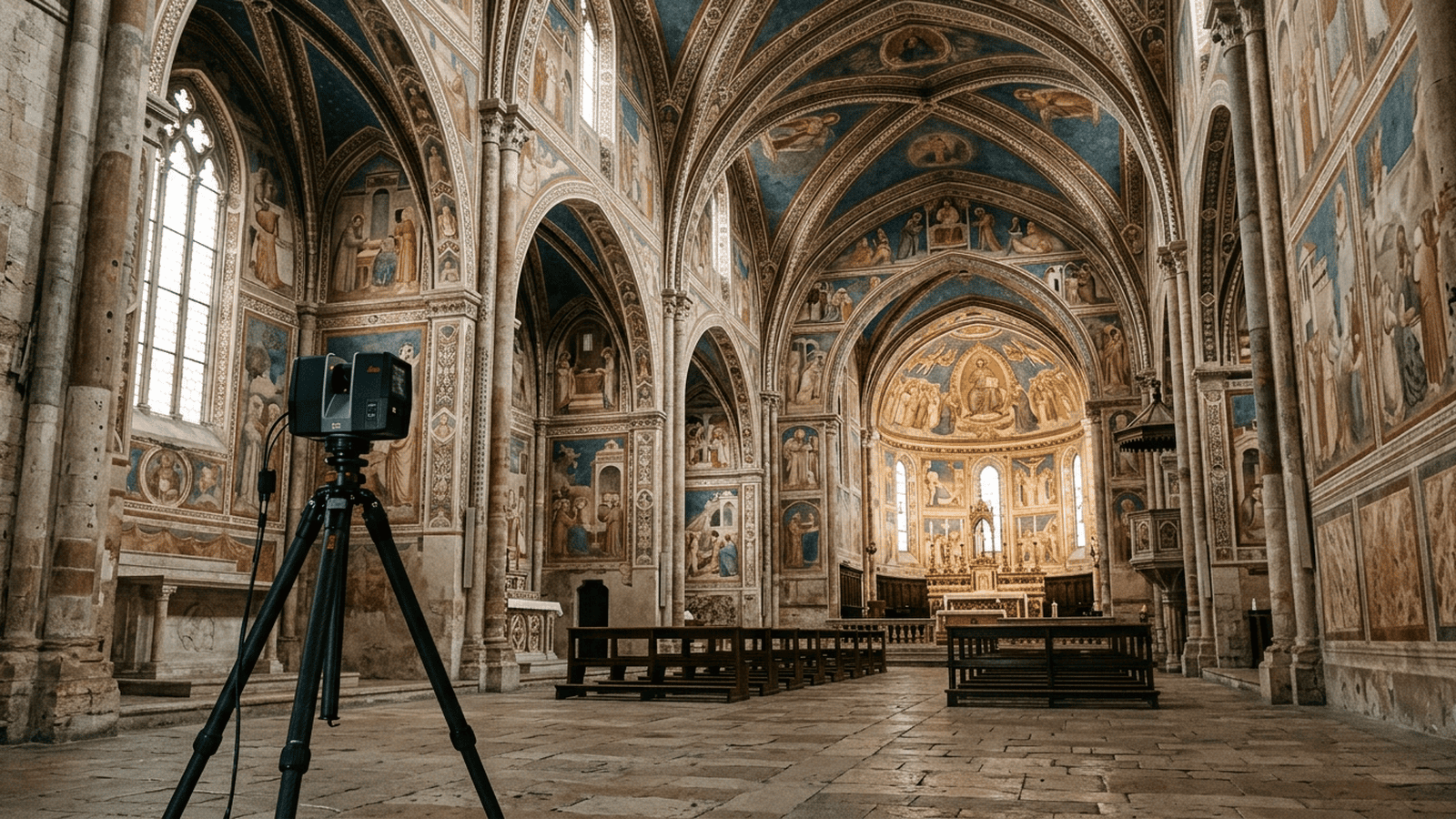
Friars at the Basilica of Saint Francis of Assisi are working with art historians and technology company Haltadefinizione to build a detailed digital twin of the historic church. Cameras, drones and lasers are collecting hundreds of thousands of images that will form a three-dimensional blueprint and a reconstruction guide in the event of another earthquake. The team also plans to use AI to help place some of more than 80,000 fragments and analyze damage to paintings. The digital twin is expected to be complete next year and available to the public. The report does not state the project’s cost or explain access rules for the underlying restoration data.
TLDR: A digital model of Assisi’s Basilica of Saint Francis is intended to help restorers document the building and respond to future earthquake damage. The public version is expected next year, while AI may assist with fragments and art analysis.
Nearly three decades after earthquakes damaged the Basilica of Saint Francis of Assisi, restorers still face a task that has resisted years of careful work: identifying where more than 80,000 fragments of the 13th-century church belong. A new project is bringing friars, art historians and software engineers together to use detailed digital images and artificial intelligence in the continuing restoration. The tools are meant to help document the basilica and support future work, not replace the people responsible for it.
The practical reason for the project is clear. A digital record can give restorers a detailed reconstruction guide if another earthquake damages the building, while AI may help sort fragments and assess problems in paintings more quickly than a person working by hand. Friar Cesareo has described the larger aim as sharing the basilica’s “treasure of faith and beauty” with more people and in a more efficient way.
The basilica stands in the hills of Umbria in central Italy and is the resting place of Saint Francis. Its walls hold works by medieval artists including Cimabue, Pietro Lorenzetti, Simone Martini and Giotto, who painted scenes from Francis’s life. The building has endured more than 20 earthquakes, according to Sergio Fusetti, who has worked on its art restoration since the 1970s.
Two powerful earthquakes struck one after another in 1997 and damaged part of the roof. Falling rubble killed four people, and Fusetti was hospitalized after being injured in the second quake. Restorers painstakingly repaired frescoes and other art, but the work remains incomplete: some frescoes are still pockmarked, some walls are bare, and more than 80,000 fragments have not been matched to their original locations.
That unresolved puzzle is one reason Fusetti said artificial intelligence could help. Friars are working with Haltadefinizione, a company that specializes in ultra-high-definition photography. The company’s chief technology officer, Giovanni Borelli, is leading the effort to create a digital twin, or detailed digital representation, of the basilica.
The team is using cameras, drones and lasers to collect hundreds of thousands of images. The equipment can record details that are difficult to see with the human eye, including brushstrokes and other features of the artwork. The images will be combined into a three-dimensional blueprint described in the source report as the highest-resolution 3D blueprint of a building ever made.
That record is intended to serve a practical purpose as well as a historical one. If another earthquake strikes the area, restorers would have an exact reconstruction road map to consult. The digital twin is expected to be complete next year and will be available to the public. The project therefore offers a way to preserve detailed information about the building while also widening access to its art.
Borelli’s team also plans to use AI to help fit some missing pieces into the church and examine damage such as cracks, discoloration and lifting paint. Borelli said a full round of that kind of analysis by people working with their eyes and hands could take years, while AI could complete it in minutes. That is a comparison of speed, not a claim that software can make every restoration decision. The source does not specify how AI-generated matches will be checked or who will make final judgments about repairs.
The technology has limits. Borelli has acknowledged that virtual reality cannot reproduce the emotional effect of standing in front of a historic work of art. Still, digital experiences can let users explore parts of Italy’s past from elsewhere. Similar technology has been used to record the remains of a Roman emperor’s thermal bath, where laser scanning captured rooms with 30-foot ceilings and delicate mosaics, while cameras revealed hidden chambers and passageways.
The practical details reported so far are specific about equipment and timing but limited in other areas. The team is collecting images with cameras, drones and lasers, and the public version of the basilica’s digital twin is scheduled for completion next year. The report gives no project cost, application forms, access fees, compliance rules or enforcement process. It also does not explain who will control access to the underlying restoration data beyond saying the completed digital twin will be public.
The next step is completion of the digital model, followed by its planned public availability next year. AI-assisted analysis and the work of matching fragments remain part of the restoration effort, while questions about review procedures and data control are not detailed in the report. The project’s stated aim is to preserve the basilica’s art and make it accessible to more people; the results and the promised public access will provide the next points to watch.

Sophie Carter serves as a Staff Writer for Just Right News, where she anchors the outlet’s critical coverage of Elections, Influence, and Democracy Infrastructure. In an era where the mechanics of voting and the flow of political capital are under constant scrutiny, Sophie provides a steady, principled voice dedicated to the preservation of American institutional integrity and the rule of law.
Raised in Charlotte, North Carolina, Sophie’s perspective was forged in a community that balances rapid modern growth with a deep respect for tradition and civic duty. Growing up in the Queen City, she witnessed firsthand how a robust local culture depends on the trust between the citizen and the state. This upbringing instilled in her a foundational belief that the right to vote is a sacred trust—one that must be protected from both administrative overreach and the encroaching influence of special interest groups. Her reporting reflects these North Carolina roots, emphasizing the importance of community-led governance and the preservation of the individual’s voice in the face of nationalized political movements.
Now based in Atlanta, Georgia, Sophie operates from the heart of one of the nation’s most pivotal and contested political landscapes. Her location allows her to report from the front lines of the debate over election security, legislative reform, and the modernization of voting systems. For Sophie, the “infrastructure” of democracy is not merely a matter of machines and ballots; it is the collection of laws, people, and transparent processes required to maintain public confidence. Her work often highlights the necessity of clear, enforceable standards that ensure every legal vote is counted fairly and that the machinery of our republic remains accountable to the taxpayers who fund it.
Central to her work at Just Right News is her acclaimed feature series, “The Price of a Vote.” Through this ongoing project, Sophie explores the complex web of influence that shapes modern campaigns and policy decisions. She delves into how high-level lobbying, non-governmental organizations, and shifting bureaucratic regulations impact the weight of an individual citizen’s ballot. By examining the financial and structural pressures placed on the electoral process, she provides readers with a comprehensive look at the forces vying for control over the American political system.
Sophie’s approach to journalism is rooted in a commitment to the constitutional framework. She views her role as a watchdog for the voter, ensuring that the systems meant to serve the public remain transparent and free from corruption. Whether she is analyzing the implementation of new voting technologies or investigating the influence of outside money on state-level policy, her work is characterized by a rigorous adherence to facts and a refusal to succumb to the sensationalism that often plagues modern political reporting.
At Just Right News, Sophie Carter continues to be a vital resource for readers who value clarity, conviction, and a defense of traditional American values. Her deep ties to the Southeast and her specialized focus on the mechanics of our republic make her an essential voice in the ongoing conversation about the future of American self-governance. Through her reporting, she remains dedicated to the idea that a secure and honest electoral system is the bedrock of a free and prosperous society.