

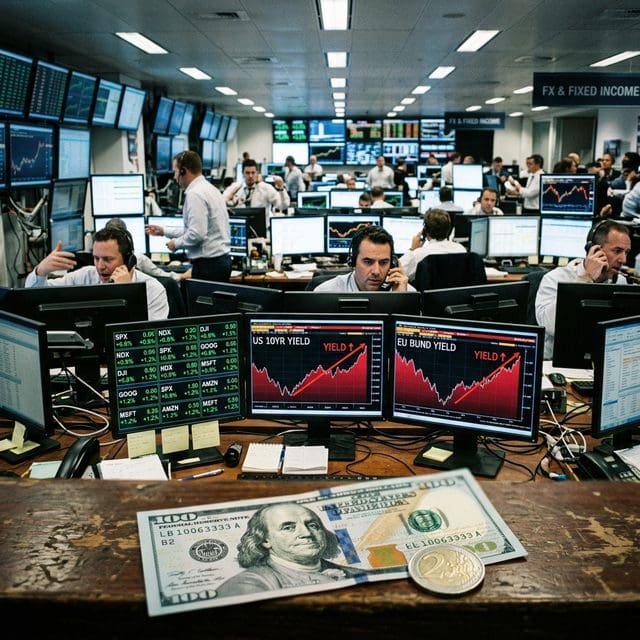
The S&P 500 gained 0.76% as a disappointing September jobs report cooled Federal Reserve rate hike expectations, while European fiscal instability and volatile energy markets continue to pressure global financial systems.
The American equity market demonstrated resilience in Friday trading as the SPY benchmark rose 0.73%, mirroring a broader 0.76% gain in the S&P 500. This upward movement in U.S. stocks occurred despite a starkly disappointing employment report from the Bureau of Labor Statistics. Employers added a mere 29,000 jobs in September, falling far short of the 90,000 consensus estimate. Furthermore, August payroll figures were revised downward to 133,000, and the national unemployment rate rose to 4.2%.
For the American taxpayer, this cooling labor market represents a double-edged sword. While the slowdown suggests a weakening economy, it has forced the Federal Reserve to reconsider its aggressive tightening cycle. Market expectations for an October interest rate hike plummeted from 64% a week ago to roughly 16–23% following the data release. This shift provided a temporary reprieve for growth-oriented sectors, with the Nasdaq Composite outperforming the broader market with a 1.19% gain. The market appears to be betting that a weakening labor market will stay the Fed’s hand, even as a December increase remains a lingering possibility.
However, the stability of the U.S. financial system remains challenged by the bond market. The 10-year Treasury yield, a critical benchmark for mortgages and consumer loans, initially dipped below 5.17% on the weak jobs data before rebounding to approximately 5.28%. This persistent pressure on yields, which recently hit a 24-year high of 5.34%, indicates that investors remain concerned about long-term fiscal sustainability and the massive supply of government debt. The rebound in yields suggests that labor data alone cannot fully reverse the broader bond-market pressure that has characterized the most recent quarter.
Internationally, the contrast to U.S. equity gains is sharp. France is currently grappling with a burgeoning fiscal crisis as it seeks 54 billion euros in budget savings for 2027. The spread between French and German 10-year yields has widened beyond 150 basis points, a level not seen since the 2011 euro-zone debt crisis. Credit default swaps for France have nearly tripled in a month, reaching 87 basis points, reflecting deep skepticism regarding European sovereign solvency. This regional instability pushed the euro below $1.13, its lowest level since May 2025, further strengthening the U.S. dollar index to 102.09.
Energy markets provided a moment of relief for household budgets as Brent crude settled at $99.74 and WTI fell 3.8% to $89.34. The decline followed discussions by EU governments to release 50 million barrels of diesel to stabilize supply, while IEA members considered releasing another 50 million barrels of crude. Nevertheless, institutional analysts at Barclays warned that this relief may be short-lived, raising their 2026 Brent forecast to $100 per barrel due to tight physical inventories and geopolitical exposure. This volatility is further complicated by the CME Group’s recent decision to suspend plans for a new 10-barrel crude oil futures contract.
In the corporate sector, the “Invisible Economy” continues to undergo consolidation and technological shifts. Akamai recently agreed to a $12 billion deal to supply cloud services to Anthropic, while the Trump administration signed a voluntary AI safety accord with giants like Nvidia and Meta. These developments, alongside Bain & Co.’s projection that the AI market could reach $6 trillion by 2031, suggest that while the labor market stumbles, capital continues to flow into centralized technological infrastructure. For the working household, the message is clear: while the SPY remains positive, the underlying structural realities of high debt, rising unemployment, and geopolitical energy risks require a vigilant approach to fiscal responsibility.

Jordan Lee serves as the Senior Correspondent for Wall Street, Finance, and Monetary Systems at Just Right News. Based in the heart of the world’s financial capital, New York City, Lee brings a sharp, principled eye to the complex mechanisms that drive the global economy. His reporting is defined by a commitment to fiscal responsibility, the defense of the free market, and a deep-seated belief that a transparent monetary system is the bedrock of a free society.
Raised in Portland, Oregon, Lee’s perspective was forged in a city that has undergone significant cultural and economic shifts. His upbringing in the Pacific Northwest instilled in him a profound appreciation for the industriousness of small business owners and the importance of local economic stability. Watching the evolution of his hometown’s landscape sparked an early interest in how federal fiscal policy and large-scale financial trends eventually trickle down to the average citizen. This background provides him with a unique vantage point; he understands the growing disconnect between the policy-making elite and the reality of Main Street, a theme that frequently resonates throughout his work.
Now operating from his base in New York City, Lee bridges the gap between the high-stakes trading floors of Manhattan and the households of everyday Americans. He views the financial sector not merely as a collection of numbers and tickers, but as a vital engine of American prosperity that requires constant vigilance and accountability. His reporting often highlights the dangers of centralized financial control and the necessity of maintaining a system that rewards merit, risk-taking, and innovation.
As the creator and lead of the featured series, “The Invisible Economy,” Lee pulls back the curtain on the often-opaque world of monetary systems. He specializes in translating the dense jargon of central banking and international finance into actionable insights for the Just Right News audience. His work explores the “invisible” forces—such as inflationary pressures, regulatory creep, and the expansion of the administrative state—that erode the purchasing power of American families. By focusing on these systemic issues, Lee empowers readers to understand the hidden forces shaping their financial independence.
Lee’s journalistic philosophy is rooted in a steadfast commitment to traditional American values. As an Asian American professional who has navigated the competitive corridors of the financial world, he is a vocal advocate for meritocracy and the preservation of the American Dream. He believes that a stable currency and a predictable regulatory environment are essential for national sovereignty and individual liberty. His reporting frequently warns against the risks of government overreach in the private sector, arguing that the most effective solutions to economic challenges arise from competition and individual enterprise rather than bureaucratic mandates.
At Just Right News, Jordan Lee remains dedicated to providing a clear-eyed defense of the taxpayer. Whether he is analyzing market volatility or investigating the long-term implications of national debt, his mission is to provide the truth about where the money is going and what it means for the future of the country. Through his rigorous analysis and principled stance, Lee has become a trusted voice for those who value a strong, sovereign, and fiscally sound America.