

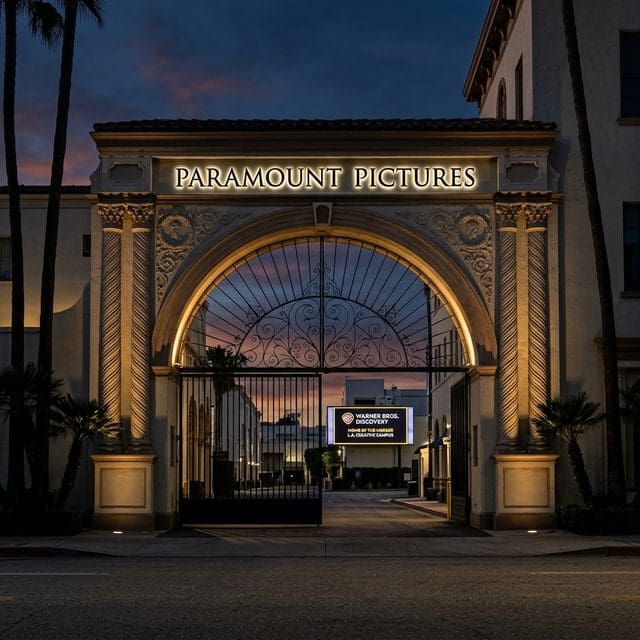
A federal judge approved Paramount’s $110 billion acquisition of Warner Bros Discovery, signaling a massive shift in media ownership despite growing concerns over market concentration.
The landscape of American media is undergoing a seismic shift as the $110 billion acquisition of Warner Bros Discovery by Paramount moves toward a scheduled October 6 closing. U.S. District Judge Araceli Martínez-Olguín cleared the path for the transaction by approving a settlement with 12 state attorneys general, lifting the previous order that had stalled the deal. While the Department of Justice closed its eight-month investigation in June, the finalization of this merger marks a significant moment of industry consolidation that skeptics argue could stifle competition.
Under the terms of a five-year consent decree, the newly combined entity must maintain specific production levels to mitigate the impact on the theatrical market. The company must release 30 films annually during the first two years, increasing to 32 films in years three through five. Crucially, these films must generally adhere to a 45-day theatrical window and remain off subscription streaming for at least 90 days. To address labor concerns, the settlement includes a $1.5 billion commitment to domestic film production and a $47.5 million worker-impact fund.
Despite these concessions, the merger faces lingering resistance. A group of streaming customers has petitioned the Ninth Circuit to intervene, arguing that the massive scale of the new corporation will lead to higher prices and reduced variety. Furthermore, the establishment of a five-member editorial-independence panel to oversee CBS News and CNN has drawn criticism. Observers note that the Ellison family, who will hold significant influence over the combined firm, retains authority over panel appointments, casting doubt on whether the body can truly act as an independent check against corporate bias.
Internal restructuring is already underway as the two giants integrate their vast holdings. Reports indicate that James Gunn and Peter Safran, the architects of the current DC Studios strategy, will remain at the helm of the superhero label at least initially. Gunn’s contract reportedly runs through 2027, following the release of Man of Tomorrow. However, the consolidation is expected to claim high-level casualties, with Warner Bros film chiefs Mike De Luca and Pam Abdy expected to depart. Paramount film co-chairs Dana Goldberg and Josh Greenstein are slated to oversee the combined film operations, centralizing control of two of Hollywood’s most historic libraries.
The DOJ’s decision to close its probe after reviewing over 2 million documents suggests a belief that the merger will not fundamentally break the competitive nature of the entertainment industry. The department concluded that the deal was unlikely to harm competition in SVOD, linear television, or theatrical distribution. Yet, for small businesses in the production supply chain and consumers facing a shrinking pool of providers, the long-term effects remain to be seen. The settlement also imposes new cable-negotiation safeguards, but critics remain wary of how these rules will be enforced in a market with fewer players.
As the October 6 deadline approaches, the focus shifts to the boardroom, where the realities of managing a media monopoly will manifest. The deal represents a high-stakes bet that scale is the only way to survive in the digital age, even if that scale comes at the cost of market diversity. While the legal hurdles have largely been cleared, the Ninth Circuit’s potential involvement serves as a reminder that the public remains skeptical of concentrated corporate power. For now, the industry watches as two of the most influential names in Western media become one.

Greg Sanders serves as the Senior Correspondent for Corporate Power and Antitrust at Just Right News, where he brings a principled, conservative perspective to the complex intersection of big business, government regulation, and the American consumer. With a career dedicated to investigative depth and economic clarity, Greg has become a leading voice in examining how the consolidation of industry power impacts the foundational values of the free market and individual liberty.
Raised in Denver, Colorado, Greg’s reporting is deeply informed by the Western spirit of independence and a healthy skepticism of centralized authority. Growing up in the shadows of the Rockies, he witnessed firsthand the importance of local entrepreneurship and the vital role that small-medium enterprises play in sustaining vibrant communities. This upbringing instilled in him a belief that the American Dream is best preserved when the playing field remains level and when competition—rather than backroom deals between corporate lobbyists and federal regulators—dictates success. For Greg, the rugged individualism of his home state serves as a constant reminder that the economy should serve the people, not the other way around.
Now based in Chicago, Illinois, Greg operates from the heart of the nation’s industrial and financial crossroads. His location in the Midwest provides him with a unique vantage point to observe the real-world consequences of corporate overreach. From the boardrooms of the Loop to the manufacturing hubs that define the region, he tracks the movement of capital and the shifting tides of market influence. Chicago’s history as a center of trade and labor offers a rich backdrop for his work, allowing him to bridge the gap between high-level economic theory and the lived experiences of hardworking Americans who feel the squeeze of monopolistic practices.
At Just Right News, Greg’s beat focuses on the “new monopolies” and the rise of “woke” corporate culture. He argues that when corporations become too large, they often abandon their fiduciary duties to shareholders in favor of social engineering and political posturing. His reporting seeks to hold these “Titans” accountable, ensuring that the power of the purse is not used to silence dissent or bypass the democratic process. He is a firm advocate for the idea that true conservatism requires a vigilant defense of competition, preventing any single entity—public or private—from exerting undue control over the lives of citizens.
This mission is most clearly seen in his acclaimed feature series, “The Titans and the Toll.” In this ongoing project, Greg explores the human cost of market consolidation, from the erosion of consumer choice to the decline of local economies. Through rigorous analysis and boots-on-the-ground reporting, he documents how the concentration of power in sectors like tech, agriculture, and finance creates a “toll” paid by the average family.
Greg Sanders remains committed to the idea that a transparent, competitive market is the greatest engine for prosperity ever devised. Through his work at Just Right News, he continues to provide the essential oversight necessary to protect that engine from the encroaching influence of corporate giants and the bureaucratic structures that enable them.