

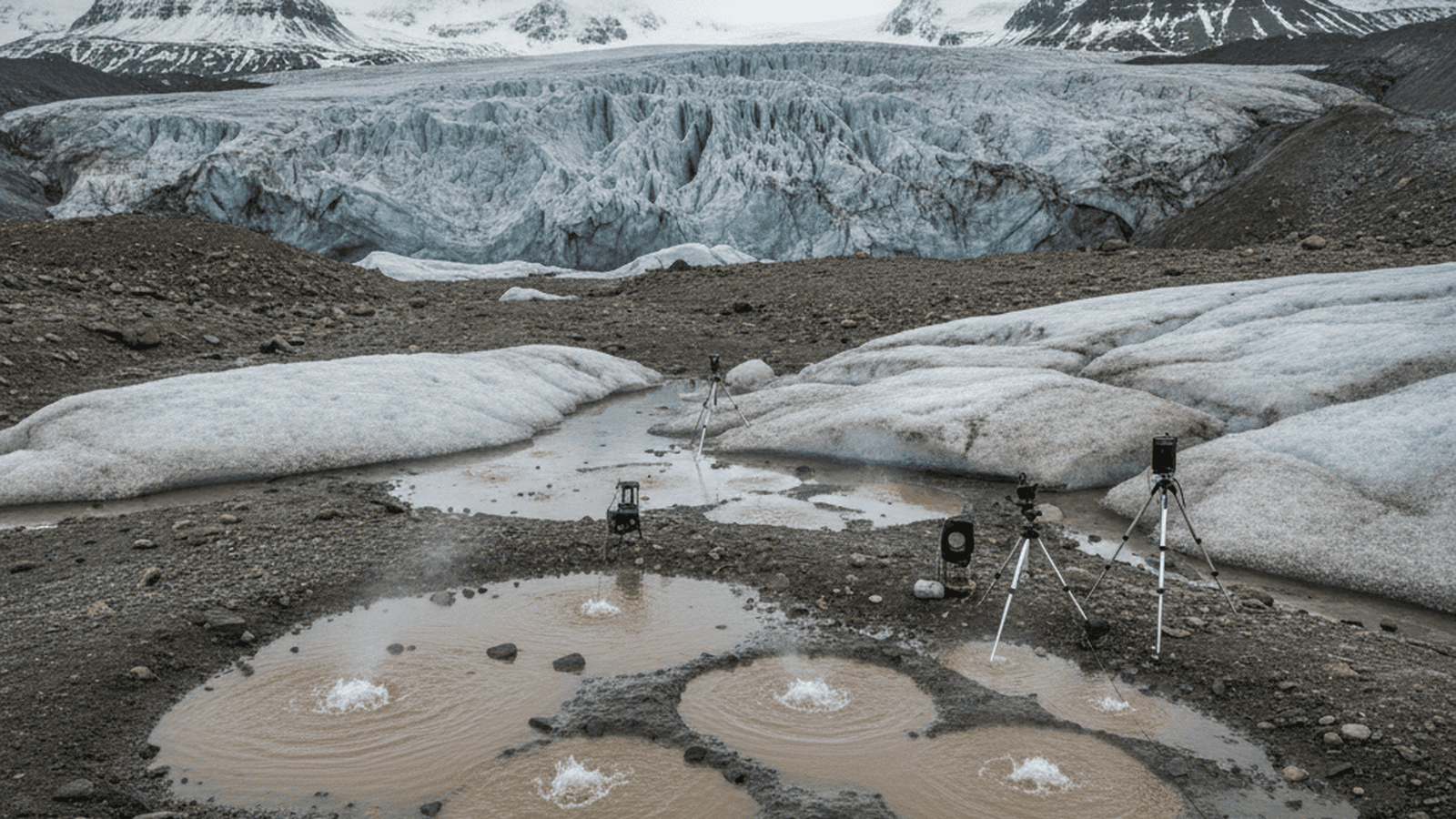
Researchers in Svalbard have identified a new source of methane emissions originating from groundwater springs exposed by retreating glaciers. These springs tap into ancient geological reservoirs, releasing the potent greenhouse gas into the atmosphere as the Arctic warms.
TLDR: A field expedition in Svalbard has revealed that retreating glaciers are uncovering groundwater springs that vent ancient methane. This discovery identifies a previously unaccounted-for feedback loop in Arctic climate models, as melting ice triggers the release of geological gases that further accelerate global warming.
Field expeditions in the Svalbard archipelago have identified a significant and previously unquantified source of methane emissions linked to the rapid retreat of Arctic glaciers. Researchers from the University of Cambridge and the University Centre in Svalbard discovered that as glaciers shrink, they expose groundwater springs that vent ancient methane into the atmosphere. This process reveals a complex feedback loop where glacial melting directly triggers the release of potent greenhouse gases from deep geological reservoirs. The study involved extensive fieldwork across 78 glaciers in Svalbard over a three-year period. Scientists sampled groundwater emerging from the forefields of these retreating ice masses, finding methane concentrations up to 600,000 times higher than those found in surface waters in equilibrium with the atmosphere. Unlike methane produced by modern biological processes in thawing permafrost, this gas originates from shale and coal beds located deep beneath the glacial footprint.
Glaciers act as a pressurized lid, keeping these geological gases trapped underground for millennia. As the ice thins and moves back, the pressure is relieved, allowing groundwater to carry the methane to the surface through newly exposed springs. These springs, known as icings or naleds when they freeze in winter, provide a year-round pathway for gas escape. The researchers noted that these emissions are particularly high in areas where the underlying geology consists of organic-rich sedimentary rocks. To distinguish the source of the gas, the team utilized isotopic analysis, which measures the ratio of different carbon atoms within the methane molecules. The results confirmed that the methane was thermogenic, meaning it was formed over millions of years through heat and pressure within the Earth’s crust. This distinction is crucial because it indicates a nearly inexhaustible supply of gas compared to the finite amount of organic matter available in surface soils.
The field conditions in Svalbard presented unique challenges for the research team during the data collection phase. Accessing the remote glacial forefields required the use of snowmobiles and specialized boats, often in sub-zero temperatures and high winds. Researchers also had to maintain constant vigilance for polar bears, which are common in the archipelago. Despite these hurdles, the team successfully mapped hundreds of springs, providing the first comprehensive look at this hidden carbon pathway. The discovery has significant implications for global climate modeling and future temperature projections. Most current projections of Arctic methane emissions focus on the microbial breakdown of organic matter in thawing permafrost. However, the Svalbard findings suggest that geological methane released via glacial retreat could be a major contributor that has been largely ignored.
Because the Arctic is warming nearly four times faster than the global average, the rate of glacial retreat is accelerating, potentially increasing the frequency and intensity of these methane seeps. Data collected during the expedition showed that the total methane flux from these springs across Svalbard could be substantial. While the current volume is a fraction of global methane sources, the localized impact on the Arctic atmosphere is pronounced. The researchers emphasized that this phenomenon is likely not unique to Svalbard and could be occurring across other glaciated regions with similar geological characteristics, such as parts of the Canadian Arctic and Greenland. Future research will focus on mapping the geological formations most likely to harbor these ancient gas reservoirs. Scientists aim to integrate these groundwater-driven emissions into broader Earth system models to better predict the pace of Arctic warming. Understanding the interplay between ice dynamics and deep-earth carbon stores remains a critical frontier in climate science as the world seeks to quantify the full extent of natural feedback mechanisms.

Mark Davis serves as the Senior Correspondent for Energy, Climate, and Resource Economics at Just Right News. In an era where the conversation around the environment is often dominated by alarmism and top-down mandates, Mark provides a vital, market-oriented perspective on the complex forces shaping our world. As the lead voice behind the acclaimed feature series “Power and the Planet,” he explores the intersection of environmental policy, global energy markets, and the fundamental economic principles that sustain modern civilization.
Mark’s pragmatic approach to resource management was forged in the high desert of his hometown, Albuquerque, New Mexico. Growing up in a region defined by both its breathtaking natural beauty and its rugged, resource-dependent landscape, he developed an early appreciation for the delicate balance between conservation and utilization. New Mexico’s unique position as a hub for both traditional energy production and cutting-edge scientific research provided Mark with a front-row seat to the evolution of the American energy sector. This upbringing instilled in him a deep-seated belief that true environmental stewardship is inseparable from economic prosperity and technological innovation.
Now based in Boulder, Colorado, Mark operates from the heart of the nation’s climate research community. While Boulder is often seen as a bastion of environmental idealism, Mark utilizes his post to provide a necessary counterweight, grounded in the realities of resource economics. He understands that energy policy does not exist in a vacuum; it has tangible consequences for the American taxpayer, the stability of the national power grid, and the strength of the domestic manufacturing sector. By reporting from the front lines of the climate debate, he is able to challenge prevailing narratives with hard data and a commitment to the principles of the free market.
Throughout his tenure at Just Right News, Mark has distinguished himself by focusing on the “Resource Economics” aspect of his beat. He frequently highlights the hidden costs of rapid energy transitions and advocates for an “all-of-the-above” energy strategy that prioritizes American energy independence. His work often shines a light on the geopolitical implications of resource scarcity, arguing that a secure nation must first be an energy-secure nation. Whether he is analyzing the impact of federal land-use regulations or investigating the supply chains required for new technologies, Mark remains focused on how policy decisions affect the lives and livelihoods of everyday citizens.
In “Power and the Planet,” Mark continues to bridge the gap between complex scientific concepts and the economic realities facing the country. He rejects the false choice between a healthy environment and a thriving economy, instead seeking out solutions that leverage American ingenuity and private-sector competition. For Mark, reporting on the climate is not about following the latest trends, but about ensuring that the conversation remains tethered to the foundational values of liberty, property rights, and fiscal responsibility. His contributions ensure that Just Right News readers receive a comprehensive, clear-eyed view of the challenges and opportunities defining the future of our planet.