

Federal regulators intensify probes into heavy industry and tech monopolies as questions regarding the Department of Justice’s political independence complicate the landscape for corporate competition and market power.
Federal antitrust authorities are navigating a complex and increasingly fraught landscape of industrial consolidation and technological dominance. As the Department of Justice (DOJ) ramps up its scrutiny of massive mergers and alleged price-fixing schemes, the structural independence of the agency has become a central point of contention. While the administration maintains an active docket against corporate giants, the intersection of market power and political influence remains a primary concern for those advocating for a truly free and competitive market.
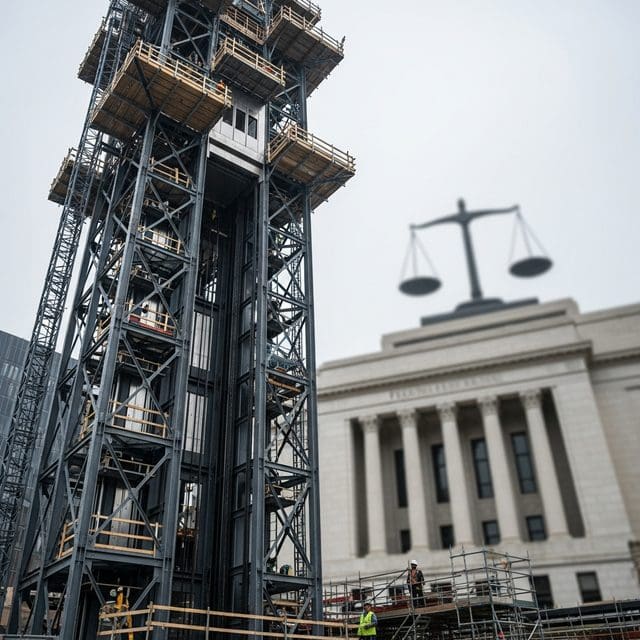
In a significant move within the heavy industry sector, the DOJ’s Antitrust Division issued a formal “second request” for information on August 10 regarding Kone’s proposed €29.4 billion acquisition of TK Elevator. This deal is not merely a corporate transaction; it is a bid to create the world’s largest elevator manufacturer. For small-business owners and property managers, such consolidation threatens to eliminate the thin margins of competition that keep maintenance costs manageable. The probe signals that regulators are at least nominally committed to preventing the kind of industrial oligopoly that has previously stifled innovation in the American heartland.
The DOJ is also maintaining pressure on established giants through new litigation. This month, the agency, alongside the State of Tennessee, filed suit against CRH plc, while also targeting Cal-Maine Foods. These cases, centered on allegations of monopolization and price-fixing, represent a traditional approach to antitrust enforcement. However, these actions are being viewed through a lens of political skepticism following an August 16 interview on Meet the Press. Attorney General Todd Blanche’s refusal to provide definitive assurances regarding the DOJ’s independence from the White House has fueled fears that antitrust priorities could be selectively applied based on executive preference rather than neutral market principles.
This tension is particularly evident in the burgeoning artificial intelligence sector. Anthropic recently filed formal objections to the DOJ’s proposed remedies in the Google search antitrust case. Anthropic warns that requirements for advance notice on AI investments could inadvertently entrench Big Tech by giving incumbents a roadmap of their smaller rivals’ moves. Industry groups like Engine Advocacy and TechNet have joined this chorus, arguing that these mandates may stifle the flow of capital to smaller AI firms. In their view, the government’s attempt to fix one monopoly may inadvertently create a regulatory environment that prevents new competitors from ever reaching scale.
Simultaneously, the market dominance of SpaceX has reached a new zenith following its June IPO, which valued the company at a staggering $1.77 trillion. With a $75 billion capital raise, SpaceX now possesses the financial might to potentially leverage its launch monopoly into adjacent sectors such as satellite broadband and defense. FTC records released under FOIA indicate that consumer and competitor grievances were logged as recently as June 29, 2026. These complaints highlight the risk of a single entity controlling the literal gateway to space, yet it remains to be seen if the DOJ will treat this politically connected firm with the same rigor it applies to the elevator or egg industries.
As the administration balances these domestic cases against shifting global dynamics—including the reopening of the Strait of Hormuz and the subsequent 10% drop in oil prices following a memorandum of understanding with Iran—the necessity for transparent enforcement is paramount. The DOJ has filed 21 statements of interest in private antitrust suits recently, signaling an activist stance. However, if the public perceives that enforcement is being weaponized or withheld based on political alignment, the very foundation of market competition is at risk. The human cost of market power is felt most acutely when the rules of the game are rewritten to favor the few at the expense of the many.

Greg Sanders serves as the Senior Correspondent for Corporate Power and Antitrust at Just Right News, where he brings a principled, conservative perspective to the complex intersection of big business, government regulation, and the American consumer. With a career dedicated to investigative depth and economic clarity, Greg has become a leading voice in examining how the consolidation of industry power impacts the foundational values of the free market and individual liberty.
Raised in Denver, Colorado, Greg’s reporting is deeply informed by the Western spirit of independence and a healthy skepticism of centralized authority. Growing up in the shadows of the Rockies, he witnessed firsthand the importance of local entrepreneurship and the vital role that small-medium enterprises play in sustaining vibrant communities. This upbringing instilled in him a belief that the American Dream is best preserved when the playing field remains level and when competition—rather than backroom deals between corporate lobbyists and federal regulators—dictates success. For Greg, the rugged individualism of his home state serves as a constant reminder that the economy should serve the people, not the other way around.
Now based in Chicago, Illinois, Greg operates from the heart of the nation’s industrial and financial crossroads. His location in the Midwest provides him with a unique vantage point to observe the real-world consequences of corporate overreach. From the boardrooms of the Loop to the manufacturing hubs that define the region, he tracks the movement of capital and the shifting tides of market influence. Chicago’s history as a center of trade and labor offers a rich backdrop for his work, allowing him to bridge the gap between high-level economic theory and the lived experiences of hardworking Americans who feel the squeeze of monopolistic practices.
At Just Right News, Greg’s beat focuses on the “new monopolies” and the rise of “woke” corporate culture. He argues that when corporations become too large, they often abandon their fiduciary duties to shareholders in favor of social engineering and political posturing. His reporting seeks to hold these “Titans” accountable, ensuring that the power of the purse is not used to silence dissent or bypass the democratic process. He is a firm advocate for the idea that true conservatism requires a vigilant defense of competition, preventing any single entity—public or private—from exerting undue control over the lives of citizens.
This mission is most clearly seen in his acclaimed feature series, “The Titans and the Toll.” In this ongoing project, Greg explores the human cost of market consolidation, from the erosion of consumer choice to the decline of local economies. Through rigorous analysis and boots-on-the-ground reporting, he documents how the concentration of power in sectors like tech, agriculture, and finance creates a “toll” paid by the average family.
Greg Sanders remains committed to the idea that a transparent, competitive market is the greatest engine for prosperity ever devised. Through his work at Just Right News, he continues to provide the essential oversight necessary to protect that engine from the encroaching influence of corporate giants and the bureaucratic structures that enable them.