

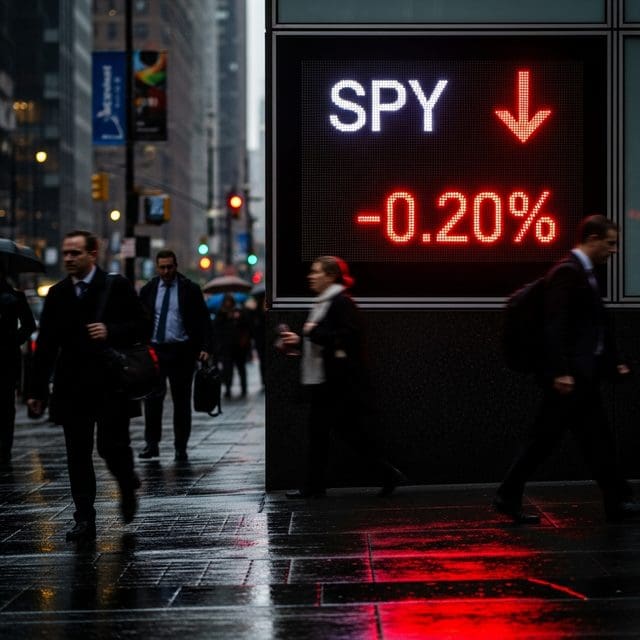
U.S. equities face modest pressure as a sharp decline in consumer sentiment and a K-shaped wealth gap challenge the stability of the current market rally.
The American equity market experienced a measured pullback in recent trading sessions, with the SPY benchmark slipping 0.20% to close at $776.34. This marginal decline reflects a broader trend of profit-taking as the S&P 500 hovers near record levels, closing at 7,785.76. While institutional narratives point to a resilient tech sector and stable megacap earnings, the underlying data suggests a growing disconnect between Wall Street valuations and the economic reality facing Main Street households. The day’s range for the SPY, between $775.43 and $778.89, indicates tentative follow-through selling rather than a structural rout.
Consumer sentiment has emerged as a primary headwind for the domestic economy, falling 8% in early August to a reading of 51. This decline is particularly pronounced among households concerned with fiscal management, with sentiment drops especially sharp among Republican respondents. Despite a slight cooling in certain inflationary markers, the K-shaped recovery continues to widen the wealth gap. High-income earners sustain demand for luxury travel and discretionary services, even as airfares surge 25% year-over-year. Conversely, lower-income consumers show signs of exhaustion, evidenced by the sharpest drop in retail sales in 14 months, driven by reduced online spending and cheaper gasoline prices that have failed to stimulate broader demand.
In the fixed-income and commodities space, the U.S. 10-year Treasury yield settled near 4.676%, indicating a slight easing in long-term rate expectations, though some intraday volatility pushed the yield toward 4.70%. Gold provided a notable hedge against domestic uncertainty, climbing 1.78% to reach $4,461. This flight to hard assets, combined with a VIX reading that remains near yearly lows at 14.60, suggests that while implied volatility is muted, investors are quietly positioning for a more defensive environment as they weigh the impact of a softening consumer base.
Internationally, the picture remains mixed. While U.S. indices like the Nasdaq 100 showed modest resilience with a 0.93% uptick in certain sessions, Asian markets provided a stronger risk-on signal. The KOSPI stood out with a 3.68% surge, while the Nikkei and CSI300 posted gains of 0.83% and 0.58% respectively. However, for the American taxpayer, these global gains are secondary to the domestic reality of constrained demand. The recent decline in retail sales following the July Amazon Prime event suggests that the underlying consumer demand trend, while appearing solid to some analysts, is increasingly reliant on specific promotional cycles.
Corporate activity remains concentrated in consolidation and technological integration. Clearlake Capital Group’s acquisition of Starborn Industries and Industrial Control Solutions’ purchase of Modern Instrument Company highlight a trend of institutional scaling in the aerospace and industrial sectors. Furthermore, the launch of the Market Maker Performance Index by Forgd on Tokenomist signals an increasing institutionalization of the cryptocurrency space, assigning letter grades to market makers in an attempt to bring Wall Street-style oversight to digital assets.
As the Invisible Economy continues to shift, the stability of the monetary system remains tethered to a consumer base that is increasingly vocal about its lack of confidence in the current trajectory. For the working household, the modest 0.20% dip in the SPY is less about a single day of trading and more about the persistent pressure of airfare inflation and the widening wealth gap. The resilience of tech earnings may keep the indices afloat for now, but the erosion of consumer sentiment to multi-year lows serves as a stark warning for the months ahead.

Jordan Lee serves as the Senior Correspondent for Wall Street, Finance, and Monetary Systems at Just Right News. Based in the heart of the world’s financial capital, New York City, Lee brings a sharp, principled eye to the complex mechanisms that drive the global economy. His reporting is defined by a commitment to fiscal responsibility, the defense of the free market, and a deep-seated belief that a transparent monetary system is the bedrock of a free society.
Raised in Portland, Oregon, Lee’s perspective was forged in a city that has undergone significant cultural and economic shifts. His upbringing in the Pacific Northwest instilled in him a profound appreciation for the industriousness of small business owners and the importance of local economic stability. Watching the evolution of his hometown’s landscape sparked an early interest in how federal fiscal policy and large-scale financial trends eventually trickle down to the average citizen. This background provides him with a unique vantage point; he understands the growing disconnect between the policy-making elite and the reality of Main Street, a theme that frequently resonates throughout his work.
Now operating from his base in New York City, Lee bridges the gap between the high-stakes trading floors of Manhattan and the households of everyday Americans. He views the financial sector not merely as a collection of numbers and tickers, but as a vital engine of American prosperity that requires constant vigilance and accountability. His reporting often highlights the dangers of centralized financial control and the necessity of maintaining a system that rewards merit, risk-taking, and innovation.
As the creator and lead of the featured series, “The Invisible Economy,” Lee pulls back the curtain on the often-opaque world of monetary systems. He specializes in translating the dense jargon of central banking and international finance into actionable insights for the Just Right News audience. His work explores the “invisible” forces—such as inflationary pressures, regulatory creep, and the expansion of the administrative state—that erode the purchasing power of American families. By focusing on these systemic issues, Lee empowers readers to understand the hidden forces shaping their financial independence.
Lee’s journalistic philosophy is rooted in a steadfast commitment to traditional American values. As an Asian American professional who has navigated the competitive corridors of the financial world, he is a vocal advocate for meritocracy and the preservation of the American Dream. He believes that a stable currency and a predictable regulatory environment are essential for national sovereignty and individual liberty. His reporting frequently warns against the risks of government overreach in the private sector, arguing that the most effective solutions to economic challenges arise from competition and individual enterprise rather than bureaucratic mandates.
At Just Right News, Jordan Lee remains dedicated to providing a clear-eyed defense of the taxpayer. Whether he is analyzing market volatility or investigating the long-term implications of national debt, his mission is to provide the truth about where the money is going and what it means for the future of the country. Through his rigorous analysis and principled stance, Lee has become a trusted voice for those who value a strong, sovereign, and fiscally sound America.