

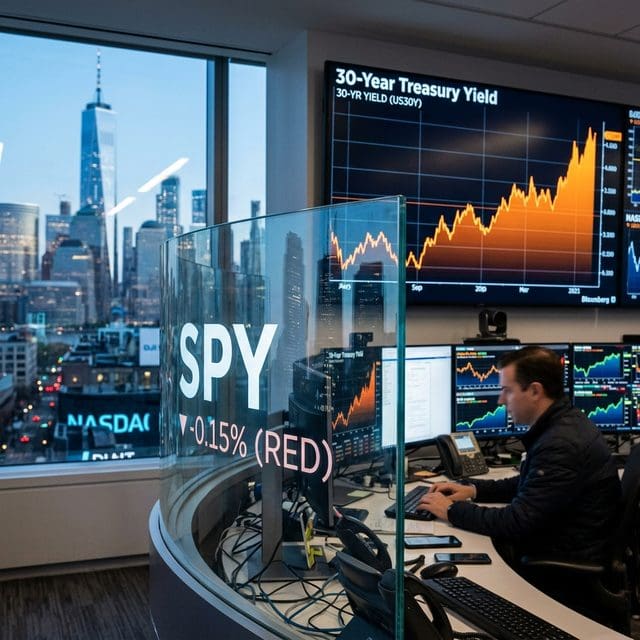
The SPY slipped 0.15% as 30-year Treasury yields hit 24-year highs, overshadowing massive AI deals and forcing investors to weigh technological growth against a restrictive monetary environment.
The American financial landscape is currently defined by a stark divergence between the burgeoning potential of the private sector and the heavy hand of centralized monetary policy. The SPY, a primary benchmark for the U.S. equity market, is down 0.15% on the session, reflecting a cautious stance among domestic investors even as international markets show signs of life. This modest decline is not a sign of broad capitulation but rather a reaction to the relentless pressure emanating from the Treasury market, where the long end of the curve is testing levels not seen in a generation.
Long-term borrowing costs have reached heights that threaten to stifle Main Street growth. The 30-year Treasury yield recently touched 5.62%, a 24-year high, driven by persistent inflation concerns and expanding fiscal deficits. While the 10-year yield holds near 5.23%, its highest point since 2007, the burden on the American taxpayer continues to mount. Investors are demanding higher compensation for holding long-term debt, a direct result of the Federal Reserve’s aggressive tightening cycle and the massive capital requirements of the artificial intelligence revolution. Higher yields effectively raise the discount rate for future earnings, placing a ceiling on the valuations of growth-oriented companies that have otherwise led the market higher this year.
Working households should pay close attention to the shifting energy and inflation landscape, which remains a primary driver of Fed policy. Brent crude has climbed back to approximately $103.20 per barrel amid conflicting signals regarding U.S.-Iran negotiations. Furthermore, Goldman Sachs strategists warn that potential U.S. diesel export restrictions could add $0.30 per gallon to domestic retail gasoline prices, a move that would hit the wallets of commuters and logistics firms alike. These inflationary pressures complicate the Federal Reserve’s path, with CME FedWatch data indicating a roughly 45% probability of an October rate hike. While New York Fed President John Williams suggested there is no immediate urgency for further tightening, he and Governor Michael Barr have signaled that further increases might be necessary if the August PCE inflation report shows headline figures rising 3.7% year-over-year as expected.
Despite these macroeconomic headwinds, the “Invisible Economy” of institutional deal-making remains remarkably active, providing a fundamental counterweight to the rates shock. Akamai recently agreed to supply cloud computing services to Anthropic in a landmark $12 billion deal, while Boeing secured a $20 billion contract to build the U.S. Navy’s next-generation F/A-XX fighter aircraft. The technology sector continues to innovate at a breakneck pace; Meta recently unveiled its Muse Charm handheld device, and OpenAI launched its “dots” AI agent to compete for high-end subscribers. These developments, supported by Bain & Co.’s projection that the global AI market could reach $6 trillion annually by 2031, suggest that the underlying engine of American meritocracy is still firing, even as it fights against the drag of high interest rates.
The resilience of the S&P 500 is being tested by what analysts describe as the “grip of bonds.” While the MSCI Asia Pacific Index gained 0.9% and European futures advanced, the U.S. market remains tethered to the Federal Reserve’s next move. Institutional shifts are also underway, as evidenced by OTCX Trading Limited integrating pricing into BlackRock’s Aladdin platform and Aon launching a $2.5 billion insurance program for gas power projects. These moves indicate that while the equity market may be stagnant, the machinery of capital allocation is preparing for a period of prolonged volatility. For the average citizen, the current market climate underscores a broader economic truth: until the federal government addresses its fiscal trajectory and stabilizes the monetary system, the benefits of technological innovation will continue to be offset by the rising cost of capital, energy, and daily life.

Jordan Lee serves as the Senior Correspondent for Wall Street, Finance, and Monetary Systems at Just Right News. Based in the heart of the world’s financial capital, New York City, Lee brings a sharp, principled eye to the complex mechanisms that drive the global economy. His reporting is defined by a commitment to fiscal responsibility, the defense of the free market, and a deep-seated belief that a transparent monetary system is the bedrock of a free society.
Raised in Portland, Oregon, Lee’s perspective was forged in a city that has undergone significant cultural and economic shifts. His upbringing in the Pacific Northwest instilled in him a profound appreciation for the industriousness of small business owners and the importance of local economic stability. Watching the evolution of his hometown’s landscape sparked an early interest in how federal fiscal policy and large-scale financial trends eventually trickle down to the average citizen. This background provides him with a unique vantage point; he understands the growing disconnect between the policy-making elite and the reality of Main Street, a theme that frequently resonates throughout his work.
Now operating from his base in New York City, Lee bridges the gap between the high-stakes trading floors of Manhattan and the households of everyday Americans. He views the financial sector not merely as a collection of numbers and tickers, but as a vital engine of American prosperity that requires constant vigilance and accountability. His reporting often highlights the dangers of centralized financial control and the necessity of maintaining a system that rewards merit, risk-taking, and innovation.
As the creator and lead of the featured series, “The Invisible Economy,” Lee pulls back the curtain on the often-opaque world of monetary systems. He specializes in translating the dense jargon of central banking and international finance into actionable insights for the Just Right News audience. His work explores the “invisible” forces—such as inflationary pressures, regulatory creep, and the expansion of the administrative state—that erode the purchasing power of American families. By focusing on these systemic issues, Lee empowers readers to understand the hidden forces shaping their financial independence.
Lee’s journalistic philosophy is rooted in a steadfast commitment to traditional American values. As an Asian American professional who has navigated the competitive corridors of the financial world, he is a vocal advocate for meritocracy and the preservation of the American Dream. He believes that a stable currency and a predictable regulatory environment are essential for national sovereignty and individual liberty. His reporting frequently warns against the risks of government overreach in the private sector, arguing that the most effective solutions to economic challenges arise from competition and individual enterprise rather than bureaucratic mandates.
At Just Right News, Jordan Lee remains dedicated to providing a clear-eyed defense of the taxpayer. Whether he is analyzing market volatility or investigating the long-term implications of national debt, his mission is to provide the truth about where the money is going and what it means for the future of the country. Through his rigorous analysis and principled stance, Lee has become a trusted voice for those who value a strong, sovereign, and fiscally sound America.