

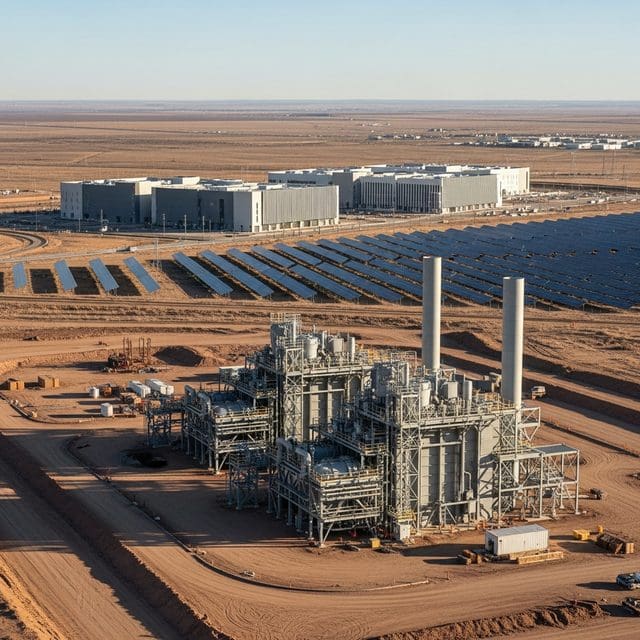
Amazon is financing a 7.65 GW gas-fired power plant in Pecos County to fuel its AI data centers, bypassing the Texas grid while potentially becoming the nation’s largest carbon emitter.
The insatiable demand for artificial intelligence is reshaping the American energy landscape, as evidenced by Amazon’s move to finance a massive 7.65 GW natural gas power plant in Pecos County, Texas. The facility, known as GW Ranch, is designed to power a sprawling AI data center campus while initially operating entirely independent of the Electric Reliability Council of Texas (ERCOT) grid. This “energy island” model comes at a time when the Texas grid is under historic strain, forcing major tech players to seek self-sufficiency to ensure operational continuity.
On August 4, 2026, Governor Greg Abbott ordered a pause on new data center grid interconnections as ERCOT reviews nearly 474 GW of proposed demand, roughly 90% of which stems from data centers. By building its own generation, Amazon secures the reliability necessary for high-intensity computing without competing for existing residential and industrial supply. This strategy reflects a broader trend in the U.S. economy, which showed accelerating growth in the second quarter of 2026, driven largely by the memory and hardware requirements of AI development. While JPMorgan strategists have suggested tech stocks might underperform in the latter half of the year, S&P 500 sales growth reached a five-year high in August, with energy companies posting a staggering 42.5% revenue gain.
However, the scale of the GW Ranch project introduces significant environmental and regulatory trade-offs. The Texas Commission on Environmental Quality (TCEQ) issued an air permit in early 2026 authorizing the plant to emit up to 33 million tons of CO2 annually. If operated at full capacity, this would make GW Ranch the largest single source of power-plant pollution in the United States, surpassing the emissions of the country’s largest remaining coal plants. To put this in perspective, the permitted emissions represent nearly 5% of Canada’s total annual greenhouse gas output.
Amazon has pushed back against the narrative of environmental degradation, highlighting its commitment to carbon-free energy. The company points to 10 GW of existing renewable projects across Texas and plans to integrate approximately 750 MW of on-site solar and 1.8 GW of battery storage at the GW Ranch site. The company maintains that the project will not raise electricity costs for Texas families because it does not rely on public grid infrastructure for its initial phase. Furthermore, the site is designed to transition to grid-connected service eventually, provided the state’s interconnection capacity can accommodate the load.
The development highlights a growing trend in the energy sector. An analysis by the Environmental Integrity Project identifies at least 74 gas plants proposed nationally to power data centers, with 32 located in Texas alone. Collectively, these Texas projects are permitted to emit approximately 287 million tons of greenhouse gases annually. Beyond carbon, the GW Ranch facility is authorized to release more than 12,000 tons of regulated air pollutants, including soot, ammonia, and volatile organic compounds. While the EPA has not yet launched specific enforcement actions, the sheer volume of these pollutants may invite future federal scrutiny under the Clean Air Act, particularly regarding local health impacts in Pecos County.
Despite these concerns, the project is moving forward at a rapid pace. Satellite imagery from late July shows significant land clearing, and three construction permits for data center buildings were filed in early August 2026. The first phase of the project, targeting 1 GW of capacity, is expected to be operational in the first half of 2027. For now, the build-out of GW Ranch stands as a monument to the priority of energy security and technological expansion in a competitive global economy, where the need for reliable power often outpaces the existing grid’s ability to adapt.

Mark Davis serves as the Senior Correspondent for Energy, Climate, and Resource Economics at Just Right News. In an era where the conversation around the environment is often dominated by alarmism and top-down mandates, Mark provides a vital, market-oriented perspective on the complex forces shaping our world. As the lead voice behind the acclaimed feature series “Power and the Planet,” he explores the intersection of environmental policy, global energy markets, and the fundamental economic principles that sustain modern civilization.
Mark’s pragmatic approach to resource management was forged in the high desert of his hometown, Albuquerque, New Mexico. Growing up in a region defined by both its breathtaking natural beauty and its rugged, resource-dependent landscape, he developed an early appreciation for the delicate balance between conservation and utilization. New Mexico’s unique position as a hub for both traditional energy production and cutting-edge scientific research provided Mark with a front-row seat to the evolution of the American energy sector. This upbringing instilled in him a deep-seated belief that true environmental stewardship is inseparable from economic prosperity and technological innovation.
Now based in Boulder, Colorado, Mark operates from the heart of the nation’s climate research community. While Boulder is often seen as a bastion of environmental idealism, Mark utilizes his post to provide a necessary counterweight, grounded in the realities of resource economics. He understands that energy policy does not exist in a vacuum; it has tangible consequences for the American taxpayer, the stability of the national power grid, and the strength of the domestic manufacturing sector. By reporting from the front lines of the climate debate, he is able to challenge prevailing narratives with hard data and a commitment to the principles of the free market.
Throughout his tenure at Just Right News, Mark has distinguished himself by focusing on the “Resource Economics” aspect of his beat. He frequently highlights the hidden costs of rapid energy transitions and advocates for an “all-of-the-above” energy strategy that prioritizes American energy independence. His work often shines a light on the geopolitical implications of resource scarcity, arguing that a secure nation must first be an energy-secure nation. Whether he is analyzing the impact of federal land-use regulations or investigating the supply chains required for new technologies, Mark remains focused on how policy decisions affect the lives and livelihoods of everyday citizens.
In “Power and the Planet,” Mark continues to bridge the gap between complex scientific concepts and the economic realities facing the country. He rejects the false choice between a healthy environment and a thriving economy, instead seeking out solutions that leverage American ingenuity and private-sector competition. For Mark, reporting on the climate is not about following the latest trends, but about ensuring that the conversation remains tethered to the foundational values of liberty, property rights, and fiscal responsibility. His contributions ensure that Just Right News readers receive a comprehensive, clear-eyed view of the challenges and opportunities defining the future of our planet.