

New labor data reveals a complex economic landscape where record hiring plans and AI-driven layoffs coexist, testing the resilience of the American workforce and social safety net.
The American labor market is currently navigating a period of profound structural realignment that defies simple categorization. While headline figures suggest a stable economy, a closer look at the latest data reveals a widening gap between traditional employment and the emerging technology-driven landscape. According to the July 2026 Challenger, Gray & Christmas report, U.S. employers announced 33,429 job cuts, marking a 27% decrease from June and the lowest monthly total since July 2024. However, the composition of these cuts signals a shift that challenges our traditional understanding of economic vulnerability and the role of the social safety net.
For five consecutive months, artificial intelligence has been cited as the leading cause of job reductions, accounting for 10,970 cuts in July alone—roughly one-third of all announced layoffs. This trend is not hitting the traditional manufacturing or retail cores of the South and Midwest first; instead, it is concentrated in the technology sector, which has seen 149,023 cuts year-to-date. When high-income, white-collar positions in tech, transportation, and healthcare are eliminated by automation, the ripple effects touch every aspect of the social safety net, from local tax revenue to the demand for transitional assistance and private-sector retraining programs.
JPMorgan Asset Management fixed income portfolio manager Kelsey Berro has noted that the Federal Reserve is closely monitoring these wage trends and the breadth of job growth. The current softening in high-income sectors serves as a potential “circuit breaker” for the broader economy. While the S&P 500 reached new highs in early August, driven by insatiable demand for AI infrastructure and computer memory, the workers displaced by that very technology face a difficult climb back to their previous earnings. This creates a unique friction: a booming stock market coexisting with a workforce that must constantly reinvent itself to maintain upward mobility.
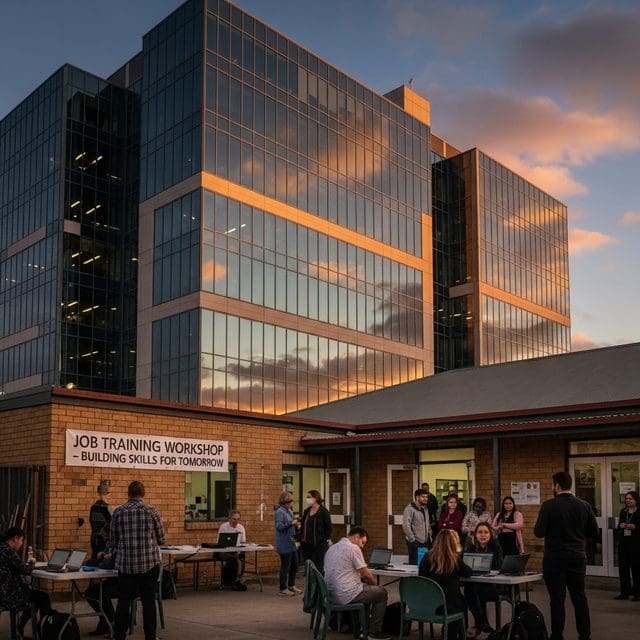
There is, however, a resilient spirit visible in the hiring data that complicates the narrative of a weak labor market. Employers simultaneously announced plans to hire 16,095 workers in July, a 47% increase from June and the highest July hiring-plans total on record. This suggests that while some roles are being automated out of existence, new opportunities are emerging in sectors like energy—where companies posted a staggering 42.5% revenue gain in the second quarter—and in regional AI factories using advanced NVIDIA infrastructure. The challenge for local communities and civic institutions is ensuring that the safety net acts as a springboard rather than a hammock, providing the dignity of work through local solutions.
Private employment growth slowed in August 2026 even as worker pay accelerated, indicating a tighter labor market with constrained supply in specific industries. This environment of rising wages and shifting demand requires a safety net that prioritizes individual dignity and local community resilience over federal bureaucracy. As business uncertainty among C-suite leaders increases due to shifting trade policies and geopolitical instability, the focus must remain on the restorative power of hard work. The data shows that the American economy is not in a simple decline, but a complex evolution where the path to prosperity is being rewritten by silicon and software.
Ultimately, the cumulative 2026 layoff picture shows that planned job cuts are down 41% year-to-date compared to 2025. This indicates that while the fear of displacement is high, the aggregate corporate environment remains relatively stable. Navigating this transition will require a principled approach to welfare policy that encourages work-based solutions, ensuring that the wealth gap does not become a permanent fixture of the new digital economy. The goal remains clear: fostering an environment where every American, regardless of their starting point, has a fair shot at the climbing the ladder of economic mobility.

James Foster serves as the Senior Correspondent for Inequality and the Social Safety Net at Just Right News, where he brings a principled and nuanced perspective to the most pressing economic challenges facing the nation. With a career dedicated to exploring the intersection of policy and personal responsibility, Foster has become a leading voice in documenting how government programs and economic shifts impact the American family. His reporting is characterized by a commitment to the “human element,” moving beyond cold statistics to highlight the stories of resilience, work, and community that define the modern American experience.
Foster’s perspective is deeply rooted in his upbringing in Birmingham, Alabama. Growing up in a city with a rich industrial heritage and a history of economic transformation, he witnessed firsthand the importance of the dignity of work and the strength of local institutions. In Birmingham, he saw how the most effective safety nets were often those woven by neighbors, faith-based organizations, and local civic groups. This background instilled in him a lifelong skepticism of “one-size-fits-all” solutions from distant bureaucracies, favoring instead the localized, community-driven support systems that he frequently champions in his writing.
Now based in Atlanta, Georgia, Foster operates from one of the most dynamic and rapidly evolving metropolitan hubs in the South. His location provides a front-row seat to the stark contrasts of the modern economy. From the gleaming towers of Atlanta’s financial districts to the struggling neighborhoods on the city’s periphery, Foster finds the stories that illustrate the complexities of upward mobility. His reporting from the Sun Belt serves as a microcosm for the national debate on poverty, highlighting how inflation, housing costs, and labor market shifts affect the working class in real-time.
As the lead for the acclaimed feature series “America’s Balancing Act,” Foster explores the delicate tension between providing a necessary hand up and fostering long-term independence. The series has become a cornerstone of Just Right News, offering a deep dive into the unintended consequences of social welfare policies. Foster’s work often focuses on the “cliff effect” and other systemic hurdles that can inadvertently discourage employment, arguing that true compassion is measured by how many people are empowered to leave the safety net, rather than how many are added to it.
Throughout his tenure, Foster has remained dedicated to the mission of Just Right News, providing a clear-eyed, conservative analysis of social issues. He believes that a free society thrives when individuals are empowered and the private sector is allowed to innovate. Whether he is interviewing small business owners about the challenges of a changing workforce or documenting the success of private charitable initiatives, Foster’s goal is to provide readers with the truth about the state of the American Dream. His work serves as a vital reminder that while the challenges of inequality are great, the solutions are often found in the strength of the American spirit and the preservation of traditional values.