

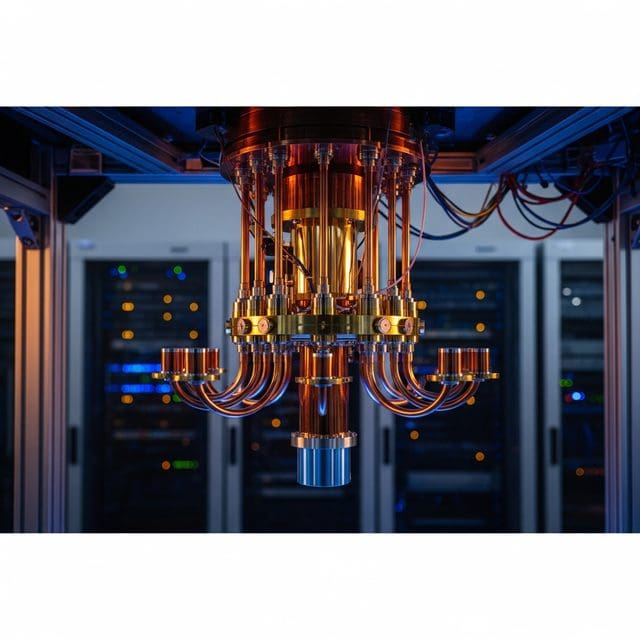
Researchers have demonstrated a verifiable quantum computation using 70 logical qubits, achieving a 10x error reduction and surpassing the practical limits of classical supercomputing in a 15-minute trial.
The long-promised era of quantum advantage has moved from the realm of theoretical physics into the light of verifiable reality. In a joint announcement this week, researchers from IBM and the University of Chicago revealed they have successfully executed a computation on a quantum system that defies practical simulation by traditional classical supercomputers. Unlike previous claims of quantum supremacy that were often dismissed as academic curiosities or niche benchmarks, this latest milestone focuses on the rigorous application of logical qubits and verifiable fidelity.
The experiment utilized 70 logical qubits to perform an incredibly dense sequence of 2,415 logical two-qubit operations and 468 logical T gates. While these figures represent technical complexity, their true value lies in the speed and accuracy of the execution. The entire operation was completed in approximately 15 minutes on IBM’s quantum hardware. Jay Gambetta, IBM’s vice president of quantum computing, noted that the industry is now firmly in the quantum advantage era, emphasizing that the results were achieved with a statistical confidence that classical systems simply cannot replicate.
For the principled observer, the significance of this breakthrough lies in the transition from physical qubits to logical qubits. Physical qubits are notoriously unstable, susceptible to the slightest environmental interference, which leads to computational noise. By implementing sophisticated error-correction protocols, the team achieved a logical error rate ten times lower than the underlying physical error rate. This stability is the bedrock required for quantum systems to eventually tackle real-world problems in cryptography, materials science, and national security. The findings, detailed in a paper titled “Sampling hard circuits with verifiably high fidelity” on arXiv, address a primary criticism of the field: the difficulty of proving a quantum answer is correct when no classical computer is powerful enough to check the work.
This development does not exist in a vacuum. It coincides with a surge of domestic breakthroughs that strengthen the American technological frontier. At UCLA, scientists recently discovered how to guide heat like light rays at room temperature, a discovery that could revolutionize the thermal management of the very chips required for these high-powered computations. This is a critical engineering hurdle; as quantum and classical chips become more powerful, the ability to route heat away from sensitive components is essential for maintaining hardware longevity and individual user privacy in decentralized systems.
Furthermore, Rice University researchers have developed precise temperature tuning for trapped-ion simulators, ensuring these delicate machines can better mimic real-world conditions. Even the energy requirements of quantum systems are being challenged by new research into generating quantum entanglement directly from sunlight, potentially bypassing the need for energy-intensive lasers. These decentralized innovations suggest a future where quantum power is not solely the province of massive, energy-hungry data centers, but a more accessible tool for innovation.
As these technologies mature, the focus must remain on ensuring that the benefits of the quantum frontier are not centralized within a few bureaucratic or corporate silos. The ability to process information at this scale represents a new form of national infrastructure and a pillar of digital sovereignty. The next step for the IBM and University of Chicago team will be scaling these logical operations further, moving toward a future where quantum utility is not just a laboratory success, but a tool for American innovation and the protection of constitutional rights in an increasingly complex digital age. The successful verification of these results ensures that as we step into this new frontier, we do so with a foundation of truth and precision.

Mason Reed serves as a Staff Writer for Just Right News, where he spearheads the Future Frontiers & Special Projects desk. In an era defined by rapid technological shifts and evolving social landscapes, Mason provides a steady, principled voice, examining the innovations of tomorrow through the lens of traditional American values. His work is most prominently featured in his signature series, “The Next Horizon,” where he explores the intersection of emerging technology, national sovereignty, and the preservation of individual liberty.
A native of San Diego, California, Mason’s worldview was shaped by the unique culture of his hometown. Growing up in a region defined by its strong military presence and its history of maritime industry, he developed a deep-seated respect for the institutions that provide national stability and the entrepreneurial spirit that drives the American economy. This upbringing instilled in him a belief that true progress is not found in discarding the past, but in building upon a foundation of proven principles. His reporting often reflects this San Diego influence, emphasizing the importance of a robust national defense and the necessity of maintaining a competitive edge in the global marketplace.
Now based in San Francisco, Mason operates from the heart of the world’s technological engine. Living and working in the Bay Area provides him with a front-row seat to the advancements—and the ideological challenges—emanating from Silicon Valley. While many in the region embrace a “move fast and break things” mentality, Mason’s reporting serves as a vital counterweight. He offers Just Right News readers a “boots on the ground” perspective, documenting how radical local policies and the concentration of tech power impact the everyday lives of citizens. His proximity to the industry allows him to cut through the marketing jargon of big tech to uncover the real-world implications for privacy, free speech, and the nuclear family.
In his “Future Frontiers” beat, Mason tackles complex subjects ranging from the ethics of artificial intelligence to the burgeoning private space race. He approaches these topics with a healthy skepticism toward centralized bureaucracy, championing instead the decentralized innovations that empower individuals. Through “The Next Horizon,” he highlights the pioneers and thinkers who are working to ensure that the future remains a place where human dignity and constitutional rights are protected. He believes that the rapid pace of change requires more than just technical expertise; it requires a moral compass rooted in the Western tradition.
Throughout his tenure at Just Right News, Mason has remained committed to the idea that the future is something to be shaped, not merely accepted. His writing is characterized by a rigorous defense of American exceptionalism and a belief that the country’s best days lie ahead, provided it remains true to its founding ideals. Whether he is investigating the impact of automation on the American workforce or profiling the next generation of aerospace engineers, Mason Reed ensures that his readers are equipped with the insights they need to navigate a changing world with confidence and clarity.