

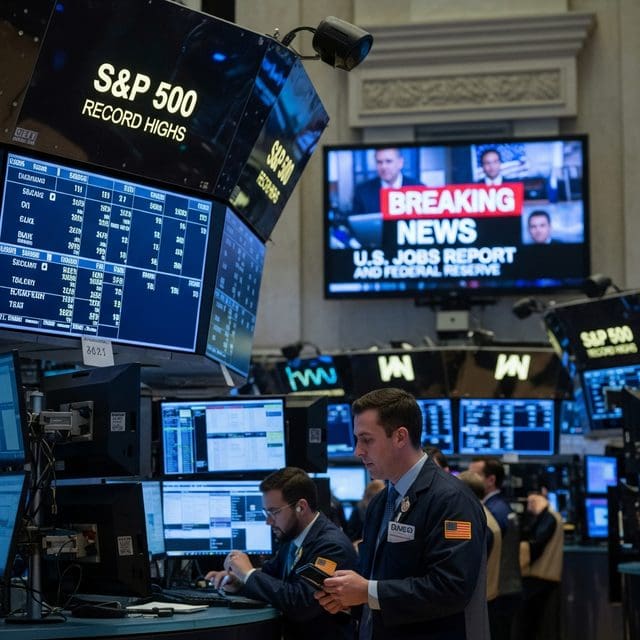
Major indices hit record highs following a surprise contraction in July payrolls, as investors bet on a more accommodative Federal Reserve and lower Treasury yields.
The American financial landscape shifted dramatically this week as a contraction in the labor market sent equities to record highs. While the S&P 500 (SPY) posted a steady gain of 0.59% on the session, the broader market narrative was defined by a “Goldilocks” reaction to disappointing data. The July jobs report revealed a loss of 23,000 nonfarm payrolls, a stark contrast to the 80,000 gain economists anticipated. This labor shock recalibrated expectations for the Federal Reserve, with futures now implying a 56% probability that the central bank will hold rates steady in September.
For the American household, the disconnect between a cooling labor market and a surging Wall Street highlights a sensitivity to centralized monetary policy. The S&P 500 closed at an all-time high of 7,757.64, up roughly 3.6% for the week, while the Nasdaq Composite outperformed with a 1.3% daily gain. This rally was fueled by the collapse of rate-hike fears, which drove the 2-year Treasury yield down to 4.20% and the 10-year yield to 4.64%. In the “Invisible Economy,” where government data dictates private prosperity, investors are rewarding signs of economic slowing in hopes of cheaper credit and a pause in tightening.
Commodities and foreign exchange markets mirrored this shift. Gold jumped 2.1% as the dollar softened, and the VIX volatility index fell to unusually calm levels. This easing of the dollar provided a boost to emerging markets, such as Brazil, where the real firmed to R$5.08 per dollar. However, the domestic picture remains complex; while the stock market celebrates, the underlying July jobs report showed a labor market less robust than spring momentum suggested, with workforce participation declining. Despite this, jobless claims reached their lowest levels since 1969 as of early August 2026.
Corporate developments continue despite macro-economic volatility. Berkshire Hathaway reported a doubling of profits, bolstered by a near $13 billion investment gain, while deploying $32 billion of its cash pile. In the banking sector, Zaria Systems applied for a national trust bank charter with the OCC, and Industrial Control Solutions expanded its aerospace capabilities through the acquisition of Modern Instrument Company. Meanwhile, Koppers Holdings Inc. declared a quarterly cash dividend of $0.09 per share, signaling continued returns for shareholders in the basic materials sector.
On the regulatory front, the Trump administration notified Federal Reserve Governor Lisa Cook of mortgage fraud allegations, giving her 21 days to respond as part of an effort to remove her. Simultaneously, the Senate confirmed Todd Blanche as Attorney General, ending a tumultuous process for the President’s former attorney. These political shifts occur as international buyers continue to pour capital into U.S. real estate, specifically in Texas, where buyers purchased $4 billion in homes between April 2025 and March 2026.
Technological and workforce shifts are also surfacing. Blue Ridge Associates appointed Adam Studdard as CTO to lead AI strategy, while Traxxion launched a wallet powered by Payactiv to provide frontline workers with earned wage access. These moves reflect a private sector attempting to bolster efficiency even as the labor market shows signs of fatigue. As upcoming inflation data prepares to test this record-setting rally, the tension between Main Street’s slowing momentum and Wall Street’s rate-cut optimism remains the defining story of the 2026 fiscal year.

Jordan Lee serves as the Senior Correspondent for Wall Street, Finance, and Monetary Systems at Just Right News. Based in the heart of the world’s financial capital, New York City, Lee brings a sharp, principled eye to the complex mechanisms that drive the global economy. His reporting is defined by a commitment to fiscal responsibility, the defense of the free market, and a deep-seated belief that a transparent monetary system is the bedrock of a free society.
Raised in Portland, Oregon, Lee’s perspective was forged in a city that has undergone significant cultural and economic shifts. His upbringing in the Pacific Northwest instilled in him a profound appreciation for the industriousness of small business owners and the importance of local economic stability. Watching the evolution of his hometown’s landscape sparked an early interest in how federal fiscal policy and large-scale financial trends eventually trickle down to the average citizen. This background provides him with a unique vantage point; he understands the growing disconnect between the policy-making elite and the reality of Main Street, a theme that frequently resonates throughout his work.
Now operating from his base in New York City, Lee bridges the gap between the high-stakes trading floors of Manhattan and the households of everyday Americans. He views the financial sector not merely as a collection of numbers and tickers, but as a vital engine of American prosperity that requires constant vigilance and accountability. His reporting often highlights the dangers of centralized financial control and the necessity of maintaining a system that rewards merit, risk-taking, and innovation.
As the creator and lead of the featured series, “The Invisible Economy,” Lee pulls back the curtain on the often-opaque world of monetary systems. He specializes in translating the dense jargon of central banking and international finance into actionable insights for the Just Right News audience. His work explores the “invisible” forces—such as inflationary pressures, regulatory creep, and the expansion of the administrative state—that erode the purchasing power of American families. By focusing on these systemic issues, Lee empowers readers to understand the hidden forces shaping their financial independence.
Lee’s journalistic philosophy is rooted in a steadfast commitment to traditional American values. As an Asian American professional who has navigated the competitive corridors of the financial world, he is a vocal advocate for meritocracy and the preservation of the American Dream. He believes that a stable currency and a predictable regulatory environment are essential for national sovereignty and individual liberty. His reporting frequently warns against the risks of government overreach in the private sector, arguing that the most effective solutions to economic challenges arise from competition and individual enterprise rather than bureaucratic mandates.
At Just Right News, Jordan Lee remains dedicated to providing a clear-eyed defense of the taxpayer. Whether he is analyzing market volatility or investigating the long-term implications of national debt, his mission is to provide the truth about where the money is going and what it means for the future of the country. Through his rigorous analysis and principled stance, Lee has become a trusted voice for those who value a strong, sovereign, and fiscally sound America.