

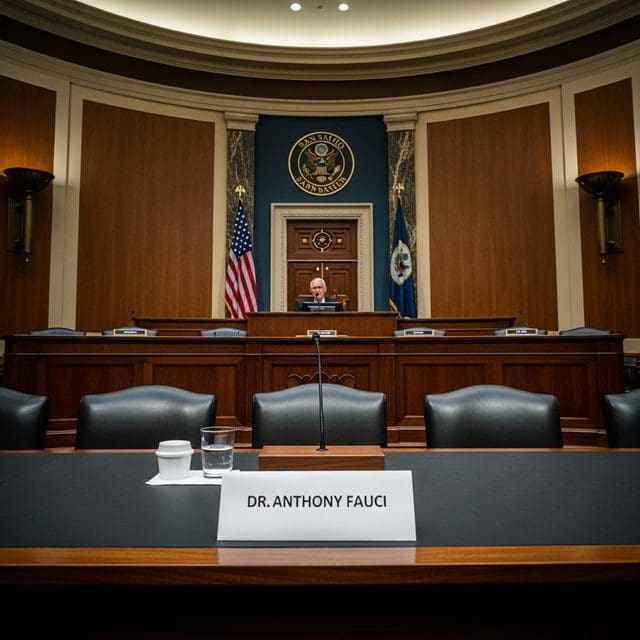
The Senate Homeland Security Committee voted to recommend criminal contempt charges against Dr. Anthony Fauci, testing the limits of congressional oversight and the Fifth Amendment in a high-stakes constitutional showdown.
The Senate Homeland Security and Governmental Affairs Committee escalated its oversight battle with the administrative state on Thursday, voting 8-5 to hold Dr. Anthony Fauci in contempt of Congress. The party-line vote, led by Chairman Rand Paul (R-Ky.), follows a contentious hearing last week in which the former White House chief medical adviser invoked his Fifth Amendment right against self-incrimination more than 100 times. This maneuver sets the stage for a constitutional showdown over the limits of legislative inquiry and the protections afforded to former executive officials.
At the heart of the dispute is a congressional subpoena seeking testimony on the origins of COVID-19 and federal pandemic mitigation strategies. Republican members argued that Dr. Fauci’s refusal to answer specific questions constitutes a willful obstruction of the legislature’s constitutional duty to conduct oversight. Senator Paul asserted that the public deserves a full accounting of the decision-making processes that governed American life for two years. Conversely, Dr. Fauci’s legal counsel characterized the proceedings as a “crude political stunt,” asserting that the doctor’s silence was a necessary protection against potential criminal targeting by partisan actors.
In a departure from standard procedure, Senator Paul indicated his intention to forward the contempt recommendation directly to the Department of Justice, bypassing a vote by the full Senate. This move tests the boundaries of committee-level authority and places the decision to prosecute a former high-ranking official squarely in the hands of the Trump administration’s Justice Department. Under federal law, contempt of Congress is a misdemeanor punishable by fines and up to one year in prison. Bypassing the full chamber suggests a strategy designed to expedite legal consequences while avoiding legislative logjams.
The committee’s action coincides with a broader legal offensive. On the same day, Republican attorneys general from Florida, West Virginia, and Louisiana issued subpoenas to Dr. Fauci as part of a joint probe into pandemic-era policies. These parallel efforts underscore a growing movement within both the legislative and executive branches to demand accountability for the expansive use of administrative power during the 2020-2022 period. This multi-front approach ensures that pandemic policy remains a central fixture of the national political landscape.
Beyond the Fauci proceedings, the day was marked by significant activity across the federal system. A federal judge confirmed that Haitian migrants in the U.S. have lost their temporary protected status following a Supreme Court ruling that the Trump administration could terminate the designation. In the realm of the Second Amendment, another federal judge ruled that regulations on firearm silencers cannot stand because Congress zeroed out the taxes that originally justified their constitutionality. These rulings reflect a judiciary and a legislature increasingly willing to dismantle regulatory frameworks established by previous administrations.
From a constitutional perspective, the Fauci referral raises questions regarding the scope of congressional subpoena power versus individual protections. While Congress possesses broad authority to investigate for legislative purposes, the use of criminal referrals to compel testimony from former officials remains an aggressive application of force. As the Justice Department reviews the referral, the outcome will serve as a precedent for future oversight of the federal bureaucracy. For those concerned with executive overreach, the proceedings represent a necessary check on the administrative class; for others, it signals a deepening politicization of public health that may deter future professionals from government service.

Miles Harrington serves as the Senior Correspondent for Federal Systems & Executive Power at Just Right News, where he brings a disciplined, constitutionalist lens to the inner workings of the American government. With a focus on the mechanics of the federal bureaucracy and the limits of executive authority, Harrington has established himself as a vital voice for readers who value transparency, accountability, and the preservation of the separation of powers.
A native of Richmond, Virginia, Harrington’s perspective is deeply rooted in the traditions of the Old Dominion. Growing up in a city defined by its historical significance and its role as a center of American jurisprudence, he developed an early appreciation for the foundational principles of the Republic. His upbringing in Richmond—a place where the legacy of the Founding Fathers is woven into the landscape—instilled in him a belief that the federal government should remain within its constitutional bounds. This background informs his skepticism of centralized overreach and his commitment to reporting on the ways in which the administrative state impacts the lives of everyday citizens.
In his current role, Harrington specializes in the complexities of federal systems. He doesn’t just report on the headlines of the day; he digs into the structural shifts within the executive branch that often go unnoticed by the mainstream press. Whether he is analyzing the implications of a new federal regulation or investigating the expansion of agency jurisdiction, his work is characterized by a rigorous adherence to the facts and a dedication to the rule of law.
Harrington is perhaps best known for his signature feature series, “How Washington Works.” Through this ongoing project, he demystifies the often-opaque processes of the nation’s capital, pulling back the curtain on the “Deep State” and the unelected officials who wield significant influence over national policy. By breaking down complex legislative maneuvers and executive orders, he empowers Just Right News readers to understand the true levers of power in Washington. His reporting serves as a necessary check on the federal government, ensuring that the actions of those in power are held up to the light of public scrutiny.
Now based in Washington, D.C., Harrington operates at the epicenter of the political world, yet he remains intentionally distanced from the “Beltway bubble.” His proximity to the halls of power allows him to maintain a robust network of sources across the federal landscape, but his heart remains in the principled conservatism of his Virginia roots. He views his role not merely as a reporter, but as a steward of the public trust, dedicated to providing the clarity and context that conservative voters need to navigate an increasingly complex political environment.
Through his sharp analysis and unwavering commitment to the truth, Miles Harrington continues to be a cornerstone of the Just Right News team. His work ensures that the principles of limited government and executive restraint remain at the forefront of the national conversation, providing a crucial service to those who believe in a government that is truly of, by, and for the people.