

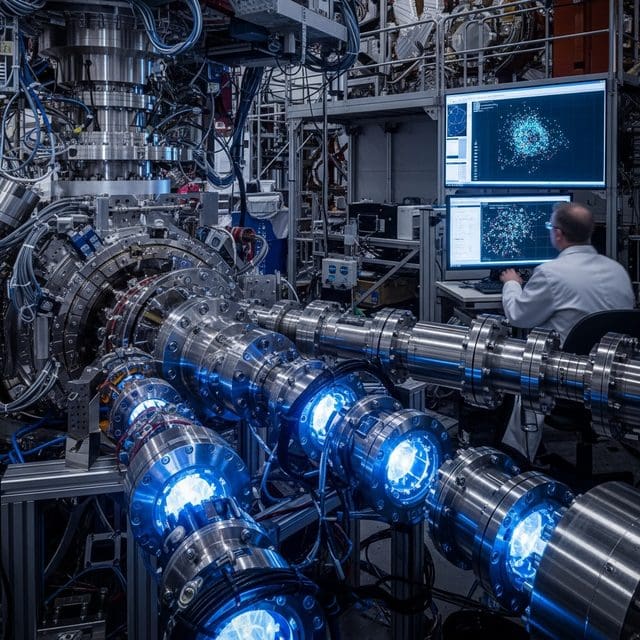
International researchers at the BESIII experiment have identified the X(2370) particle as the long-sought glueball, a new form of matter composed entirely of force-mediating gluons.
A fifty-year search for the most elusive building blocks of the universe reached a historic milestone this week as physicists announced the definitive identification of a ‘glueball.’ The discovery, presented as a special plenary report at the International Conference on High Energy Physics in Brazil, confirms that gluons—the particles responsible for ‘gluing’ nuclear matter together—can bind to one another to form a stable, independent form of matter. This finding marks the first time humanity has captured a particle composed of pure force, validating a core prediction of the Standard Model of physics.
The breakthrough comes from the BESIII collaboration at the Beijing Electron Positron Collider II (BEPCII). By analyzing a massive dataset of 10 billion J/psi particles collected in 2024, researchers identified the specific properties of a particle known as X(2370). While first spotted in 2011, its true nature remained a subject of intense debate until this month. The team confirmed the particle possesses the exact spin-parity quantum numbers of 0⁻⁺, matching the ‘lattice QCD’ predictions for a pseudoscalar glueball. Crucially, the researchers observed a ‘flavor-singlet’ behavior, a key signature that distinguishes a glueball from traditional particles composed of quarks.
For decades, the theory of quantum chromodynamics (QCD) has suggested that because gluons carry their own color charge, they should be able to interact with themselves. Unlike traditional matter, which is composed of quarks held together by gluons, a glueball is matter composed entirely of force mediators. This finding validates the non-Abelian gauge structure of the universe, proving that the forces governing the subatomic realm can manifest as physical objects. The BESIII collaboration, which includes approximately 700 physicists from 15 countries, described the result as the clearest experimental verification of a major theoretical prediction in nearly half a century.
Simultaneously, researchers at Lawrence Berkeley National Laboratory and UC Berkeley have reported a separate breakthrough in the realm of condensed matter. The team observed a Bose-Einstein condensate (BEC) of excitons—bound electron-hole pairs—within an atomically thin semiconductor device. Published in the journal Nature, the study reveals a quantum fluid that behaves as an equilibrium system rather than a fleeting excited state. Remarkably, this quantum fluid persisted at temperatures near 2 Kelvin (−456°F), which is millions of times warmer than the ultracold environments typically required for atomic gas condensates.
The Berkeley Lab team, led by researcher Ruishi Qi, demonstrated that they could switch the exciton fluid between three distinct internal states using small magnetic fields and electrical gates. This ‘tunable’ nature allows for the control of spin-valley configurations, effectively creating a solid-state platform for quantum fluids on a chip. By engineering the semiconductor so that excitons remain in their ground state, the researchers have opened a new frontier for studying strongly interacting quantum matter without the need for massive cryogenic infrastructure.
These twin discoveries represent a significant leap in our understanding of how energy and matter intersect. While the BESIII result settles a foundational question about the nature of the strong nuclear force, the Berkeley Lab research provides a practical path toward new quantum technologies. Both findings underscore a shift toward mastering the internal ‘flavors’ and configurations of particles that were once considered purely theoretical. As the physics community processes these results, the focus turns to how these new forms of matter might be harnessed for future innovation in computing and materials science. The confirmation of the glueball, in particular, signals that the era of ‘force-only’ matter has finally arrived, providing a crucial low-energy validation of the laws that govern the universe.

Mason Reed serves as a Staff Writer for Just Right News, where he spearheads the Future Frontiers & Special Projects desk. In an era defined by rapid technological shifts and evolving social landscapes, Mason provides a steady, principled voice, examining the innovations of tomorrow through the lens of traditional American values. His work is most prominently featured in his signature series, “The Next Horizon,” where he explores the intersection of emerging technology, national sovereignty, and the preservation of individual liberty.
A native of San Diego, California, Mason’s worldview was shaped by the unique culture of his hometown. Growing up in a region defined by its strong military presence and its history of maritime industry, he developed a deep-seated respect for the institutions that provide national stability and the entrepreneurial spirit that drives the American economy. This upbringing instilled in him a belief that true progress is not found in discarding the past, but in building upon a foundation of proven principles. His reporting often reflects this San Diego influence, emphasizing the importance of a robust national defense and the necessity of maintaining a competitive edge in the global marketplace.
Now based in San Francisco, Mason operates from the heart of the world’s technological engine. Living and working in the Bay Area provides him with a front-row seat to the advancements—and the ideological challenges—emanating from Silicon Valley. While many in the region embrace a “move fast and break things” mentality, Mason’s reporting serves as a vital counterweight. He offers Just Right News readers a “boots on the ground” perspective, documenting how radical local policies and the concentration of tech power impact the everyday lives of citizens. His proximity to the industry allows him to cut through the marketing jargon of big tech to uncover the real-world implications for privacy, free speech, and the nuclear family.
In his “Future Frontiers” beat, Mason tackles complex subjects ranging from the ethics of artificial intelligence to the burgeoning private space race. He approaches these topics with a healthy skepticism toward centralized bureaucracy, championing instead the decentralized innovations that empower individuals. Through “The Next Horizon,” he highlights the pioneers and thinkers who are working to ensure that the future remains a place where human dignity and constitutional rights are protected. He believes that the rapid pace of change requires more than just technical expertise; it requires a moral compass rooted in the Western tradition.
Throughout his tenure at Just Right News, Mason has remained committed to the idea that the future is something to be shaped, not merely accepted. His writing is characterized by a rigorous defense of American exceptionalism and a belief that the country’s best days lie ahead, provided it remains true to its founding ideals. Whether he is investigating the impact of automation on the American workforce or profiling the next generation of aerospace engineers, Mason Reed ensures that his readers are equipped with the insights they need to navigate a changing world with confidence and clarity.