

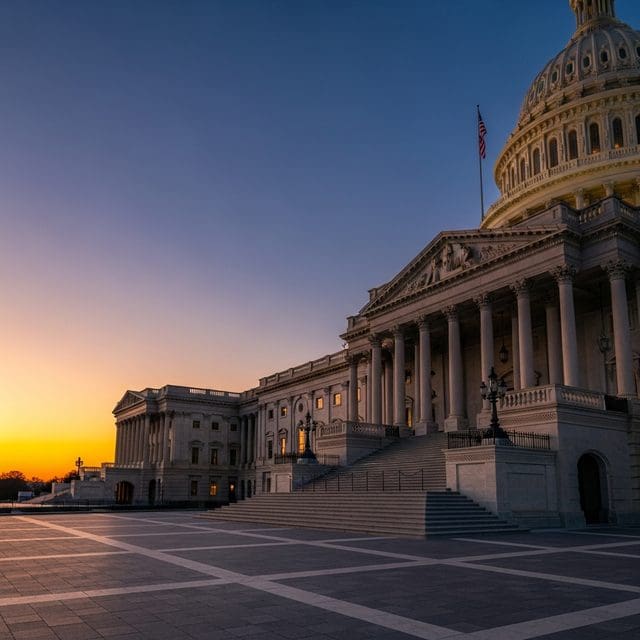
Senate Republicans face a critical Tuesday deadline to decide whether to advance a $95 billion budget resolution or delay fiscal negotiations until after the August recess.
The halls of the Senate are currently defined by a disconnect between White House expectations and legislative reality. As the August recess looms, Senate Republicans are convening for high-stakes meetings this Tuesday to determine the fate of a $95 billion budget resolution. While the House cleared its version on July 22 with a narrow 216–214 vote, the upper chamber remains mired in a procedural stalemate that threatens to punt the framework into the autumn.
At the heart of the friction is a package containing $60 billion for defense, $13 billion for intelligence, $12 billion in farm aid, and $10 billion for election grants. While OMB Director Russ Vought initially advocated for a “tight” bill focused on core priorities, Majority Leader John Thune indicated that the administration’s requests have expanded. The White House is now reportedly seeking a comprehensive framework involving instructions for up to a dozen committees, a shift that has muddied the strategy for floor timing.
Senate Budget Chair Ron Johnson has remained non-committal regarding the release of a formal resolution. This hesitation reflects a broader skepticism; Senator John Kennedy noted Monday that leadership appears reluctant to bring the measure to the floor because the votes are not yet secured. Without a unified front, the GOP risks a public failure, given slim margins and vocal opposition from fiscal hawks who criticize the blueprint’s lack of spending offsets for the Iran war.
This budget battle unfolds alongside other pressing business. Senate appropriators reached a deal on August 3 to prevent a government shutdown through December, with an initial procedural vote scheduled for August 4. The chamber is also still adjusting to the loss of Senator Lindsey Graham, who passed away in early July. Simultaneously, the executive branch continues to navigate complex portfolios. Treasury Secretary Scott Bessent signaled a deal regarding the Strait of Hormuz could be reached this week, while HHS Secretary Robert F. Kennedy Jr. has been tasked to investigate perceived links between vaccines and autism.
For the constitutionalist observer, the current impasse highlights the inherent friction of the committee process and the limitations of executive influence. While President Trump urged Senate Republicans on July 24 to adopt the resolution before recess, the traditional mechanisms of the Senate are acting as a brake on the administration’s timeline. Thune has warned the conference that the blueprint currently lacks the necessary support.
The Tuesday GOP lunch is viewed as a “put up or shut up” moment. If a framework is not agreed upon, the prospect of passing a resolution this summer will likely vanish. This would leave the GOP without a reconciliation vehicle for the remainder of the quarter, potentially stalling the administration’s broader policy agenda. Meanwhile, the administrative state continues its steady churn, evidenced by the U.S. Patent and Trademark Office awarding a $62.3 million contract to Blackwatch International and the Justice Department moving to dismiss charges against former Olympian David Hearn after finding faulty construction, not vandalism, damaged the Reflecting Pool.

Miles Harrington serves as the Senior Correspondent for Federal Systems & Executive Power at Just Right News, where he brings a disciplined, constitutionalist lens to the inner workings of the American government. With a focus on the mechanics of the federal bureaucracy and the limits of executive authority, Harrington has established himself as a vital voice for readers who value transparency, accountability, and the preservation of the separation of powers.
A native of Richmond, Virginia, Harrington’s perspective is deeply rooted in the traditions of the Old Dominion. Growing up in a city defined by its historical significance and its role as a center of American jurisprudence, he developed an early appreciation for the foundational principles of the Republic. His upbringing in Richmond—a place where the legacy of the Founding Fathers is woven into the landscape—instilled in him a belief that the federal government should remain within its constitutional bounds. This background informs his skepticism of centralized overreach and his commitment to reporting on the ways in which the administrative state impacts the lives of everyday citizens.
In his current role, Harrington specializes in the complexities of federal systems. He doesn’t just report on the headlines of the day; he digs into the structural shifts within the executive branch that often go unnoticed by the mainstream press. Whether he is analyzing the implications of a new federal regulation or investigating the expansion of agency jurisdiction, his work is characterized by a rigorous adherence to the facts and a dedication to the rule of law.
Harrington is perhaps best known for his signature feature series, “How Washington Works.” Through this ongoing project, he demystifies the often-opaque processes of the nation’s capital, pulling back the curtain on the “Deep State” and the unelected officials who wield significant influence over national policy. By breaking down complex legislative maneuvers and executive orders, he empowers Just Right News readers to understand the true levers of power in Washington. His reporting serves as a necessary check on the federal government, ensuring that the actions of those in power are held up to the light of public scrutiny.
Now based in Washington, D.C., Harrington operates at the epicenter of the political world, yet he remains intentionally distanced from the “Beltway bubble.” His proximity to the halls of power allows him to maintain a robust network of sources across the federal landscape, but his heart remains in the principled conservatism of his Virginia roots. He views his role not merely as a reporter, but as a steward of the public trust, dedicated to providing the clarity and context that conservative voters need to navigate an increasingly complex political environment.
Through his sharp analysis and unwavering commitment to the truth, Miles Harrington continues to be a cornerstone of the Just Right News team. His work ensures that the principles of limited government and executive restraint remain at the forefront of the national conversation, providing a crucial service to those who believe in a government that is truly of, by, and for the people.