

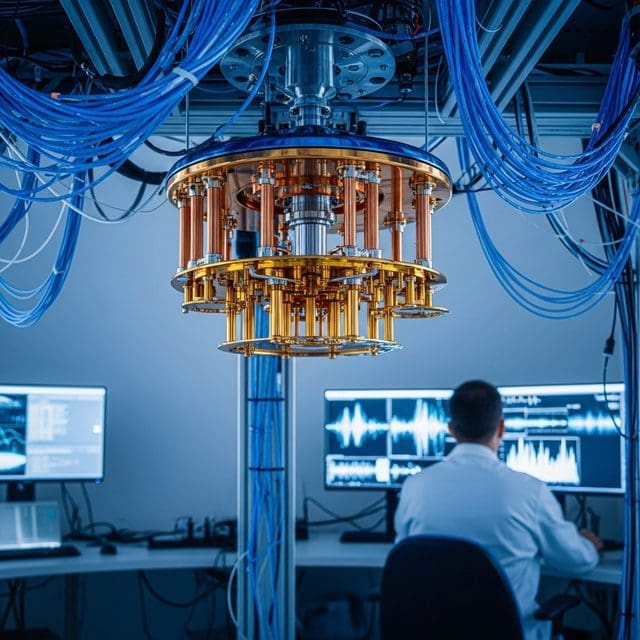
Researchers demonstrate a logical quantum circuit that outperforms classical supercomputers while maintaining a tenfold reduction in error rates through advanced self-certification and 70 logical qubits.
The pursuit of a reliable quantum computer—one capable of solving problems beyond the reach of the world’s most powerful silicon-based supercomputers—reached a significant milestone this week. On July 30, 2026, IBM and the University of Chicago announced the successful demonstration of verified quantum advantage. Unlike previous industry claims that relied on niche mathematical proofs or specialized sampling, this experiment utilized 70 logical qubits to perform 2,415 logical two-qubit operations and 468 logical T gates. The computation was completed in just 15 minutes, a task that would require prohibitive runtimes for even the most advanced classical simulators like the Fugaku supercomputer.
This breakthrough centers on the transition from physical qubits, which are notoriously fragile and prone to environmental interference, to logical qubits. By using spacetime codes on doped Clifford circuits, the researchers achieved logical error rates approximately ten times lower than the underlying physical hardware. This suggests that the industry is finally moving past the era of noisy, intermediate-scale quantum devices toward stable, trusted scientific instruments. The results were publicly released on the IBM Quantum Advantage Tracker, allowing for independent scrutiny and benchmarking by the global scientific community, ensuring that the findings are transparent and verifiable.
While IBM focused on the computational architecture, researchers at IIT Gandhinagar and the Harish-Chandra Research Institute are applying similar advanced processing techniques to the fundamental building blocks of the universe. Utilizing active machine learning to sift through 600 billion random particle combinations, these physicists have narrowed the search for additional members of the Higgs boson family. Their work focuses on a model involving three Higgs doublets and the known 125 GeV Higgs, even identifying a scenario for a new Higgs particle as light as 82 GeV. This high-performance modeling reduced a complex four-hour analysis to just ten minutes, providing a roadmap for future experiments at particle colliders.
Other developments in the field underscore a broader push toward hardware efficiency and decentralized innovation. In the realm of condensed matter physics, researchers have successfully extended the lifetime of magnons—tiny magnetic waves—from a few hundred nanoseconds to as much as 18 microseconds. This nearly 100-fold increase in magnon longevity, published in Science Advances, suggests that the limitation is material purity rather than a fundamental law of physics. Such advancements could eventually lead to ultra-compact quantum hardware the size of a penny, moving away from the massive, centralized cooling towers currently required for quantum operations.
Complementing these efforts, the introduction of a quantum Newton’s cradle in trapped-ion chains of 30 to 40 qubits offers a new gate scheme. This architecture allows for the addressing of any two ions regardless of their identity, facilitating fast multi-qubit gates and state transport. This hardware-agnostic approach to verification is further supported by companion studies from Qedma and Algorithmiq, which used error-mitigated analog dynamics to observe long-lived quantum behavior in systems up to 74 qubits. These coordinated roadmaps emphasize that the future of the field lies in treating quantum processors as reliable tools for scientific discovery.
For those concerned with national sovereignty and the security of the digital frontier, these advancements represent a double-edged sword. While verified quantum advantage promises to unlock new materials and medicines, it also necessitates a rapid shift in cryptographic standards to protect individual liberty and constitutional rights. As quantum processors evolve from experimental prototypes into trusted tools, the priority must remain on ensuring these technologies serve to empower the citizenry rather than centralize control over the global information architecture. The path forward requires a commitment to decentralized innovation and the rigorous, public verification of these powerful emerging systems.

Mason Reed serves as a Staff Writer for Just Right News, where he spearheads the Future Frontiers & Special Projects desk. In an era defined by rapid technological shifts and evolving social landscapes, Mason provides a steady, principled voice, examining the innovations of tomorrow through the lens of traditional American values. His work is most prominently featured in his signature series, “The Next Horizon,” where he explores the intersection of emerging technology, national sovereignty, and the preservation of individual liberty.
A native of San Diego, California, Mason’s worldview was shaped by the unique culture of his hometown. Growing up in a region defined by its strong military presence and its history of maritime industry, he developed a deep-seated respect for the institutions that provide national stability and the entrepreneurial spirit that drives the American economy. This upbringing instilled in him a belief that true progress is not found in discarding the past, but in building upon a foundation of proven principles. His reporting often reflects this San Diego influence, emphasizing the importance of a robust national defense and the necessity of maintaining a competitive edge in the global marketplace.
Now based in San Francisco, Mason operates from the heart of the world’s technological engine. Living and working in the Bay Area provides him with a front-row seat to the advancements—and the ideological challenges—emanating from Silicon Valley. While many in the region embrace a “move fast and break things” mentality, Mason’s reporting serves as a vital counterweight. He offers Just Right News readers a “boots on the ground” perspective, documenting how radical local policies and the concentration of tech power impact the everyday lives of citizens. His proximity to the industry allows him to cut through the marketing jargon of big tech to uncover the real-world implications for privacy, free speech, and the nuclear family.
In his “Future Frontiers” beat, Mason tackles complex subjects ranging from the ethics of artificial intelligence to the burgeoning private space race. He approaches these topics with a healthy skepticism toward centralized bureaucracy, championing instead the decentralized innovations that empower individuals. Through “The Next Horizon,” he highlights the pioneers and thinkers who are working to ensure that the future remains a place where human dignity and constitutional rights are protected. He believes that the rapid pace of change requires more than just technical expertise; it requires a moral compass rooted in the Western tradition.
Throughout his tenure at Just Right News, Mason has remained committed to the idea that the future is something to be shaped, not merely accepted. His writing is characterized by a rigorous defense of American exceptionalism and a belief that the country’s best days lie ahead, provided it remains true to its founding ideals. Whether he is investigating the impact of automation on the American workforce or profiling the next generation of aerospace engineers, Mason Reed ensures that his readers are equipped with the insights they need to navigate a changing world with confidence and clarity.