

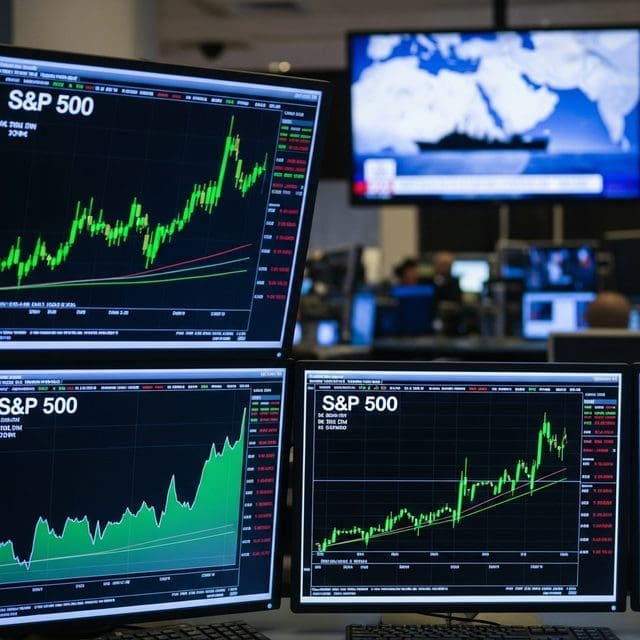
The S&P 500 climbed 1.65% as investors dismissed AI spending fears and focused on strong tech earnings, despite renewed military conflict in the Middle East and $100 oil.
Global financial markets staged a broad risk-on reversal on Friday, with the S&P 500 (SPY) climbing 1.65% as investors recalibrated their outlook on artificial intelligence. The rally follows a period of volatility where concerns over capital expenditures by Alphabet and Tesla initially rattled confidence. Alphabet shares had previously slid 6.4% and Tesla plummeted 12.2% as the market questioned immediate returns on AI investment. However, a reassessment of the AI demand story, bolstered by strong performance from Microsoft, signaled that the technological arms race remains fundamentally sound.
In Asia, the recovery provided a massive lead-in for Western markets. South Korea’s KOSPI index jumped 14% intraday, mitigating a brutal July that saw the index face its steepest monthly decline since 1997. Japan’s Nikkei rose 5% after the Bank of Japan held its policy rate steady at 1%. This decision, coupled with suspected coordinated currency intervention by Japanese and Korean authorities, left the yen weaker at 160.51 per dollar. This stabilization provided a tailwind for exporters and calmed regional fears of a liquidity crunch.
For the American household, this market buoyancy arrives amidst rising domestic costs. While the second-quarter U.S. economy showed growth driven by demand for computer memory and AI infrastructure, inflationary pressures remain. S&P Global surveys indicate supply chain disruptions are surfacing again, exacerbated by a spike in energy costs as oil prices touched $100 per barrel. This surge in crude is linked to the collapse of regional peace talks and the subsequent escalation of hostilities in the Middle East.
National security concerns have returned to the forefront. Following a brief pause in hostilities, the U.S. military conducted fresh airstrikes in Iran on July 30. These were a direct retaliation for an Iranian ballistic missile attack on a U.S. base in Jordan. Although the missiles were intercepted, the collapse of diplomacy has injected a risk premium into commodities. Working families may feel this at the pump, even as retirement accounts benefit from the tech-led rally.
On the corporate front, the legal environment is tightening. Pomerantz LLP has initiated investigations into investor claims against Metropolitan Bank Holding Corp. and Rollins, Inc., highlighting scrutiny of corporate governance. Simultaneously, the private sector continues to automate. CharityEngine launched its Copilot platform for nonprofits, and Ractigen Therapeutics secured $31 million for its saRNA pipeline. Firms like Mili and Global Relay are also applying AI-driven compliance to wealth management, showing that technological integration remains relentless.
The current trajectory suggests that while the ‘Invisible Economy’ of centralized banking and tech growth remains robust, the American taxpayer faces dual pressures of geopolitical instability and a volatile monetary environment. The 1.65% gain in the SPY reflects a market focusing on technological progress and earnings, even as oil prices and military engagement loom over the fiscal horizon. Investors are betting on long-term productivity gains to outpace the immediate costs of global friction and inflationary headwinds.

Jordan Lee serves as the Senior Correspondent for Wall Street, Finance, and Monetary Systems at Just Right News. Based in the heart of the world’s financial capital, New York City, Lee brings a sharp, principled eye to the complex mechanisms that drive the global economy. His reporting is defined by a commitment to fiscal responsibility, the defense of the free market, and a deep-seated belief that a transparent monetary system is the bedrock of a free society.
Raised in Portland, Oregon, Lee’s perspective was forged in a city that has undergone significant cultural and economic shifts. His upbringing in the Pacific Northwest instilled in him a profound appreciation for the industriousness of small business owners and the importance of local economic stability. Watching the evolution of his hometown’s landscape sparked an early interest in how federal fiscal policy and large-scale financial trends eventually trickle down to the average citizen. This background provides him with a unique vantage point; he understands the growing disconnect between the policy-making elite and the reality of Main Street, a theme that frequently resonates throughout his work.
Now operating from his base in New York City, Lee bridges the gap between the high-stakes trading floors of Manhattan and the households of everyday Americans. He views the financial sector not merely as a collection of numbers and tickers, but as a vital engine of American prosperity that requires constant vigilance and accountability. His reporting often highlights the dangers of centralized financial control and the necessity of maintaining a system that rewards merit, risk-taking, and innovation.
As the creator and lead of the featured series, “The Invisible Economy,” Lee pulls back the curtain on the often-opaque world of monetary systems. He specializes in translating the dense jargon of central banking and international finance into actionable insights for the Just Right News audience. His work explores the “invisible” forces—such as inflationary pressures, regulatory creep, and the expansion of the administrative state—that erode the purchasing power of American families. By focusing on these systemic issues, Lee empowers readers to understand the hidden forces shaping their financial independence.
Lee’s journalistic philosophy is rooted in a steadfast commitment to traditional American values. As an Asian American professional who has navigated the competitive corridors of the financial world, he is a vocal advocate for meritocracy and the preservation of the American Dream. He believes that a stable currency and a predictable regulatory environment are essential for national sovereignty and individual liberty. His reporting frequently warns against the risks of government overreach in the private sector, arguing that the most effective solutions to economic challenges arise from competition and individual enterprise rather than bureaucratic mandates.
At Just Right News, Jordan Lee remains dedicated to providing a clear-eyed defense of the taxpayer. Whether he is analyzing market volatility or investigating the long-term implications of national debt, his mission is to provide the truth about where the money is going and what it means for the future of the country. Through his rigorous analysis and principled stance, Lee has become a trusted voice for those who value a strong, sovereign, and fiscally sound America.