

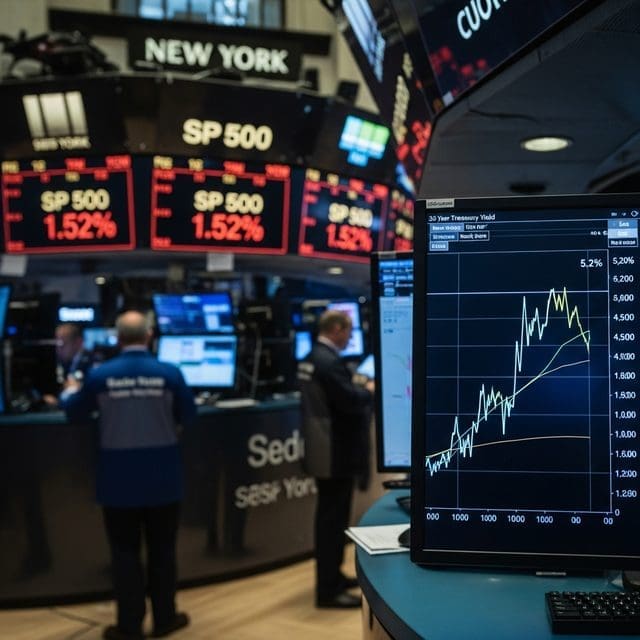
Wall Street faced a sharp sell-off as the S&P 500 fell 1.52% following a hawkish Federal Reserve hold and escalating geopolitical tensions in the Middle East.
The American taxpayer is once again caught in the crossfire of policy uncertainty and global instability. On Tuesday, the S&P 500 (SPY) retreated 1.52%, a move reflecting deepening skepticism toward the current monetary trajectory. This downturn was punctuated by the Nasdaq 100 entering technical correction territory, falling more than 11% from its June peak as artificial intelligence fervor meets the reality of high capital expenditure and tightening credit.
At the heart of the volatility is a Federal Reserve that appears increasingly fractured. While the central bank maintained interest rates at 3.50%–3.75% for the fifth consecutive meeting, the decision was far from unanimous. Three dissenting votes for a rate hike signaled a ‘hawkish hold,’ leaving the door open for a September increase. This lack of clear direction sent 30-year Treasury yields to 5.20%, a level not seen since June 2007. These yields are the bedrock of the ‘Invisible Economy,’ and their ascent to 19-year highs reinforces a rate-pressure backdrop that strains small businesses and prospective homebuyers.
The geopolitical landscape has further burdened the U.S. economy, which showed signs of acceleration before peace talks collapsed. After a brief reprieve where oil prices dipped below $87 per barrel, Brent crude surged back toward $92 following Iran’s ballistic missile attack on a U.S. base in Jordan on July 29. This escalation, occurring after a pause in U.S. strikes intended to facilitate negotiations, prompted vows of heavy retaliation. The resulting energy price spike threatens to reignite inflation, while the VIX fear gauge jumped over 13% to 20.66.
In Washington, the U.S. Senate responded with an 86-12 vote to advance a sanctions bill against Russia and Iran, a measure championed by the late Senator Lindsey Graham. While national sovereignty requires a firm hand, the economic fallout is felt most acutely on Main Street. The global nature of this rout was evidenced by a South Korean market slump that erased more than $2 trillion in equity value this week, underscoring that the sell-off is no longer contained to domestic tech names but represents a systemic re-pricing of global risk.
Despite the carnage in equities, certain sectors forge ahead through private capital. Ractigen Therapeutics recently closed a $31 million financing round to advance its saRNA pipeline, and Bloxley is pushing forward with EU early access for AI-driven finance. In real estate, Livmark Communities broke ground on a 457-unit project in Colorado, while Cove Capital acquired a 170-unit community in San Antonio via a lender’s REO disposition. These moves show that while central planners vacillate, American enterprise continues to seek meritocratic opportunities.
However, the broader market remains defensive. Gold traded above $4,089 per ounce, gaining over 1.3% as investors look for sovereignty in an unstable fiat environment. The Dow Jones Industrial Average suffered even more than the SPY benchmark, dropping 2.19%. As long as the Federal Reserve remains in a state of ‘hawkish uncertainty’ and foreign policy remains reactive, the American taxpayer will bear the cost. The road to a stable monetary system remains blocked by federal debt and global disorder, leaving households to navigate a landscape where the only certainty is further volatility.

Jordan Lee serves as the Senior Correspondent for Wall Street, Finance, and Monetary Systems at Just Right News. Based in the heart of the world’s financial capital, New York City, Lee brings a sharp, principled eye to the complex mechanisms that drive the global economy. His reporting is defined by a commitment to fiscal responsibility, the defense of the free market, and a deep-seated belief that a transparent monetary system is the bedrock of a free society.
Raised in Portland, Oregon, Lee’s perspective was forged in a city that has undergone significant cultural and economic shifts. His upbringing in the Pacific Northwest instilled in him a profound appreciation for the industriousness of small business owners and the importance of local economic stability. Watching the evolution of his hometown’s landscape sparked an early interest in how federal fiscal policy and large-scale financial trends eventually trickle down to the average citizen. This background provides him with a unique vantage point; he understands the growing disconnect between the policy-making elite and the reality of Main Street, a theme that frequently resonates throughout his work.
Now operating from his base in New York City, Lee bridges the gap between the high-stakes trading floors of Manhattan and the households of everyday Americans. He views the financial sector not merely as a collection of numbers and tickers, but as a vital engine of American prosperity that requires constant vigilance and accountability. His reporting often highlights the dangers of centralized financial control and the necessity of maintaining a system that rewards merit, risk-taking, and innovation.
As the creator and lead of the featured series, “The Invisible Economy,” Lee pulls back the curtain on the often-opaque world of monetary systems. He specializes in translating the dense jargon of central banking and international finance into actionable insights for the Just Right News audience. His work explores the “invisible” forces—such as inflationary pressures, regulatory creep, and the expansion of the administrative state—that erode the purchasing power of American families. By focusing on these systemic issues, Lee empowers readers to understand the hidden forces shaping their financial independence.
Lee’s journalistic philosophy is rooted in a steadfast commitment to traditional American values. As an Asian American professional who has navigated the competitive corridors of the financial world, he is a vocal advocate for meritocracy and the preservation of the American Dream. He believes that a stable currency and a predictable regulatory environment are essential for national sovereignty and individual liberty. His reporting frequently warns against the risks of government overreach in the private sector, arguing that the most effective solutions to economic challenges arise from competition and individual enterprise rather than bureaucratic mandates.
At Just Right News, Jordan Lee remains dedicated to providing a clear-eyed defense of the taxpayer. Whether he is analyzing market volatility or investigating the long-term implications of national debt, his mission is to provide the truth about where the money is going and what it means for the future of the country. Through his rigorous analysis and principled stance, Lee has become a trusted voice for those who value a strong, sovereign, and fiscally sound America.