

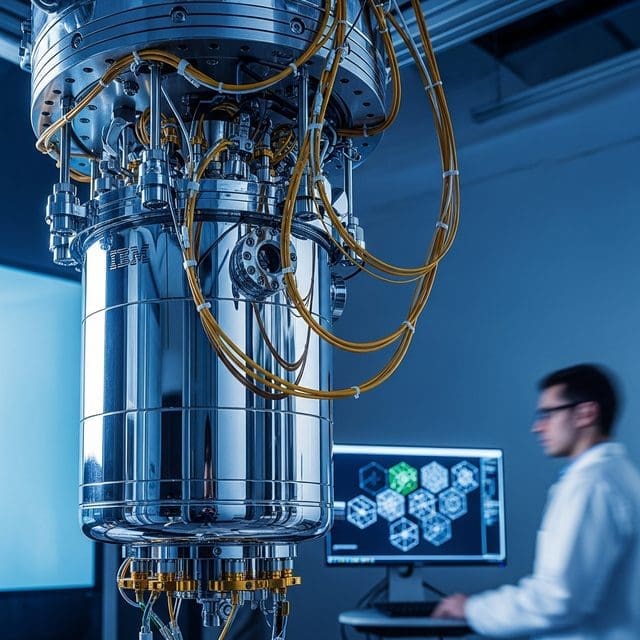
Researchers have successfully executed a complex computation using 70 logical qubits, completing in 15 minutes a task deemed intractable for today’s most powerful classical supercomputers.
The long-promised era of quantum utility moved a significant step closer to reality this week. IBM and the University of Chicago announced on July 30, 2026, that they have achieved quantum advantage by performing computations that exceed the capabilities of leading classical simulation methods while maintaining a high degree of accuracy. This milestone represents a shift from the theoretical to the practical, signaling that quantum systems are maturing into reliable scientific instruments capable of defending American technological leadership in the 21st century.
Unlike previous ‘quantum supremacy’ experiments that often focused on niche mathematical problems with little practical application, this demonstration utilized 70 logical qubits to solve a classically intractable problem. Logical qubits are a critical evolution in the field; they use sophisticated error-correction and encoding methods to protect information from the ‘noise’ and decoherence that typically plague quantum hardware. The team reported that their new encoding method resulted in a logical error rate approximately ten times lower than the physical error rate of the underlying hardware, a feat that suggests we are finally overcoming the fragility of quantum states.
The speed of the computation was particularly notable. The quantum system finished the task in roughly 15 minutes. According to the researchers, a comparable simulation on a classical supercomputer would have required an infeasible amount of time, effectively barring traditional binary systems from reaching the same result. The findings were released on the Quantum Advantage Tracker to ensure reproducibility and transparency, a move that aligns with the principles of open scientific inquiry and decentralized innovation. By making these results verifiable, IBM and the University of Chicago are providing a concrete benchmark that will likely influence near-term investment decisions and national security roadmaps.
Simultaneously, IBM partnered with Tel Aviv-based Qedma Quantum Computing to apply these advancements to the realm of condensed matter physics. Using Qedma’s QESEM error-mitigation software on commercially available IBM hardware, the collaboration modeled quantum materials with up to 74 qubits. This effort successfully observed long-lived dynamics that were previously invisible to classical simulations, even when benchmarked against world-class supercomputing resources at RIKEN. These results are expected to have immediate implications for the development of ultrafast optoelectronics and light-induced superconductors, technologies that could revolutionize everything from energy grids to domestic manufacturing.
These milestones arrive amid a broader flurry of developments in the sector. While Aalto University recently demonstrated the first cyclic quantum heat engine and researchers at the University of Amsterdam measured long-lived ytterbium ion states for atomic clocks, the IBM-Chicago announcement stands out for its scale and verifiability. This is not just a lab-scale stunt; it is a logical-qubit demonstration with explicit error correction. By providing ‘trusted’ results, the researchers are addressing the primary skepticism facing the industry: whether quantum computers can be reliable tools for exploring the fundamental laws of nature without the errors that have historically rendered quantum data suspect.
As these systems scale, challenges remain. Recent reports suggest the ‘Quantum Zeno effect’—where frequent measurement can actually freeze the state of a system—may pose constraints on performance as qubit counts grow. Furthermore, the use of rare-earth ions for telecom-ready control of interacting qubits shows that the hardware race is far from over. However, the successful deployment of 70 logical qubits suggests that the path toward high-performance quantum innovation is widening. For those who value national sovereignty and the pursuit of truth through rigorous data, this week’s breakthroughs offer a glimpse of a future where American researchers can model the building blocks of the universe with unprecedented precision, free from the limitations of yesterday’s silicon-based bureaucracy.

Mason Reed serves as a Staff Writer for Just Right News, where he spearheads the Future Frontiers & Special Projects desk. In an era defined by rapid technological shifts and evolving social landscapes, Mason provides a steady, principled voice, examining the innovations of tomorrow through the lens of traditional American values. His work is most prominently featured in his signature series, “The Next Horizon,” where he explores the intersection of emerging technology, national sovereignty, and the preservation of individual liberty.
A native of San Diego, California, Mason’s worldview was shaped by the unique culture of his hometown. Growing up in a region defined by its strong military presence and its history of maritime industry, he developed a deep-seated respect for the institutions that provide national stability and the entrepreneurial spirit that drives the American economy. This upbringing instilled in him a belief that true progress is not found in discarding the past, but in building upon a foundation of proven principles. His reporting often reflects this San Diego influence, emphasizing the importance of a robust national defense and the necessity of maintaining a competitive edge in the global marketplace.
Now based in San Francisco, Mason operates from the heart of the world’s technological engine. Living and working in the Bay Area provides him with a front-row seat to the advancements—and the ideological challenges—emanating from Silicon Valley. While many in the region embrace a “move fast and break things” mentality, Mason’s reporting serves as a vital counterweight. He offers Just Right News readers a “boots on the ground” perspective, documenting how radical local policies and the concentration of tech power impact the everyday lives of citizens. His proximity to the industry allows him to cut through the marketing jargon of big tech to uncover the real-world implications for privacy, free speech, and the nuclear family.
In his “Future Frontiers” beat, Mason tackles complex subjects ranging from the ethics of artificial intelligence to the burgeoning private space race. He approaches these topics with a healthy skepticism toward centralized bureaucracy, championing instead the decentralized innovations that empower individuals. Through “The Next Horizon,” he highlights the pioneers and thinkers who are working to ensure that the future remains a place where human dignity and constitutional rights are protected. He believes that the rapid pace of change requires more than just technical expertise; it requires a moral compass rooted in the Western tradition.
Throughout his tenure at Just Right News, Mason has remained committed to the idea that the future is something to be shaped, not merely accepted. His writing is characterized by a rigorous defense of American exceptionalism and a belief that the country’s best days lie ahead, provided it remains true to its founding ideals. Whether he is investigating the impact of automation on the American workforce or profiling the next generation of aerospace engineers, Mason Reed ensures that his readers are equipped with the insights they need to navigate a changing world with confidence and clarity.